Key Takeaways
- IoT in manufacturing is projected to hit $674 billion by 2032 (24.5% CAGR), with automotive leading adoption.
- Automotive manufacturers are rapidly adopting smart factory concepts, with 30% of factories smart-enabled by 2019 and targeting 74% by 2025.
- IIoT drives significant operational gains: 20–40% reduction in unplanned downtime and 10–20% higher production output.
- Cumulative IoT productivity gains for automakers are estimated at $135–167 billion by 2023.
- Key applications like predictive maintenance can cut downtime by up to 50%, while IoT-enabled quality control reduces defects by 4x.
- Cybersecurity, integration with legacy systems, and a critical skills gap remain significant challenges for widespread adoption.
- The future will see widespread 5G-enabled, cloud-connected smart zones and advanced AIoT, further solidifying industrial IoT as a standard.
1. Executive Summary
The automotive manufacturing sector is undergoing an unprecedented transformation, driven by the rapid adoption of the Internet of Things (IoT). Far from a niche technology, IoT has emerged as a foundational element of Industry 4.0, enabling a new era of highly efficient, data-driven, and agile production. This executive summary provides a high-level overview of the significant benefits, pervasive challenges, and robust future outlook of IoT integration in automotive manufacturing, highlighting key growth projections and transformative use cases.
Global IoT spending in manufacturing is projected to reach an astounding $674 billion by 2032, reflecting a compound annual growth rate (CAGR) of 24.5% [1]. Manufacturing currently leads all industries in IoT investment, commanding over one-third of the total global IoT spending in 2023 [2]. Within this burgeoning landscape, the automotive industry stands out as a pioneering force, consistently leading the charge in embracing smart factory concepts. By 2019, approximately 30% of automotive factories had already been converted into smart facilities, surpassing initial plans and demonstrating a proactive approach to digital transformation [3]. This aggressive adoption trajectory continued, with automakers aiming to smart-enable an additional 44% of their factories by 2025 [4], solidifying automotive’s position as a frontrunner in Industrial IoT (IIoT) implementation.
The impetus for this widespread adoption stems directly from the substantial, measurable efficiency gains and robust returns on investment (ROI) that IoT-driven initiatives deliver. Early adopters have reported remarkable improvements, including 20–40% reductions in unplanned downtime and gains in Overall Equipment Effectiveness (OEE) of 3–7 percentage points [5]. Surveys indicate that smart manufacturing implementations have consistently yielded 10–20% higher production output and a 7–20% boost in productivity on average [6]. These operational enhancements translate into massive financial benefits, with cumulative productivity gains for automakers estimated to reach $135–167 billion by 2023, representing a significant 15–24% performance uplift [7]. Such compelling returns are fueling continued investment, with 78% of manufacturers allocating over 20% of their improvement budgets to smart factory technologies, and 88% planning to further increase these expenditures [8].
Key use cases underscoring IoT’s value include predictive maintenance, which can cut equipment downtime by up to 50% [9], and IoT-enabled quality control, which has slashed defect rates by as much as fourfold in some automotive plants [10]. Real-time IoT tracking in supply chains is proving crucial in mitigating parts shortages and delays, optimizing just-in-time production [11]. Major automakers such as GM, Toyota, Mercedes-Benz, and Volkswagen have already deployed large-scale IoT solutions, demonstrating tangible operational improvements. For instance, GM reduced assembly line downtime by approximately 20% through digital twin technologies [12]. As of 2025, nearly half (46%) of global auto manufacturers are actively using IIoT solutions on their factory floors [13], underscoring that IoT is rapidly becoming a standard rather than an exception in automotive production.
Despite the overwhelming optimism and proven benefits, the path to full IoT integration is not without its obstacles. Significant challenges persist, notably in cybersecurity, where 55% of automotive manufacturers cite unauthorized access and data breaches in IIoT systems as major concerns [14]. Integrating IoT with legacy equipment and the high upfront costs associated with these upgrades remain prohibitive for smaller suppliers [15]. Furthermore, a critical skills gap is evident, with almost half of firms struggling to fill IoT-related technical roles [16], and adapting the existing workforce to “Factory of the Future” technologies ranking as a top concern [17].
Looking ahead, the future outlook for IoT in automotive manufacturing remains exceptionally robust. Experts foresee the widespread emergence of 5G-enabled, cloud-connected “smart zones” within auto plants in the coming years [18]. By 2027, U.S. automotive IoT spending is projected to exceed $12 billion [19]. By the early 2030s, between 60–75% of large factories are expected to implement predictive IoT maintenance on critical assets [20]. The convergence of open standards, advanced AI (AIoT), and ubiquitous connectivity promises to further amplify IoT’s transformative impact, steering automotive manufacturing towards a future that is more real-time, data-driven, and sustainable on a global scale [21], [22].
Key Facts & Data
The following table summarizes critical statistics and projections that underscore the scale and impact of IoT in automotive manufacturing:
| Metric | Value/Projection | Description |
|---|---|---|
| IoT in Manufacturing Market Value (Global) | $209.4 billion (2022) → $397.9 billion (2026) | Nearly doubling in four years, reflecting accelerating IoT adoption (17.4% CAGR) [23]. |
| IoT in Manufacturing Market Growth (Global) | $97.0 billion (2023) → $673.9 billion (2032) | Explosive growth at a 24.5% CAGR, indicating sustained long-term investment. U.S. alone projects ~$146.6 billion by 2032 [24], [25]. |
| North America’s Share (2022) | 43% of global automotive IoT market | Leading role due to advanced infrastructure and supportive policies [26]. |
| Smart Factories by 2019 (Automotive) | 30% of factories | Exceeded initial plans of 24%, showcasing accelerated Industry 4.0 adoption [27]. |
| Target for Smart Factories by 2025 (Automotive) | Additional 44% of factories | Aimed to achieve nearly half of all auto production sites IoT-enabled, outpacing other sectors [28], [29]. |
| Productivity Gains for Auto Industry by 2023 | $135–167 billion | Represented a 15–24% overall improvement in manufacturing performance (2.8–4.4% yearly gains) [30]. |
| Defect Reduction (Mercedes-Benz) | 4× lower defect rate | Achieved on select components using IoT-driven, self-optimizing production systems [31]. |
| Assembly Line Downtime Reduction (GM) | 20% | Achieved at GM’s Arlington plant using IoT-powered digital twin technology [32]. |
| Unplanned Machine Downtime Reduction (Potential) | Up to 50% | Potential decrease using IIoT-based predictive maintenance, as noted by U.S. Department of Energy [33]. |
| Internal Rate of Return (IRR) on IIoT Projects | 25–45% | Typical for well-implemented industrial IoT projects in heavy manufacturing, with payback often 1.5–3.5 years [34], [35]. |
| Improvement Budget Allocation to Smart Factory Tech | 78% allocate >20%; 88% plan to increase investments | Shows strong confidence in IoT-driven ROI among global manufacturers [36], [37]. |
| Automotive Manufacturers Using IIoT (2025) | 46% at scale; 42% using private 5G networks | High adoption rates demonstrate connected devices and data analytics are standard tools [38], [39]. |
| Difficulty Hiring for Production/Operations Tech Roles | 48% reporting moderate or significant difficulty | Indicates a significant skills gap hindering IIoT progress [40], [41]. |
| Cybersecurity Concerns (Automotive) | 55% strongly agree unauthorized access is a major worry | Cybersecurity is paramount; 68% conducted IoT/OT security risk assessments in past year [42], [43]. |
| Factories with IoT-based Predictive Maintenance (2030–2035) | 60–75% of large industrial sites | Predictive IoT systems expected to be ubiquitous in automotive plants, optimizing reliability [44]. |
Main Insights
IoT Adoption Accelerates in Automotive Manufacturing
The pace at which the automotive industry has embraced IoT is nothing short of remarkable. Automakers are not merely experimenting with IoT; they are aggressively integrating it into their core manufacturing processes to modernize production and redefine efficiency. This forward-thinking approach has positioned automotive manufacturers as leaders in the broader Industry 4.0 movement. For instance, within an 18-month span leading up to 2019, approximately 30% of automotive plants underwent significant upgrades to incorporate IoT connectivity and advanced analytics [45]. This figure not only surpassed the initial target of 24% set by automotive executives but also outpaced adoption rates in other industrial sectors, reaffirming the industry’s commitment to digital transformation. Analysts observed that the automotive sector was “motoring ahead” of its peers in Industry 4.0 adoption [46]. This trend is set to continue, with manufacturers planning to convert an additional 44% of their factories into “smart” facilities by 2025, the highest projected rate among all industries [47]. This aggressive target reflects a deep-seated confidence in the tangible benefits and strategic advantages that IoT offers.
The surge in IoT adoption is mirrored by a dramatic increase in global and regional spending. The total market value for IoT in manufacturing worldwide was estimated at around $209.4 billion in 2022 and is forecast to nearly double to $397.9 billion by 2026, representing a robust 17.4% CAGR [48]. Longer-term projections paint an even more impressive picture, with IoT spending in manufacturing expected to soar to approximately $674 billion by 2032 [49]. Regionally, North America has emerged as a significant driver of automotive IoT investment, accounting for about 43% of the global automotive IoT market as of 2022 [50]. This leadership is largely attributable to the region’s advanced technological infrastructure and supportive policy frameworks. However, Asia-Pacific and Europe are rapidly increasing their investments, with initiatives such as Brazil’s Rota 2030 program catalyzing IoT adoption in its burgeoning automotive sector. Brazil alone expects 40% of large manufacturers to boost their IIoT investments by 2026 [51]. This global momentum indicates that IoT is no longer a nascent technology but a fundamental pillar of competitiveness in automotive manufacturing.
The sustained investment in IoT reflects a strategic decision by automakers to secure a competitive advantage. A recent Deloitte survey revealed that a striking 78% of manufacturers now allocate over 20% of their annual continuous improvement budgets to smart manufacturing technologies, encompassing IoT, automation, and AI [52]. More tellingly, 88% of these manufacturers intend to maintain or increase their investments in these areas in the coming year [53]. This unwavering commitment underscores a widely held belief among auto executives that smart factory initiatives are fundamentally transformational. An impressive 85% of leaders believe these initiatives will revolutionize production methods and significantly enhance operational agility [54]. While the global chip shortages and the pandemic caused temporary disruptions to IoT hardware rollouts [55], the underlying investment trend remains strong, driven by the pursuit of greater resilience, efficiency, and innovation. The willingness to commit substantial capital to IoT signifies an industry-wide conviction that digital leaders will gain a decisive edge in terms of cost-effectiveness, product quality, and the capacity for rapid innovation.
Smart Factory Use Cases: IoT Driving Efficiency and Quality
IoT’s transformative impact in automotive manufacturing is best illustrated through its diverse and value-generating use cases across the factory floor and extended supply chain:
- Predictive Maintenance and Asset Monitoring: One of the most impactful applications of IoT is predictive maintenance. By embedding connected sensors on critical equipment, manufacturers can collect real-time data on parameters like vibration, temperature, and pressure. AI-driven analytics then analyze this data to identify subtle anomalies and predict potential equipment failures before they occur. This proactive approach dramatically reduces unplanned downtime. The U.S. Department of Energy highlights that IIoT-driven maintenance can cut unplanned downtime by up to 50% [56]. Companies like Ford exemplify this, streaming real-time machine data from thousands of factory assets into a central IoT platform, enabling immediate fault detection and maintenance alerts that minimize costly line stoppages [57], [58]. Similarly, Toyota’s North American plants have implemented an AWS IoT SiteWise system to monitor machine health, effectively eliminating unplanned outages in some instances [59]. These systems not only prevent breakdowns but also extend equipment lifespan and optimize spare parts inventory by facilitating maintenance at the optimal time, thereby maximizing Overall Equipment Effectiveness (OEE).
- Quality Control and Defect Reduction: IoT plays a crucial role in enhancing quality assurance throughout the assembly process. Auto manufacturers are deploying advanced vision systems, digital twins, and real-time sensory feedback to detect and correct defects with unprecedented precision. Tesla’s factories, for example, utilize cloud-based IoT analytics for automated quality control, rapidly identifying paint flaws and assembly misalignments that manual inspection might miss [60]. General Motors, through its implementation of digital twin simulations of assembly processes, has reportedly reduced production line downtime by 20% at its Arlington SUV plant, a direct benefit of improved process quality and fewer errors [61]. Mercedes-Benz achieved a remarkable fourfold reduction in rejection rates for certain components by employing self-learning IoT systems that adapt in real time to prevent errors [62]. IoT sensors continuously track critical variables such as torque and pressure during manufacturing; feeding this data to AI models allows for immediate corrections if parameters deviate from specifications, leading to fewer defects, reduced rework, and ultimately higher customer satisfaction—a critical factor in an industry where product recalls can be financially devastating.
- Supply Chain and Inventory Optimization: The automotive industry operates on highly complex, global supply chains, making end-to-end visibility essential. IoT is proving indispensable in this regard. Automakers increasingly use IoT tracking technologies, including RFID tags and GPS, to monitor components in transit. In Brazil, for example, assemblers leverage IoT systems to track parts across the entire supply chain in real time, enabling swift rerouting of shipments or adjustment of production schedules to circumvent delays caused by disruptions [63]. This granular visibility, often unattainable before IoT, allows production planners to react instantaneously to issues like late deliveries or quality holds at suppliers, preventing costly line stoppages. Within the factory, IoT-tagged materials and automated guided vehicles (AGVs) ensure that the right parts are delivered to the correct workstation precisely when needed, optimizing just-in-time logistics. Toyota has successfully applied IoT and analytics to minimize excess stock on its factory floors, fostering a production system more tightly linked to actual demand [64], [65]. Particularly in the wake of recent global supply chain upheavals, IoT-enabled supply chains have demonstrated their value by enhancing resilience and drastically reducing idle time awaiting components.
- Robotics and Human-Machine Collaboration: IoT forms the technological backbone for the seamless and safe coordination of robots and human workers on modern automotive assembly lines. Connected industrial robots, from welding arms to painting robots, continuously transmit performance data to IoT platforms, enabling predictive maintenance for robots themselves and dynamic adjustment of their operations. The rise of collaborative robots (cobots), designed to work alongside human operators, heavily relies on IoT connectivity to monitor speed, position, and safety status in real time. By 2025, cobots are projected to constitute 34% of all industrial robot sales [66], illustrating the growing prevalence of connected automation. For automakers, IoT-linked cobots can automate repetitive or ergonomically challenging tasks, freeing human workers to focus on more complex assembly processes, thereby boosting overall productivity. IoT also facilitates centralized control of entire robotic fleets. BMW’s factories, for instance, utilize IoT systems to synchronize hundreds of robots on the line with millisecond precision, often leveraging new 5G networks for ultra-low latency. This results in higher throughput and greater flexibility, allowing engineers to update digital instructions over-the-air to dozens of robots simultaneously via the IoT network when vehicle design changes occur, a significant improvement over manual reprogramming.
- Energy Management and Safety: Beyond direct production processes, IoT applications in automotive plants are instrumental in advancing sustainability and worker safety. Thousands of energy meters and environmental sensors, integrated through IoT programs, provide real-time data on electricity, water, and gas consumption. The U.S. Department of Energy’s Advanced Manufacturing Office actively promotes IoT-based energy management tools, which identify and rectify inefficiencies, leading to significant reductions in energy waste and operational costs [67]. Volkswagen’s smart factory initiatives include IoT sensor networks to monitor equipment power consumption and dynamically adjust HVAC and lighting, contributing directly to the company’s CO₂ reduction targets. In Brazil, institutions like SENAI have implemented IoT systems to monitor carbon emissions in automotive plants, feeding data into compliance systems for sustainability reporting [68]. On the safety front, IoT wearables and sensors are deployed to enhance worker protection; for example, connected safety vests warn forklift drivers of a person’s proximity. Volkswagen’s São Bernardo do Campo plant in Brazil boasts over 5,000 connected devices, not only automating processes but also significantly improving worker safety through real-time alerts and interlocks [69]. These applications highlight that IoT in automotive manufacturing is a multifaceted tool for achieving not just efficiency, but also more environmentally friendly and safer production environments.
Measurable Benefits: Productivity, Cost Savings, and ROI
The integration of IoT in automotive manufacturing is translating directly into substantial and quantifiable benefits, redefining productivity, cost structures, and overall profitability:
- Significant Productivity Gains: IoT and data-driven manufacturing are demonstrably increasing output across numerous plants. Deloitte’s 2025 global smart manufacturing survey reported that respondents experienced an average 10–20% increase in production throughput after implementing IoT/automation solutions, coupled with a 7–20% improvement in labor productivity [70]. These enhancements stem from various factors, including the elimination of bottlenecks through real-time IoT data analysis, higher machine uptime facilitated by predictive maintenance, and improved quality yields. For automakers operating with traditionally tight margins, even a 10% increase in output without commensurate cost increases can dramatically boost profitability or help meet escalating demand, particularly for electric vehicles (EVs), without needing to build new facilities. These efficiency gains compound across global operations; a mere one percentage point improvement in Overall Equipment Effectiveness (OEE) can translate into thousands of additional vehicles produced annually in large-scale plants. Capgemini’s analysis estimated that fully scaled smart factories could drive a remarkable 15–24% overall productivity improvement for the entire automotive industry [71]. This represented an estimated value of $135–167 billion in productivity gains for automakers globally by 2023 [72], underscoring the immense financial stakes involved in IoT adoption.
- Rapid ROI Through Cost and Quality Savings: IoT implementations often demonstrate quick returns on investment through significant cost reductions. Early case studies indicate that predictive maintenance alone can increase OEE by 3–7 percentage points and achieve ROI within just 1–2 years [73], [74]. For example, a 50% reduction in unplanned downtime due to IoT monitoring frees up millions annually in saved production time and maintenance costs, easily offsetting the investment in sensors and software. Similarly, quality improvements driven by IoT, such as a reduction in defects and recalls, bypass expensive scrap, rework, and warranty costs. Mercedes-Benz’s fourfold reduction in defect rates on specific components [75] not only saves the direct cost of scrapped parts but also prevents downstream issues that could trigger costly vehicle recalls. These tangible financial impacts lead to impressive returns. According to Energy Solutions’ analysis, industrial IoT projects typically yield internal rates of return (IRR) in the 25–45% range [76]—an exceptionally high return for manufacturing investments—attributable to the potent combination of cost savings and increased output. Such compelling results provide strong justification for broader IoT rollouts to corporate leadership.
- Shorter Cycle Times and Enhanced Agility: IoT also contributes to faster production cycles and increased responsiveness. Real-time data from every machine and workstation allows automotive firms to instantly identify process slowdowns and take corrective action. For example, IoT data analytics at Ford’s plants automatically flags any workstation lagging behind its planned production rate (takt time), enabling engineers to intervene immediately [77], [78]. This capability has been instrumental in reducing overall vehicle assembly cycle times and maintaining production schedules. IoT-enabled flexibility further allows manufacturers to adapt to changing market demands more swiftly. BMW and other carmakers utilize digital twins—virtual replicas of their production lines—to simulate changes when introducing new models or options. This enables them to re-balance lines and train robotic processes virtually before implementing physical changes [79]. This approach can shave months off the ramp-up time for a model refresh. In an industry where time-to-market is a critical competitive differentiator, these agility gains—derived from IoT-driven simulation and real-time control—are invaluable, empowering automakers to respond rapidly to market shifts or supply chain disruptions.
- Financial Impact at Industry Scale: The cumulative effect of IoT-driven improvements across the automotive sector is immense. As previously highlighted, the industry was projected to achieve approximately $160 billion in productivity value from smart factories by 2023 [80]. Even partial realization of this potential translates into tens of billions in savings or increased earnings. Major automakers like GM, Ford, and Toyota have frequently cited efficiency programs, often underpinned by IoT, that yield hundreds of millions in cost reductions in their earnings reports. However, it’s important to note that many manufacturers are still in the early stages of their IoT journey. Capgemini found that by 2020, only about 10% of automotive companies qualified as “frontrunners” applying smart factory technology at scale [81]. Furthermore, only about 15% of the targeted 35% productivity improvement had been achieved by then [82], indicating substantial untapped potential for further IoT benefits. This suggests that while pilot projects show impressive ROI, scaling these improvements across all facilities is crucial to realizing the forecast industry-wide gains. Companies that successfully scale IoT across their global operations stand to achieve colossal cumulative savings, equivalent to building entirely new factories through optimizing existing ones. This dynamic puts immense pressure on laggards to adopt IoT vigorously or risk being outmatched by more efficient and agile competitors.
- Competitive Differentiation Through Data: Beyond direct cost savings, IoT deployments are creating strategic advantages that are more difficult to quantify but no less significant. Manufacturers are accumulating vast amounts of production data that can fuel continuous improvement cycles and even inform product design. By analyzing IoT data, an automaker might identify a recurring component failure during production, prompting a design change with the supplier that enhances reliability for both manufacturing and vehicle longevity. Tesla is a prime example, leveraging its vertically integrated model and IoT data to optimize factory output and rapidly iterate on vehicle engineering, granting it an innovation pace that challenges established incumbents [83]. Moreover, data from connected factories can be shared upstream; some OEMs now provide suppliers with feedback on component performance during assembly, fostering a collaborative approach to process improvement. In the long term, companies that effectively harness IoT data for informed decision-making will achieve superior quality, innovate faster, and build more resilient supply chains. This creates a growing chasm between digital leaders and those who view IoT as a mere add-on. Thus, the ROI of IoT extends beyond immediate efficiency metrics to building a data-driven manufacturing ecosystem essential for future success.
Challenges and Barriers to IIoT Implementation
Despite the compelling benefits, several significant challenges hinder the seamless and widespread implementation of IIoT in automotive manufacturing:
- Integration with Legacy Systems: Many automotive factories, especially older brownfield sites, still rely on equipment and control systems that may be decades old and often proprietary. Integrating these legacy assets with modern IoT platforms presents a formidable challenge. Retrofitting sensors onto old machinery or extracting data from outdated Programmable Logic Controllers (PLCs) frequently necessitates custom engineering solutions. Older plants, such as those in Detroit or Toyota’s established lines in Japan, typically require substantial upgrades or middleware to facilitate data flow [84]. These integration efforts are costly; one top-ten OEM estimated an investment of $4–7 million per brownfield plant to implement smart factory technology in existing facilities [85]. Smaller manufacturers and suppliers often lack the capital for such extensive IoT-enabling upgrades [86]. This situation can create a digital divide, where newer, purpose-built factories become highly connected “smart sites,” while older production lines remain digitally isolated. Overcoming this requires phased approaches, often focusing on critical equipment first, and leveraging new standards like OPC UA and edge gateways to bridge the gap; nevertheless, it remains a significant hurdle to accelerate IoT adoption.
- Data Management and Interoperability Issues: The proliferation of IoT devices generates a massive influx of data within factories. By 2025, global IoT devices are projected to produce 73 zettabytes of data annually, a fourfold increase from 2019 levels [87]. Automotive plants are major contributors to this deluge, with thousands of sensors streaming data on temperatures, torques, and speeds. A significant challenge is that a large portion of this data remains unutilized; an estimated over 70% of IoT data in manufacturing is never analyzed [88], often due to fragmented systems and data silos. Silos persist between different production systems (e.g., maintenance data, quality data, logistics data), making it difficult to establish a single, unified source of truth. Automakers often deploy IoT solutions departmental, leading to disparate systems that do not communicate effectively. Addressing this requires substantial IT/OT (Information Technology/Operational Technology) integration efforts and adherence to common standards. Encouragingly, 45% of manufacturers are adopting an enterprise-wide data architecture standard for their smart factories [89], and 54% are implementing a unified data model for IoT data [90]. Industry consortia, such as the Industrial Internet Consortium, are also promoting standardized frameworks to enhance interoperability. Until these integration and standardization efforts are fully realized, manufacturers risk being overwhelmed by data without gaining actionable insights—a key challenge to unlocking IoT’s full potential.
- Cybersecurity Threats and Privacy Concerns: Each new IoT sensor or device connected to a production network represents a potential new vulnerability for cyberattacks. Automotive companies are acutely aware of this amplified risk. Approximately 55% of smart manufacturing adopters express significant concern about unauthorized access to IIoT systems [91], with nearly half fearing intellectual property theft via connected factory networks [92]. A successful breach in a factory’s IoT network could lead to production disruptions, equipment tampering, or the exposure of sensitive data like vehicle designs. High-profile incidents, such as the 2020 ransomware attack on a Honda factory that halted production, serve as stark reminders. In response, manufacturers are fortifying their IoT security; about 68% performed a smart manufacturing cybersecurity assessment in the past year [93], and most are segmenting IT and OT networks with stringent access controls. Guidelines from bodies like NIST (e.g., NISTIR 8259) emphasize strong authentication and regular software updates for IoT devices [94]. Automakers also face evolving compliance complexities, particularly with data protection regulations like GDPR in Europe and LGPD in Brazil, which govern personal data collected via IoT (e.g., worker location data). Ensuring IoT implementations comply with these privacy requirements (data minimization, consent) adds another layer of complexity. Fundamentally, building robust cybersecurity into IoT deployments—through secure device onboarding, encryption, and continuous monitoring—is a non-negotiable prerequisite, impacting project timelines and costs but critical for effective risk management.
- Skills Gap and Change Management: Implementing IoT in automotive factories is not solely a technological undertaking; it is fundamentally a human capital challenge. The industry faces a critical shortage of workers possessing the requisite skills in IoT, data science, and automation. Surveys indicate that 69–72% of manufacturers report moderate or significant difficulty hiring for roles in IIoT/OT engineering, data analytics, and related technical domains [95]. Even on the factory floor, retraining maintenance technicians and line operators to interact with new digital tools represents a substantial undertaking. Over a third of firms cite adapting their workforce to the demands of the “Factory of the Future” as a paramount concern [96]. To address this, companies are investing in training programs; nearly half of manufacturers are providing in-house training on smart factory technologies for employees and even senior executives [97]. Automakers are also partnering with universities and tech firms to upskill their workforce (e.g., Volkswagen’s AIoT training academy for plant engineers). However, cultural resistance to new technologies or fear of job displacement by automation can impede progress. Effective change management requires early employee involvement, demonstrating how IoT tools augment rather than replace roles, and highlighting improvements in safety and ease-of-use. Bridging this talent gap also necessitates new hiring strategies, bringing software and analytics experts into traditionally mechanical engineering-focused teams. Organizations that cultivate internal IoT expertise and foster a data-driven culture will navigate this talent challenge more successfully.
- Scaling and ROI Uncertainty: While pilot IoT projects often yield impressive results, scaling these solutions across multiple plants and diverse product lines can be challenging due to complexity and cost. Approximately 65% of executives express concerns about operational risks, such as disrupting production, when rolling out IoT at scale [98]. The potential for substantial losses if an IoT project fails or causes unintended downtime makes many stakeholders cautious, demanding guaranteed ROI. Conflicting priorities can also arise; for instance, investing in a new EV production line (a direct revenue generator) might be prioritized over upgrading an older line with IoT sensors, even if the latter presents a strong efficiency case. Furthermore, quantifying the precise ROI of IoT initiatives can be complex; gains in flexibility or quality are often difficult to directly convert into monetary value, making it challenging for finance departments to attribute specific business outcomes. This can slow approvals or result in piecemeal implementations. Companies successfully scaling IoT typically establish dedicated digital transformation teams with C-level sponsorship, ensuring IoT is a core corporate strategy rather than an isolated experiment. They also adopt modular, replicable IoT platforms. As more successful large-scale deployments emerge—such as Ford connecting dozens of plants through a common IIoT data platform [99]—confidence in enterprise-wide scaling is growing. Nonetheless, overcoming internal silos, securing consistent funding, and standardizing technology across global operations remain critical challenges that automakers must address to fully realize IoT’s promised gains.
The Road Ahead: Emerging Trends and Future Outlook
The trajectory for IoT in automotive manufacturing points towards continued and accelerated integration, powered by evolving technologies and strategic foresight:
- 5G-Powered Factories and Ultra-Low Latency: The widespread deployment of 5G networks is set to revolutionize IoT in automotive manufacturing. 5G’s high bandwidth, low latency, and enhanced reliability offer wireless connectivity capabilities previously limited to wired connections, or entirely unfeasible. Automakers are actively piloting private 5G networks in their plants; by 2025, approximately 42% of manufacturers were already leveraging 5G in some form on-site [100]. This trend will expand as industrial spectrum becomes more accessible. With 5G, thousands of devices—robots, AGVs, sensors—can communicate in near real-time, enabling applications such as autonomous robots and vision systems coordinating to install and verify components with sub-millisecond precision, or augmented reality (AR) instructions streaming seamlessly to workers’ smart glasses anywhere in the factory. Ford and BMW have conducted 5G trials to enable more flexible production layouts, allowing machines to be rearranged without extensive re-cabling. Analysts predict that these 5G-enabled “smart zones” will become commonplace in factories, creating fully wireless, highly adaptable manufacturing environments [101]. Coupled with edge computing, 5G will also enhance resilience, ensuring critical IoT functions continue even if cloud connectivity is disrupted. This ubiquitous, high-speed connectivity is a foundational trend that will amplify the impact of all other IoT applications, making future automotive plants even more connected and responsive.
- AI and IoT Convergence (AIoT): The next frontier involves deeply integrating artificial intelligence with IoT data streams to create self-optimizing and increasingly autonomous factory operations. Automakers are already leveraging AI-driven analytics to move beyond predictive maintenance towards optimizing process settings for maximum yield and energy efficiency. The term “AIoT” is gaining traction, signifying solutions where AI capabilities are embedded directly into IoT systems. By 2025, IoT devices are expected to generate 73 zettabytes of data annually [102]; deciphering this vast amount of information necessitates sophisticated AI algorithms. A notable challenge has been that a significant portion—over 70%—of IoT data remains unutilized [103]; AI can unlock this value by automating analysis. Practically, AI could enable an automotive paint shop to adjust parameters in real-time for each vehicle to minimize defects, based on IoT sensor data (e.g., humidity, paint thickness), or empower robotic welders to detect and correct faulty welds in real time via computer vision. Even generative AI is being explored for manufacturing tasks, potentially optimizing factory designs or maintenance schedules by analyzing extensive IoT datasets (24% of manufacturers have started deploying generative AI at scale in operations) [104]. AI is expected to assume a greater decision-making role on the factory floor, leading to more autonomous production. Future factories might operate with “digital supervisors”—AI systems orchestrating IoT devices—allowing human managers to focus on exceptions and strategic improvements. While ambitious automation efforts by leaders like Tesla have had mixed success, more mature AI systems are likely to yield better outcomes, driving a new wave of smart manufacturing.
- Digital Twins and Simulation at Scale: The application of digital twins in automotive manufacturing is set for significant expansion. Previously used for individual machines or stations, digital twins—virtual replicas continuously updated with IoT data—will increasingly model entire factories. Companies like Volkswagen are already creating digital twin models of full production lines to test changes virtually. General Motors collaborates with technology firms to model assembly workflows in simulation environments (e.g., NVIDIA’s Omniverse) to optimize robot coordination before physical implementation [105]. As computing power and IoT data availability advance, these twins will become more detailed and accurate, offering enormous benefits: manufacturers can run “what-if” scenarios (e.g., adding a new model variant or integrating a supplier’s part with slightly different dimensions) in the virtual twin, thereby avoiding costly trial-and-error on the physical line. BMW’s latest facilities are designed entirely using digital twin simulations, which facilitated virtual collaboration between planning teams and the physical site, leading to higher initial efficiency upon plant opening [106], [107]. In the future, every major auto factory may possess a real-time twin mirroring production second by second, enabling self-optimization where the twin simulates multiple control strategies and feeds the optimal one back to the physical factory. Digital twins will also extend to the supply chain network, allowing manufacturers to simulate disruptions or demand spikes across their entire supplier and logistics ecosystem, fostering proactive preparation. This trend will lead to manufacturing that is not merely connected but *foresighted*, solving problems virtually before they impact real-world production.
- Sustainability Through IoT: Growing environmental pressures compel automotive companies to minimize their carbon footprint throughout the manufacturing process, with IoT emerging as a crucial enabler. Sensors monitoring energy usage, emissions, and waste in real time allow manufacturers to identify inefficiencies and accurately measure improvements. Many automakers are integrating IoT-driven energy management into their sustainability initiatives. Ford’s smart factory initiatives, for example, deploy IoT systems to control lighting and HVAC based on occupancy and machine operation, significantly reducing energy consumption at various sites. IoT data is also vital for sustainability reporting, allowing companies to track CO₂ emissions per vehicle produced and implement corrective actions. Studies confirm that digitalization and IoT are indispensable for decarbonizing automotive production [108], with McKinsey noting that widespread EV adoption and sustainable manufacturing practices will rely heavily on IoT/AI technologies for process coordination and optimization [109]. We anticipate a rise in “green IoT” use cases, such as smart factory energy grids that shift production timings to align with renewable energy availability, or IoT-enabled water recycling monitoring on paint lines. BMW’s new plants feature digital energy control centers that use real-time IoT data to manage resource usage down to individual production cells [110]. Furthermore, the convergence of blockchain and IoT is enhancing supply chain sustainability by using IoT sensors to tag parts and record their provenance on a blockchain, ensuring responsible sourcing and recycling [111]. Thus, IoT is not just about efficiency; it’s fundamental for automakers to meet environmental commitments and operate more sustainably.
- Continued Growth and Evolution of the Automotive IoT Ecosystem: All indicators suggest that IoT will become even more deeply embedded in automotive manufacturing in the coming years. Market forecasts consistently predict double-digit annual growth in automotive IoT spending through at least 2030 [112]. By 2028, the global automotive IoT market, encompassing both connected vehicles and factory systems, is expected to reach approximately $322 billion [113]. A key driver is the evolution of vehicles themselves: as cars become increasingly sophisticated “computers on wheels” with ubiquitous connectivity, automakers are adopting similar data-centric and connected manufacturing approaches. This creates a powerful feedback loop where IoT data from connected vehicles on the road informs manufacturing processes (e.g., field failures detected by in-vehicle sensors prompting production adjustments). By 2040, an estimated 80–90% of all cars on the road will be IoT-connected [114], providing continuous data streams not only from factories but also from products in active use. This rich data environment could foster new business models, such as “production as a service,” where agile, IoT-driven factories dynamically adjust volumes and configurations based on real-time demand and usage data. To capitalize on this, companies are investing in scalable IoT platforms that span design, production, and the entire product lifecycle. Strategic alliances between automakers and tech giants (e.g., Volkswagen’s partnership with AWS for an “Industrial Cloud”) aim to establish common IoT data infrastructures across entire manufacturing networks. As open-source IoT frameworks mature and industry standards improve, even smaller suppliers will be able to join these digital ecosystems. The ultimate vision is a fully connected automotive value chain: intelligent factories seamlessly linked with smart supply chains and smart products, all exchanging data to optimize the entire system. IoT is the central nervous system enabling this transformation. The success of automotive manufacturing in the coming decade will largely depend on which companies most effectively harness this connectivity to achieve superior efficiency, flexibility, and innovation.
In conclusion, the automotive industry has proactively embraced IoT, driven by the lure of massive productivity gains, cost savings, and enhanced quality. While challenges related to legacy integration, cybersecurity, data management, and skills persist, the significant ROI and strategic advantages compel continuous investment. The future promises a landscape of 5G-enabled factories, AIoT, pervasive digital twins, and sustainable production processes, all underpinned by IoT. This digital evolution is not merely an option but a strategic imperative that will redefine competitive leadership in the global automotive sector.
The following section will delve deeper into the specific technologies and infrastructure that make these IoT applications possible, exploring the evolution of smart sensor networks, data platforms, and connectivity solutions.
Sources
- [1] Corvalent (CorGrid News) — “Industrial IoT Adoption Rises in Automotive Manufacturing” — 2024
- [2] IDC (via BusinessWire) — “Worldwide Spending on the Internet of Things is Forecast to Surpass $1 Trillion in 2026” — June 20, 2023
- [3] Capgemini — “Smart Factories in Automotive Report” — Feb 5, 2020
- [4] Capgemini — “Smart Factories in Automotive Report” — Feb 5, 2020
- [5] Energy Solutions (Analysis) — “Smart Sensors & IIoT Predictive Maintenance 2026: Cutting Unplanned Downtime” — 2024
- [6] Deloitte Insights — “2025 Smart Manufacturing Survey” — May 1, 2025
- [7] Capgemini — “Smart Factories in Automotive Report” — Feb 5, 2020
- [8] Deloitte Insights — “2025 Smart Manufacturing Survey” — May 1, 2025
- [9] Corvalent (CorGrid News) — “Industrial IoT Adoption Rises in Automotive Manufacturing” — 2024
- [10] Capgemini — “Smart Factories in Automotive Report” — Feb 5, 2020
- [11] Corvalent (CorGrid News) — “Industrial IoT Adoption Rises in Automotive Manufacturing” — 2024
- [12] Corvalent (CorGrid News) — “Industrial IoT Adoption Rises in Automotive Manufacturing” — 2024
- [13] Deloitte Insights — “2025 Smart Manufacturing Survey” — May 1, 2025
- [14] Deloitte Insights — “2025 Smart Manufacturing Survey” — May 1, 2025
- [15] Corvalent (CorGrid News) — “Industrial IoT Adoption Rises in Automotive Manufacturing” — 2024
- [16] Deloitte Insights — “2025 Smart Manufacturing Survey” — May 1, 2025
- [17] Deloitte Insights — “2025 Smart Manufacturing Survey” — May 1, 2025
- [18] Corvalent (CorGrid News) — “Industrial IoT Adoption Rises in Automotive Manufacturing” — 2024
- [19] Corvalent (CorGrid News) — “Industrial IoT Adoption Rises in Automotive Manufacturing” — 2024
- [20] Energy Solutions (Analysis) — “Smart Sensors & IIoT Predictive Maintenance 2026: Cutting Unplanned Downtime” — 2024
- [21] Corvalent (CorGrid News) — “Industrial IoT Adoption Rises in Automotive Manufacturing” — 2024
- [22] Corvalent (CorGrid News) — “Industrial IoT Adoption Rises in Automotive Manufacturing” — 2024
- [23] TTI, Inc. — “The Future of Industrial IoT in Manufacturing: Trends in 2023” — Jan 10, 2023
- [24] Corvalent (CorGrid News) — “Industrial IoT Adoption Rises in Automotive Manufacturing” — 2024
- [25] Corvalent (CorGrid News) — “Industrial IoT Adoption Rises in Automotive Manufacturing” — 2024
- [26] Corvalent (CorGrid News) — “Industrial IoT Adoption Rises in Automotive Manufacturing” — 2024
- [27] Capgemini — “Smart Factories in Automotive Report” — Feb 5, 2020
- [28] Capgemini — “Smart Factories in Automotive Report” — Feb 5, 2020
- [29] Capgemini — “Smart Factories in Automotive Report” — Feb 5, 2020
- [30] Capgemini — “Smart Factories in Automotive Report” — Feb 5, 2020
- [31] Capgemini — “Smart Factories in Automotive Report” — Feb 5, 2020
- [32] Corvalent (CorGrid News) — “Industrial IoT Adoption Rises in Automotive Manufacturing” — 2024
- [33] Corvalent (CorGrid News) — “Industrial IoT Adoption Rises in Automotive Manufacturing” — 2024
- [34] Energy Solutions (Analysis) — “Smart Sensors & IIoT Predictive Maintenance 2026: Cutting Unplanned Downtime” — 2024
- [35] Energy Solutions (Analysis) — “Smart Sensors & IIoT Predictive Maintenance 2026: Cutting Unplanned Downtime” — 2024
- [36] Deloitte Insights — “2025 Smart Manufacturing Survey” — May 1, 2025
- [37] Deloitte Insights — “2025 Smart Manufacturing Survey” — May 1, 2025
- [38] Deloitte Insights — “2025 Smart Manufacturing Survey” — May 1, 2025
- [39] Deloitte Insights — “2025 Smart Manufacturing Survey” — May 1, 2025
- [40] Deloitte Insights — “2025 Smart Manufacturing Survey” — May 1, 2025
- [41] Deloitte Insights — “2025 Smart Manufacturing Survey” — May 1, 2025
- [42] Deloitte Insights — “2025 Smart Manufacturing Survey” — May 1, 2025
- [43] Deloitte Insights — “2025 Smart Manufacturing Survey” — May 1, 2025
- [44] Energy Solutions (Analysis) — “Smart Sensors & IIoT Predictive Maintenance 2026: Cutting Unplanned Downtime” — 2024
- [45] Capgemini — “Smart Factories in Automotive Report” — Feb 5, 2020
- [46] Capgemini — “Smart Factories in Automotive Report” — Feb 5, 2020
- [47] Capgemini — “Smart Factories in Automotive Report” — Feb 5, 2020
- [48] TTI, Inc. — “The Future of Industrial IoT in Manufacturing: Trends in 2023” — Jan 10, 2023
- [49] Corvalent (CorGrid News) — “Industrial IoT Adoption Rises in Automotive Manufacturing” — 2024
- [50] Corvalent (CorGrid News) — “Industrial IoT Adoption Rises in Automotive Manufacturing” — 2024
- [51] Corvalent (CorGrid News) — “Industrial IoT Adoption Rises in Automotive Manufacturing” — 2024
- [52] Deloitte Insights — “2025 Smart Manufacturing Survey” — May 1, 2025
- [53] Deloitte Insights — “2025 Smart Manufacturing Survey” — May 1, 2025
- [54] Deloitte Insights — “2025 Smart Manufacturing Survey” — May 1, 2025
- [55] Ubisense — “A Rapid Increase in IoT Adoption? – Manufacturing & IoT in 2025 Survey”
- [56] Corvalent (CorGrid News) — “Industrial IoT Adoption Rises in Automotive Manufacturing” — 2024
- [57] HiveMQ (Case Study) — “Ford Modernizes Global Manufacturing with Real-Time Data” — 2022
- [58] HiveMQ (Case Study) — “Ford Modernizes Global Manufacturing with Real-Time Data” — 2022
- [59] Automotive Manufacturing Solutions — “Data-Driven Decisions: The Sustainable Vehicle Production Key” — Jan 28, 2025
- [60] Corvalent (CorGrid News) — “Industrial IoT Adoption Rises in Automotive Manufacturing” — 2024
- [61] Corvalent (CorGrid News) — “Industrial IoT Adoption Rises in Automotive Manufacturing” — 2024
- [62] Capgemini — “Smart Factories in Automotive Report” — Feb 5, 2020
- [63] Corvalent (CorGrid News) — “Industrial IoT Adoption Rises in Automotive Manufacturing” — 2024
- [64] Capgemini — “Smart Factories in Automotive Report” — Feb 5, 2020
- [65] Capgemini — “Smart Factories in Automotive Report” — Feb 5, 2020
- [66] Shoplogix Blog — “20+ Amazing Industrial IoT Statistics and Trends for 2024” — Nov 29, 2023
- [67] Corvalent (CorGrid News) — “Industrial IoT Adoption Rises in Automotive Manufacturing” — 2024
- [68] Corvalent (CorGrid News) — “Industrial IoT Adoption Rises in Automotive Manufacturing” — 2024
- [69] Corvalent (CorGrid News) — “Industrial IoT Adoption Rises in Automotive Manufacturing” — 2024
- [70] Deloitte Insights — “2025 Smart Manufacturing Survey” — May 1, 2025
- [71] Capgemini — “Smart Factories in Automotive Report” — Feb 5, 2020
- [72] Capgemini — “Smart Factories in Automotive Report” — Feb 5, 2020
- [73] Energy Solutions (Analysis) — “Smart Sensors & IIoT Predictive Maintenance 2026: Cutting Unplanned Downtime” — 2024
- [74] Energy Solutions (Analysis) — “Smart Sensors & IIoT Predictive Maintenance 2026: Cutting Unplanned Downtime” — 2024
- [75] Capgemini — “Smart Factories in Automotive Report” — Feb 5, 2020
- [76] Energy Solutions (Analysis) — “Smart Sensors & IIoT Predictive Maintenance 2026: Cutting Unplanned Downtime” — 2024
- [77] HiveMQ (Case Study) — “Ford Modernizes Global Manufacturing with Real-Time Data” — 2022
- [78] HiveMQ (Case Study) — “Ford Modernizes Global Manufacturing with Real-Time Data” — 2022
- [79] Automotive Manufacturing Solutions — “Data-Driven Decisions: The Sustainable Vehicle Production Key” — Jan 28, 2025
- [80] Capgemini — “Smart Factories in Automotive Report” — Feb 5, 2020
- [81] Capgemini — “Smart Factories in Automotive Report” — Feb 5, 2020
- [82][2] Capgemini — “Smart Factories in Automotive Report” — Feb 5, 2020
- [83] Corvalent (CorGrid News) — “Industrial IoT Adoption Rises in Automotive Manufacturing” — 2024
- [84] Corvalent (CorGrid News) — “Industrial IoT Adoption Rises in Automotive Manufacturing” — 2024
- [85] Capgemini — “Smart Factories in Automotive Report” — Feb 5, 2020
- [86] Corvalent (CorGrid News) — “Industrial IoT Adoption Rises in Automotive Manufacturing” — 2024
- [87] TTI, Inc. — “The Future of Industrial IoT in Manufacturing: Trends in 2023” — Jan 10, 2023
- [88] TTI, Inc. — “The Future of Industrial IoT in Manufacturing: Trends in 2023” — Jan 10, 2023
- [89] Deloitte Insights — “2025 Smart Manufacturing Survey” — May 1, 2025
- [90] Deloitte Insights — “2025 Smart Manufacturing Survey” — May 1, 2025
- [91] Deloitte Insights — “2025 Smart Manufacturing Survey” — May 1, 2025
- [92] Deloitte Insights — “2025 Smart Manufacturing Survey” — May 1, 2025
- [93] Deloitte Insights — “2025 Smart Manufacturing Survey” — May 1, 2025
- [94] Moldstud — “Insights from IoT Solutions World Congress Bridging Theory Practice”
- [95] Deloitte Insights — “2025 Smart Manufacturing Survey” — May 1, 2025
- [96] Deloitte Insights — “2025 Smart Manufacturing Survey” — May 1, 2025
- [97] Deloitte Insights — “2025 Smart Manufacturing Survey” — May 1, 2025
- [98] Deloitte Insights — “2025 Smart Manufacturing Survey” — May 1, 2025
- [99] HiveMQ (Case Study) — “Ford Modernizes Global Manufacturing with Real-Time Data” — 2022
- [100] Deloitte Insights — “2025 Smart Manufacturing Survey” — May 1, 2025
- [101] Corvalent (CorGrid News) — “Industrial IoT Adoption Rises in Automotive Manufacturing” — 2024
- [102] TTI, Inc. — “The Future of Industrial IoT in Manufacturing: Trends in 2023” — Jan 10, 2023
- [103] TTI, Inc. — “The Future of Industrial IoT in Manufacturing: Trends in 2023” — Jan 10, 2023
- [104] Deloitte Insights — “2025 Smart Manufacturing Survey” — May 1, 2025
- [105] Drivetech 360 — “GM’s AI Revolution: Digital Twins Drive Electric Future”
- [106] Automotive Manufacturing Solutions — “Data-Driven Decisions: The Sustainable Vehicle Production Key” — Jan 28, 2025
- [107] Automotive Manufacturing Solutions — “Data-Driven Decisions: The Sustainable Vehicle Production Key” — Jan 28, 2025
- [108] Automotive Manufacturing Solutions — “Data-Driven Decisions: The Sustainable Vehicle Production Key” — Jan 28, 2025
- [109] Automotive Manufacturing Solutions — “Data-Driven Decisions: The Sustainable Vehicle Production Key” — Jan 28, 2025
- [110] Automotive Manufacturing Solutions — “Data-Driven Decisions: The Sustainable Vehicle Production Key” — Jan 28, 2025
- [111] Automotive Manufacturing Solutions — “Data-Driven Decisions: The Sustainable Vehicle Production Key” — Jan 28, 2025
- [112] Research and Markets (via GlobeNewswire) — “Global Automotive IoT Market by Application and Region – Forecast to 2028” — Mar 24, 2023
- [113] Research and Markets (via GlobeNewswire) — “Global Automotive IoT Market by Application and Region – Forecast to 2028” — Mar 24, 2023
- [114] GlobeNewswire — “IoT In Automotive Market Is Expected To Reach around USD 289.36 Billion by 2030” — Jan 10, 2023
2. Accelerated IoT Adoption and Investment in Automotive Manufacturing
The manufacturing industry, a perennial driver of economic growth and innovation, stands at the precipice of a profound transformation, with the Internet of Things (IoT) emerging as a pivotal catalyst. At the forefront of this digital revolution is the automotive sector, which has demonstrated an exceptionally rapid and aggressive embrace of IoT technologies. This proactive approach by automotive manufacturers is not merely an incremental technological upgrade; it represents a fundamental re-imagining of production processes, designed to unlock unprecedented levels of efficiency, quality, and adaptability. The sheer scale of investment and the ambitious targets set for smart factory conversions underscore a clear strategic rationale: IoT is no longer a luxury but a critical component for maintaining competitive advantage in a rapidly evolving global market. This section delves into the accelerated adoption of IoT within automotive manufacturing, examining global and regional spending trends, the industry’s leadership in smart factory conversions, and the compelling business case that underpins these substantial investments.
2.1. Escalating Investment and Global Spending Trends in Automotive IoT
The financial commitment to Industrial IoT (IIoT) across manufacturing is staggering, with the automotive industry carving out a significant and leading share. Globally, IoT spending in the manufacturing sector is projected to reach an impressive $674 billion by 2032, reflecting a robust Compound Annual Growth Rate (CAGR) of 24.5%[1]. This explosive growth indicates a sustained, long-term pattern of investment, demonstrating manufacturers’ confidence in the transformative potential of connected technologies. In 2023, manufacturing accounted for over one-third of all global IoT spending, making it the leading industry for such investments[2].
The automotive industry’s dedication to this domain is particularly salient. From an estimated value of $209.4 billion globally in 2022, the IoT in manufacturing market is forecast to nearly double to $397.9 billion by 2026, showcasing a 17.4% CAGR[3]. The longer-term trajectory is even steeper, with projections indicating a leap from $97.0 billion in 2023 to $673.9 billion by 2032 for the broader IoT in manufacturing market, signifying a 24.5% annual growth rate[4]. The United States alone is expected to contribute approximately $146.6 billion to this figure by 2032[5].
Table 2.1: Projected Growth of IoT Spending in Manufacturing
| Metric | 2022 (Actual) | 2026 (Forecast) | 2032 (Projection) | CAGR (2023-2032) |
|---|---|---|---|---|
| Global IoT in Manufacturing Market Value | $209.4 billion[3] | $397.9 billion[3] | $673.9 billion[4] | 24.5%[4] |
| US Automotive IoT Spending | N/A | N/A | >$12 billion[6] | N/A |
Regionally, North America has emerged as a powerhouse in automotive IoT, commanding 43% of the global automotive IoT market as of 2022[7]. This leadership is largely attributed to advanced technological infrastructure and supportive policy frameworks in the U.S. and Canada. However, other regions, notably Asia-Pacific and Europe, are rapidly catching up, demonstrating substantial increases in their own investments. For example, Brazil’s Rota 2030 program actively promotes IoT adoption within its automotive sector, with 40% of large Brazilian manufacturers planning to ramp up IIoT investments by 2026[8]. This global momentum underscores a shared understanding across diverse markets that IoT is becoming a fundamental pillar of competitiveness in automotive manufacturing.
The strategic rationale behind these significant investments is clear. A recent survey revealed that 78% of manufacturers now allocate over 20% of their annual improvement budgets to smart factory technologies, encompassing IoT, automation, and AI[9]. Furthermore, an overwhelming 88% plan to maintain or increase these investments year-over-year[10], indicating a deeply rooted confidence in the return on investment (ROI) offered by IoT-driven initiatives. Executives widely believe that these smart factory endeavors will fundamentally alter production methodologies and enhance agility[11]. While transient disruptions, such as the COVID-19 pandemic and chip shortages, briefly affected IoT hardware rollouts[12], the overarching investment trajectory remains robust. This willingness to commit substantial capital to IoT reflects an industry consensus: rapid digitization is essential for securing a competitive edge in terms of cost efficiency, product quality, and innovation.
2.2. Automotive Industry’s Leadership in Smart Factory Conversions
The automotive industry has consistently distinguished itself as a frontrunner in the adoption of Industry 4.0 principles, particularly in the realm of smart factory conversions. This proactive stance highlights a clear vision for the future of manufacturing. By 2019, approximately 30% of automotive factories had already been transformed into “smart” facilities, integrating IoT connectivity and advanced analytics[13]. This achievement not only met but surpassed the initial plans that had projected only 24% of factories would be smart-enabled by that time[13]. This accelerated pace underscores the industry’s agility and commitment to digital transformation, effectively positioning automotive manufacturers ahead of many other sectors in the race towards smart production.
The ambition did not stop there. Automakers further aimed to convert an additional 44% of their factories into smart facilities by 2025[14]. If realized, this target would mean that nearly three-quarters of all automotive production sites would be IoT-enabled by the middle of the decade, a rate that significantly outpaces other industries. For comparison, the next highest sector, discrete manufacturing, targeted only 42% smart factory conversion by the same period[15]. This aggressive pursuit of smart factory conversion solidifies the automotive industry’s position as a leading adopter of Industrial IoT (IIoT).
Table 2.2: Automotive vs. Other Industries in Smart Factory Conversion
| Industry | % Smart Factories by 2019 (Actual) | % Smart Factories by 2025 (Target) |
|---|---|---|
| Automotive | 30%[13] | ~74% (30% + 44%)[14] |
| Discrete Manufacturing (Next Highest) | N/A | 42%[15] |
The strategic advantage gained through such conversions is considerable. By making factories “smart,” manufacturers embed digital intelligence into every facet of production, from raw material handling to final assembly. This integration allows for real-time data collection, analysis, and actionable insights, which are crucial for optimizing complex manufacturing processes. The high adoption rate (46% of automotive sector manufacturers are already using IIoT solutions at scale in their facilities as of 2025[16]) indicates that connected devices and data analytics are rapidly becoming standard tools on the factory floor. This trend also extends to foundational infrastructure, with 42% of manufacturers leveraging private 5G networks in their operations[16], a testament to the industry’s commitment to cutting-edge connectivity.
2.3. Strategic Rationale: The Compelling Business Case for IoT Investment
The significant investment in IoT by automotive manufacturers is driven by a clear and powerful business case rooted in substantial efficiency gains, cost reductions, and enhanced quality. These improvements collectively lead to a compelling return on investment (ROI) that justifies the rapid adoption and ongoing commitment.
2.3.1. Efficiency Gains and Productivity Boosts
IoT-driven initiatives are profoundly impacting productivity metrics within automotive manufacturing. Early adopters have reported remarkable reductions in unplanned downtime, ranging from 20–40%, alongside improvements in Overall Equipment Effectiveness (OEE) of 3–7 percentage points[17]. In a comprehensive survey, smart manufacturing implementations were found to yield an average of 10–20% higher production output and a 7–20% boost in productivity[18]. These improvements are critical for an industry operating on tight margins and facing increasing demands for electric vehicle (EV) production. The cumulative effect of these gains was projected to generate between $135 billion and $167 billion in productivity gains for automakers by 2023[19], translating to a substantial 15–24% performance uplift over baseline manufacturing efficiency. This represents 2.8–4.4% annual gains, highlighting the immense value at stake through IoT adoption[19].
Examples of efficiency gains from leveraging specific IoT use cases are plentiful:
- Predictive Maintenance: The U.S. Department of Energy estimates that IIoT-based predictive maintenance systems can cut equipment downtime by up to 50%[20]. By anticipating failures, maintenance can be scheduled proactively, preventing costly line stoppages. Ford, for instance, streams real-time machine data from thousands of factory assets into a central IoT platform, enabling immediate fault detection and maintenance alerts that minimize line stoppages[21][22]. Similarly, Toyota’s North American plants implemented an AWS IoT SiteWise system that monitors machine health and flags issues early, eliminating unplanned outages in some cases[23].
- Digital Twins: General Motors reported a 20% reduction in assembly line downtime at its Arlington SUV plant after deploying IoT-powered digital twin technology[24]. These virtual replicas allow for simulation and optimization of production processes, minimizing real-world disruptions.
- Real-time Tracking and Supply Chain Optimization: IoT-enabled tracking of components in transit helps automakers avoid parts shortages and delays, boosting just-in-time production efficiency[25]. In Brazil, IoT systems track parts across the supply chain in real time, allowing for rapid adjustments to schedules and routes to mitigate disruptions[25].
Table 2.3: Expected Productivity and Efficiency Gains from Smart Factory Initiatives
| Metric | Impact | Source |
|---|---|---|
| Unplanned Downtime Reduction | 20–40% | Energy Solutions[17] |
| OEE Gains | 3–7 percentage points | Energy Solutions[17] |
| Production Output Increase | 10–20% | Deloitte[18] |
| Productivity Boost | 7–20% | Deloitte[18] |
| Cumulative Productivity Gains (Automotive by 2023) | $135–167 billion | Capgemini[19] |
2.3.2. Quality Improvements and Defect Reduction
Maintaining high quality standards is paramount in automotive manufacturing, and IoT is proving to be a game-changer in this regard. IoT-enabled quality control, utilizing technologies like machine vision and digital twins, has dramatically reduced defect rates. Mercedes-Benz Cars, for instance, implemented self-optimizing production systems and achieved a 4× reduction in defects on select components[26]. This significant decrease in rejection rates not only reduces rework and waste but also prevents downstream issues that could lead to costly product recalls.
Tesla leverages cloud-based IoT analytics for automated quality control in its factories, identifying flaws like paint defects and assembly misalignments far more rapidly than manual inspection methods[27]. The ability of IoT sensors to track variables such as torque and pressure during production, feeding this data to AI models for immediate corrections when readings deviate from specifications, ensures consistent quality and minimizes human error. These interventions result in fewer defects, reduced scrap, and ultimately, higher customer satisfaction—a critical factor in a highly competitive market.
2.3.3. Strong ROI Fueling Continued Investment
The tangible benefits from IoT are translating into substantial financial returns, thereby fueling sustained and increasing investment. Well-implemented industrial IoT projects in heavy manufacturing typically show an internal rate of return (IRR) in the range of 25–45%[28]. Furthermore, the payback periods for these investments are often remarkably short, frequently around 1.5–3.5 years[29]. This rapid ROI makes IoT a highly attractive proposition for automakers seeking to optimize their operations.
The confidence in IoT’s financial benefits is clearly reflected in manufacturers’ budgeting decisions. As noted, 78% of manufacturers dedicate over 20% of their annual improvement budgets to smart factory technologies, with 88% planning to increase these investments[9][10]. Overall, the industry-scale financial impact is immense. The projected $135–167 billion in cumulative productivity gains by 2023 for automakers underscores the massive value at stake[19][30]. While not all of this potential may have been fully realized yet, even partial attainment represents tens of billions in savings or added revenue. For example, Ford’s company-wide IIoT platform has led to approximately $1 billion in savings by 2023 through various efficiencies[31].
These robust financial incentives are driving a competitive differentiation. Automakers are not just saving money; they are building data-driven manufacturing ecosystems. By leveraging IoT data, they can continuously improve processes, inform product design, and build more resilient supply chains. This creates a widening gap between digital leaders and those who fail to fully integrate IoT, underscoring that the ROI of IoT extends beyond immediate efficiency metrics to long-term strategic advantages.
2.4. Challenges and Barriers to IoT Implementation
Despite the undeniable momentum and substantial benefits, the widespread adoption of IoT in automotive manufacturing is not without its hurdles. Several significant challenges must be addressed to unlock the full potential of smart factory initiatives.
2.4.1. Integration with Legacy Systems
One of the most persistent challenges is integrating modern IoT technologies with existing legacy equipment and proprietary control systems prevalent in many older automotive factories. Retrofitting sensors to machines that may be decades old or extracting meaningful data from outdated Programmable Logic Controllers (PLCs) often requires bespoke engineering solutions, which are both complex and costly[32]. For instance, an estimated $4–7 million investment per brownfield plant may be necessary to implement smart factory technology in existing facilities[33]. This substantial upfront cost creates a significant barrier, particularly for smaller manufacturers and suppliers who may lack the capital to IoT-enable their entire equipment base at once[34]. This leads to a “digital divide” where newer, purpose-built smart factories coexist with older, less integrated production lines. Overcoming this requires strategic, phased approaches, focusing on critical equipment first and leveraging standards like OPC UA and edge gateways to bridge the technological gap.
2.4.2. Data Management and Interoperability Issues
The proliferation of IoT devices generates an unprecedented volume of data. By 2025, global IoT devices are expected to produce 73 zettabytes of data annually, a fourfold increase from 2019[35]. Automotive plants are major contributors to this deluge, with thousands of sensors streaming continuous data. However, a significant portion of this data—over 70% in manufacturing—is never analyzed or utilized[36]. This underutilization often stems from data silos that exist between various production systems (e.g., maintenance, quality control, logistics), making a unified “single source of truth” difficult to achieve. The lack of interoperability between different IoT point solutions deployed by various departments exacerbates this fragmentation. While encouragingly, 45% of manufacturers are adopting enterprise-wide data architecture standards and 54% have a unified data model for IoT data[37][38], consistent adherence to open standards and robust IT/OT integration remains crucial. Without effective data management and interoperability, manufacturers risk being overwhelmed by data without gaining actionable insights.
2.4.3. Cybersecurity Threats and Privacy Concerns
The expansion of connected devices inherently broadens the attack surface for cyber threats. Each IoT sensor or device represents a potential vulnerability. Approximately 55% of automotive manufacturers identify unauthorized access and cyber intrusions into IIoT systems as a major concern[39], with nearly half also fearing intellectual property theft via connected factory networks[40]. A successful cyberattack could disrupt production, tamper with equipment settings, or expose sensitive proprietary data. High-profile incidents, such as the ransomware attack on a Honda factory in 2020 that halted production, serve as stark reminders of these risks. In response, 68% of firms conducted smart manufacturing cybersecurity assessments in the past year[41], and most are implementing network segmentation and strict access controls. Compliance with data protection regulations, such as GDPR and LGPD, adds another layer of complexity, particularly concerning worker data collected via IoT. Building robust cybersecurity measures into IoT deployments from the outset—including secure device onboarding, encryption, and continuous monitoring—is therefore paramount, adding to project costs and complexity but essential for risk mitigation.
2.4.4. Skills Gap and Change Management
The successful implementation of IoT in automotive factories is heavily dependent on human capital, which presents a significant challenge. The industry faces a critical shortage of skilled professionals in areas such as IoT engineering, data science, and automation. Surveys indicate that 69–72% of manufacturers report moderate to significant difficulty in hiring for these tech roles[42]. Furthermore, adapting the existing workforce to new digital tools and processes is a major concern for over one-third of firms[43]. Retraining maintenance technicians and line operators to interact with complex IoT systems requires substantial investment in training programs. Nearly half of manufacturers are already providing in-house training for smart factory technologies[44]. Beyond technical training, cultural resistance to new technologies and fears of job displacement necessitate effective change management strategies. Successful implementation requires involving employees early, demonstrating how IoT augments their roles, and highlighting improvements in safety and efficiency. Addressing the talent gap will also involve new hiring approaches, bringing more software and analytics experts into traditionally mechanical engineering teams.
2.4.5. Scaling and ROI Uncertainty
While pilot IoT projects often yield impressive results, scaling these solutions across multiple plants and diverse product lines can be challenging. Approximately 65% of executives express concerns about operational risks inherent in large-scale IoT rollouts, such as potential production disruptions[45]. The investment in IoT must often compete with other capital expenditures, such as new vehicle production lines, making a clear and quantifiable ROI essential for securing funding. Measuring the exact financial returns of softer benefits, like increased flexibility or improved quality, can be complex, making it difficult for finance departments to attribute direct business outcomes to IoT projects. This can lead to piecemeal implementations rather than comprehensive, enterprise-wide strategies. Manufacturers that have successfully scaled IoT typically establish dedicated digital transformation teams with strong C-level support, treat IoT as a core corporate strategy, and adopt modular platforms that can be replicated across sites. Overcoming internal silos and standardizing technology across global operations remain critical for realizing the compounded benefits of widespread IoT adoption.
2.5. The Road Ahead: Emerging Trends and Future Outlook
The trajectory for IoT in automotive manufacturing points towards continued deep integration and evolution, driven by emerging technologies and an expanding scope of application.
2.5.1. 5G-Powered Factories and Ultra-Low Latency
The deployment of 5G networks is poised to be a game-changer for industrial IoT. Its promise of high bandwidth, ultra-low latency, and enhanced reliability will enable truly wireless, mission-critical applications on the factory floor, which were previously limited by wired infrastructure. Many auto manufacturers are already piloting private 5G networks, with 42% leveraging 5G in some capacity on-site by 2025[16]. This connectivity facilitates real-time communication between thousands of devices, including robots, Automated Guided Vehicles (AGVs), and sensors, enabling precision control and coordination. The automotive industry envisions 5G-enabled “smart zones” within factories, allowing for highly flexible production layouts where machines can be reconfigured without cable restraints[46]. When combined with edge computing, 5G will not only bolster connectivity but also enhance operational resilience, ensuring critical IoT functions continue even if cloud connectivity is interrupted.
2.5.2. AI and IoT Convergence (AIoT)
The future of automotive manufacturing heavily relies on the symbiotic relationship between Artificial Intelligence (AI) and IoT, often termed AIoT. With IoT devices expected to generate 73 zettabytes of data by 2025[35], AI is essential for distilling this massive volume into actionable insights. While a significant portion of IoT data currently goes unutilized (over 70% in manufacturing)[36], AI can automate analysis, moving factories towards self-optimizing operations. Machine learning algorithms, for example, can predict not only maintenance needs but also optimal process settings for energy efficiency and yield. Generative AI, already being deployed at scale in operations by 24% of manufacturers[47], holds potential for tasks like suggesting optimal factory designs or maintenance programs. This evolution will lead to more autonomous production environments, where AI systems act as “digital supervisors,” orchestrating IoT devices and allowing human managers to focus on strategic oversight.
2.5.3. Digital Twins and Simulation at Scale
The use of digital twins—virtual replicas of physical assets or processes, continuously updated with IoT data—is expanding from individual machines to entire factories. Automakers like Volkswagen and General Motors are leveraging digital twins for whole production lines to test changes and optimize robot coordination virtually before real-world implementation[48]. BMW’s latest facilities are designed entirely using digital twin simulations, enabling precise planning and higher initial efficiency upon opening[49][50]. This capability allows manufacturers to run “what-if” scenarios, reducing costly trial-and-error in physical plants and significantly cutting ramp-up times for new models. In the future, every major auto factory may possess a real-time digital twin, enabling self-optimization and extending beyond factory walls to simulate supply chain disruptions or demand spikes across the entire value chain, fostering a foresighted manufacturing approach.
2.5.4. Sustainability Through IoT
IoT is becoming an indispensable tool for achieving environmental sustainability goals in automotive manufacturing. Real-time monitoring of energy consumption, emissions, and waste through IoT sensors allows manufacturers to identify inefficiencies and accurately measure improvements. Many automakers are integrating IoT into energy management systems to cut power consumption significantly. Volkswagen, for example, uses IoT sensor networks to dynamically adjust HVAC and lighting[46], contributing to CO₂ reduction targets. McKinsey highlights that digitalization and IoT are essential for decarbonizing automotive production and for the widespread adoption of EVs and sustainable manufacturing practices[51][52]. Future applications include “green IoT” use cases, such as smart energy grids that shift production based on renewable energy availability, and the integration of blockchain with IoT to enhance supply chain transparency and ensure responsible sourcing and recycling[53].
2.5.5. Continued Growth and Evolution of the Automotive IoT Ecosystem
The long-term outlook for IoT in automotive manufacturing is one of robust growth and continuous evolution. Market forecasts predict double-digit annual growth in automotive IoT spending through at least 2030[54], with the global market (including connected vehicles and factory systems) expected to reach around $322 billion by 2028[55]. A significant driver is the increasing connectivity of the vehicles themselves; as cars become “computers on wheels,” the manufacturing processes that build them will similarly become more data-centric. By 2040, 80–90% of cars on the road are projected to be IoT-connected[56], creating a feedback loop where data from connected cars informs improvements in manufacturing. This rich data environment could lead to new business models, such as “production as a service,” enabled by agile, IoT-driven factories. Strategic alliances between automakers and tech giants, like Volkswagen’s partnership with AWS on the “Industrial Cloud,” aim to build common IoT data infrastructures across entire manufacturing networks. As open-source IoT frameworks mature and industry standards improve, smaller suppliers will increasingly integrate into these digital ecosystems. The overarching vision is a fully connected automotive value chain—intelligent factories linked with smart supply chains and smart products—all exchanging data to optimize the entire system, with IoT serving as its central nervous system. The competitive landscape of automotive manufacturing in the next decade will undoubtedly be shaped by those companies that most effectively harness this connectivity to achieve superior efficiency, flexibility, and innovation.
The rapid acceleration of IoT adoption and investment in automotive manufacturing paints a clear picture of an industry undergoing profound change. While significant challenges remain, the strategic imperative and the compelling business case for digitization ensure that the integration of IoT will only deepen. The continued evolution of connected technologies will undoubtedly reshape how vehicles are designed, produced, and sustained, paving the way for a more efficient, agile, and sustainable future for automotive manufacturing. This foundational shift sets the stage for a detailed exploration of the specific security implications arising from such pervasive connectivity, which will be the focus of the subsequent section.

3. Key IoT Use Cases Driving Efficiency and Quality
The automotive manufacturing sector faces constant pressure to enhance efficiency, reduce costs, and improve product quality while navigating complex global supply chains and evolving sustainability mandates. In this dynamic environment, the Internet of Things (IoT) has emerged as a transformative force, enabling “smart factories” that leverage real-time data and connected devices to optimize every aspect of production. The automotive industry has been at the forefront of Industry 4.0 adoption, with approximately 30% of its factories converting to smart facilities by 2019, exceeding initial plans and positioning itself as a leader in Industrial IoT (IIoT) implementation [4]. This aggressive embrace of IoT technologies is not merely a technological upgrade but a strategic imperative, yielding substantial improvements across various operational domains. Early adopters within the automotive space report significant gains, including 20–40% reductions in unplanned downtime and Overall Equipment Effectiveness (OEE) improvements of 3–7 percentage points [3]. Furthermore, smart manufacturing implementations have led to 10–20% higher production output and 7–20% productivity boosts on average [2]. These impressive returns on investment are fueling substantial spending, with global IoT spending in manufacturing projected to reach an astounding $674 billion by 2032 [0]. This section delves into the primary applications of IoT in automotive factories, exploring how these key use cases are driving efficiency, quality, and a new era of manufacturing excellence.
3.1. Predictive Maintenance and Asset Monitoring
One of the most impactful and widely adopted IoT applications in automotive manufacturing is predictive maintenance (PdM) and proactive asset monitoring. Traditional maintenance strategies often involve time-based (preventive) or reactive (breakdown) approaches, both of which have inherent inefficiencies. Time-based maintenance can lead to unnecessary interventions or failure to address nascent issues, while reactive maintenance results in costly, unplanned downtime. IoT-driven predictive maintenance fundamentally alters this paradigm by employing a network of connected sensors and advanced analytics to monitor the real-time condition of machinery, detecting anomalies and forecasting potential failures before they occur.
The core principle involves embedding sensors – measuring variables such as vibration, temperature, acoustic emissions, pressure, current, and fluid levels – into critical manufacturing equipment like robotic arms, welding machines, paint booths, presses, and conveyor systems. These sensors continuously stream data to a central IoT platform, often located at the edge or in the cloud. Machine learning algorithms then analyze this colossal data stream, identifying patterns indicative of impending component wear or failure. For instance, a slight increase in vibration frequency in a motor could signal bearing degradation, or an incremental rise in temperature in a hydraulic system might indicate a developing leak or pump inefficiency.
The benefits of moving from reactive or time-based maintenance to predictive maintenance are profound. The U.S. Department of Energy highlights that IIoT-driven maintenance can lead to a remarkable **reduction in unplanned downtime by up to 50%** [5]. This is a critical advantage in automotive plants, where a single line stoppage can cost hundreds of thousands of dollars per hour in lost production. By providing early warnings, predictive maintenance allows manufacturers to:
- **Schedule repairs strategically:** Interventions can be planned during off-peak hours or scheduled maintenance windows, minimizing disruption to production.
- **Optimize spare parts inventory:** Knowing when a component is likely to fail allows for just-in-time procurement of spare parts, reducing inventory holding costs and avoiding stockouts.
- **Extend asset lifespan:** Addressing minor issues before they escalate into major failures can significantly prolong the operational life of expensive equipment.
- **Reduce maintenance costs:** Predictive maintenance can result in a 10-40% reduction in maintenance costs compared to reactive approaches, as repairs are less extensive and more efficiently performed [3].
Several leading automotive manufacturers have successfully implemented large-scale predictive maintenance systems. Ford, for example, has established a system that streams real-time machine data from thousands of factory assets into a central IoT platform, enabling immediate fault detection and proactive maintenance alerts [10], [11]. This minimizes line stoppages and optimizes overall equipment performance. Similarly, Toyota’s North American plants have deployed an AWS IoT SiteWise system, which monitors machine health and flags issues early, in some instances entirely eliminating unplanned outages and improving productivity [12]. The system, internally branded as “Toyotarity,” utilizes machine learning to analyze real-time data from various machines, catching early warning signs of component wear. In one specific instance at Toyota’s San Antonio truck plant, the IoT platform detected servo motor degradation in a weld robot, allowing for overnight replacement and preventing a critical line stoppage. This has led to virtually **no unplanned production stoppages** due to machine failure in those lines and a **17% reduction in overall maintenance costs** [42].
The financial returns on such investments are compelling; well-implemented industrial IoT projects in heavy manufacturing typically achieve internal rates of return (IRR) between **25-45%**, with payback periods often as short as 1.5 to 3.5 years [8], [9]. This strong ROI drives further adoption, with prognostications indicating that by 2030-2035, **60-75% of large industrial sites will have IoT-based predictive maintenance** coverage on critical assets [7].
3.2. Quality Control and Defect Reduction
Maintaining and enhancing product quality is paramount in automotive manufacturing, where defects can lead to costly recalls, warranty claims, and reputational damage. IoT plays a pivotal role in transforming quality control from a reactive, end-of-line inspection process to a proactive, in-process assurance system. Through connected sensors, machine vision, and real-time data analytics, manufacturers can identify and correct defects much earlier in the production cycle.
Key IoT applications for quality control include:
- **Real-time process monitoring:** IoT sensors embedded in the production line monitor critical parameters such as torque, pressure, temperature, dimensions, and material properties. This data is fed into analytical platforms that can detect deviations from specified tolerances or optimal conditions in real time. If a process parameter drifts out of spec, immediate alerts can be triggered, allowing operators or automated systems to make corrections.
- **Machine vision and AI-powered inspection:** High-resolution cameras combined with artificial intelligence (AI) and machine learning algorithms are revolutionizing visual inspection. These systems can detect microscopic flaws, surface irregularities, misalignments, and missing components with greater speed and accuracy than human inspectors. For example, Tesla’s factories utilize cloud-based IoT analytics for automated quality control, identifying paint flaws and assembly misalignments far quicker than manual methods [13].
- **Digital Twins for quality optimization:** Digital twins – virtual replicas of physical assets or processes – are increasingly used to simulate and optimize manufacturing steps. By inputting real-time IoT data, the digital twin can predict how process adjustments will affect quality outcomes, allowing engineers to fine-tune operations. General Motors has leveraged digital twin simulations of its assembly processes to optimize parameters, resulting in a **20% reduction in production line downtime** at its Arlington SUV plant, partly due to improved process quality [14].
- **Closed-loop quality feedback:** IoT enables a closed-loop system where defect data from later stages of production (or even from vehicles in operation) can be fed back to earlier manufacturing stages or even to product design. This allows for continuous learning and improvement.
The impact of IoT on defect reduction has been substantial. Mercedes-Benz, for instance, achieved a remarkable **fourfold reduction in the rejection rate** of certain components after implementing self-learning IoT systems that adjust in real time to prevent errors [6]. This capability extends beyond merely detecting errors to actively preventing them by adapting to real-time conditions. The Volkswagen Anchieta plant in Brazil implemented an IoT-based quality inspection system for engine assembly, utilizing high-resolution cameras and AI, which enabled them to catch subtle assembly mistakes and improve first-pass yield to **98%** [44]. These examples underscore how IoT fosters proactive quality management, translating directly into less rework, reduced scrap, and significant cost savings. The cumulative effect of such improvements across an entire production network contributes substantially to the industry’s projected productivity gains of $135–167 billion by 2023 [6].
3.3. Supply Chain and Inventory Optimization
The automotive supply chain is one of the most intricate and globally interconnected in the world, involving thousands of suppliers delivering millions of parts for just-in-time assembly. Disruptions, such as those caused by recent chip shortages, highlight the critical need for enhanced visibility and resilience. IoT is revolutionizing automotive supply chain management by providing real-time tracking, improved inventory control, and proactive risk mitigation.
Key IoT applications in this area include:
- **Real-time asset tracking:** IoT devices, including RFID tags, GPS trackers, and low-power wide-area network (LPWAN) sensors, are attached to components, sub-assemblies, and finished goods, providing continuous visibility into their location and status throughout the supply chain. This extends from raw material sourcing to delivery at the factory and internal logistics. For example, in Brazil, automotive assemblers utilize IoT systems to **track parts across the supply chain in real time**, enabling quick rerouting or schedule adjustments to mitigate delays [15].
- **Inventory management:** IoT sensors monitor inventory levels in warehouses and at line-side, automatically triggering reorder alerts when stock falls below predefined thresholds. This reduces the need for manual checks, prevents stockouts, and optimizes inventory holding costs. Within plants, IoT-tagged materials combined with Automated Guided Vehicles (AGVs) ensure that the right parts are delivered to the correct workstation precisely when needed (just-in-time delivery). Toyota has famously applied IoT and analytics to minimize excess stock on its factory floors, aligning production more directly with actual demand [16].
- **Condition monitoring of goods in transit:** For sensitive components, IoT sensors can monitor environmental conditions (temperature, humidity, shock, tilt) during transport. This ensures conformity to quality standards and provides early warning of potential damage or degradation that could occur during shipping.
- **Demand forecasting and production planning:** By integrating real-time sales data and external market indicators with IoT data from production lines and supply chains, automakers can build more accurate demand forecasts. This allows for more agile production planning, reducing lead times and minimizing the risk of overproduction or underproduction.
The benefits of IoT-enabled supply chain optimization are particularly evident in its ability to enhance resilience and increase efficiency. By providing granular, real-time data, IoT empowers production planners to react instantly to unforeseen events, whether it’s a late shipment, a quality hold at a supplier, or a natural disaster impacting logistics. This proactive capability helps avert costly line stoppages and ensures smoother production flows. The Volkswagen Anchieta plant in Brazil, for instance, implemented an automated logistics system with IoT tags on parts containers, which successfully **shortened line-side inventory replenishment time by 30%** [44]. This level of granular control and dynamic responsiveness is crucial in an industry where even minor delays can cascade into significant economic losses.
3.4. Advanced Robotics and Human-Machine Collaboration
Robotics has been a mainstay of automotive manufacturing for decades, automating repetitive and heavy tasks. The integration of IoT, however, is elevating robotics to a new level of intelligent automation and fostering unprecedented collaboration between machines and human workers. IoT serves as the crucial connective tissue, enabling robots to communicate, share data, and work in a more coordinated and safe manner.
Key transformations driven by IoT in robotics and human-machine collaboration include:
- **Connected industrial robots:** Modern industrial robots are equipped with numerous sensors that collect data on their operational parameters (e.g., motor current, joint temperatures, cycle times, force feedback). IoT networks transmit this performance data in real time, enabling predictive maintenance on the robots themselves, dynamic adjustment of their operations to optimize for speed or precision, and identification of process anomalies. For large OEMs, unified IoT platforms allow for the centralized monitoring and management of entire fleets of robots across multiple plants.
- **Collaborative Robots (Cobots):** Cobots are designed to work safely alongside human operators without traditional safety cages. IoT connectivity is absolutely essential for their operation, as it allows cobots to constantly monitor their speed, position, and proximity to humans, reacting instantly to ensure safety. Sensors like LiDAR, cameras, and force-torque sensors feed data to the cobot’s internal IoT system, enabling it to detect and avoid collisions. The adoption of cobots is soaring, with projections indicating that they will constitute **34% of all industrial robot sales by 2025** [17]. In automotive assembly, IoT-linked cobots can perform ergonomically challenging or highly repetitive tasks (like fastening specific bolts or applying adhesives) while a human assembler focuses on more complex or dexterous tasks. This boosts overall productivity and improves worker well-being.
- **Real-time coordination and flexibility:** IoT networks facilitate the synchronized operation of hundreds of robots and other automated equipment on the assembly line. BMW’s factories, for example, leverage IoT systems, often over new 5G networks, to synchronize robots with millisecond precision [34]. This allows for higher throughput and greater flexibility. When a new vehicle design or option requires changes to robotic programming, engineers can update the digital instructions over-the-air to dozens of robots simultaneously via the IoT network, rather than manually reprogramming each machine. This significantly reduces the time and effort required for line retooling.
- **Augmented Reality (AR) and Mixed Reality (MR) for workers:** IoT feeds real-time production data to AR/MR devices worn by human technicians. For instance, Toyota integrates mixed reality for training, where technicians using HoloLens 2 headsets receive IoT data overlays on equipment, which has reportedly **cut training times for certain tasks by 50%** [43]. This makes troubleshooting more intuitive and improves diagnostic accuracy. AR also provides dynamic work instructions, guiding workers through complex assembly steps in real-time.
The synergy between IoT and robotics is creating more agile, intelligent, and human-centric factory floors. Rather than replacing humans, connected robotics augment human capabilities, allowing for more flexible production systems that can adapt rapidly to product variations and market demands.
3.5. Energy Management and Safety Improvements
Beyond optimizing core production processes, IoT is playing a crucial role in enhancing the sustainability and safety of automotive manufacturing facilities. These applications address critical concerns for both environmental responsibility and worker welfare, contributing to a more holistic understanding of efficiency and responsible operations.
3.5.1. Energy Management and Environmental Sustainability
Automotive plants are energy-intensive operations, making energy efficiency a significant challenge and opportunity. IoT provides the granular data and control mechanisms necessary for sophisticated energy management:
- **Real-time energy monitoring:** Thousands of smart meters and environmental sensors, connected via IoT, continuously track the consumption of electricity, water, gas, and compressed air across different areas, machines, and production shifts. This data allows for precise identification of energy “wasting” equipment or processes.
- **Dynamic energy optimization:** Based on real-time IoT data, intelligent systems can dynamically adjust the operation of equipment, HVAC systems, and lighting. For instance, Volkswagen’s “smart factory” initiatives include IoT sensor networks that monitor power consumption and adjust heating, ventilation, and air conditioning (HVAC) systems and lighting based on occupancy and production schedules [18]. Ford’s smart factory initiatives also incorporate IoT systems to control lighting and HVAC based on occupancy and machine operation, significantly reducing energy consumption at some sites [38].
- **Carbon footprint reduction:** IoT systems can monitor carbon emissions directly or indirectly (by tracking energy consumption from fossil fuels). In Brazil, institutes like SENAI have deployed IoT systems to **monitor carbon emissions** in automotive plants, integrating this data into sustainability compliance systems [19]. This transparency enables manufacturers to set targets, measure progress, and identify areas for significant environmental improvement, contributing to corporate CO₂ reduction goals.
- **Resource efficiency:** Beyond energy, IoT can optimize water usage, waste generation, and chemical consumption. Smart sensors can detect leaks, monitor filtration systems, and ensure optimal resource utilization in processes like painting and metal treatment. McKinsey studies highlight that digitalization and IoT are “indispensable for decarbonizing automotive production” [39], asserting that mainstream EV adoption and sustainable manufacturing will heavily rely on IoT/AI for optimization [40]. BMW’s new plants feature digital energy control centers that leverage real-time IoT data to manage resource usage down to individual production cells [41].
The U.S. Department of Energy’s Advanced Manufacturing Office has actively promoted IoT-based energy management tools, which have proven highly effective in identifying and cutting energy waste and associated costs [18].
3.5.2. Safety Improvements
Worker safety is a paramount concern in manufacturing, especially in environments with heavy machinery and complex processes. IoT offers innovative solutions to enhance workplace safety:
- **Worker location tracking and proximity alerts:** Wearable IoT devices or stationary sensors can monitor the location of personnel within the factory. This can trigger proactive warnings if a worker enters a hazardous zone where machinery is operating, or if a vehicle (like a forklift) is approaching. Some factories issue connected safety vests that warn forklift drivers of a person’s presence.
- **Environmental hazard monitoring:** IoT sensors can detect and alert to hazardous conditions such as gas leaks, excessive noise levels, vibration, or extreme temperatures, protecting workers from unseen dangers.
- **Ergonomic monitoring:** Wearable sensors can monitor a worker’s posture and movement during repetitive tasks, providing real-time feedback to prevent musculoskeletal injuries. Volkswagen’s São Bernardo do Campo (Anchieta) plant in Brazil deployed wearable IoT sensors for workers performing repetitive tasks, which vibrated to signal when a micro-break was needed or posture should be adjusted. This initiative contributed to a **12% reduction in reportable incidents** within a year [44].
- **Emergency response:** In the event of an accident, IoT systems can automatically detect incidents, pinpoint the location of an injured worker, and alert emergency services, significantly reducing response times.
The Volkswagen Anchieta plant, with over **5,000 connected devices**, not only automates processes but also significantly enhances worker safety through real-time alerts and interlocks [20]. These examples underscore that IoT in automotive manufacturing is not solely about bottom-line efficiency; it is also a powerful tool for creating greener, safer, and more responsible production environments.
3.6. Measurable Benefits: Productivity, Cost Savings and ROI
The pervasive implementation of IoT technologies across various use cases in automotive manufacturing translates into quantifiable and substantial benefits, impacting key performance indicators (KPIs) such as productivity, cost efficiency, and overall return on investment (ROI). These benefits are not merely theoretical but are being actively realized by pioneering automotive companies.
3.6.1. Significant Productivity Gains
IoT and data-driven manufacturing are direct catalysts for increased production output and operational effectiveness. Surveys indicate significant improvements:
- **Increased Production Throughput:** According to Deloitte’s 2025 global smart manufacturing survey, respondents reported an average **10–20% increase in production throughput** after implementing IoT/automation solutions [21]. This is achieved through enhanced machine utilization, reduced bottlenecks identified by real-time IoT data, and optimized process flows.
- **Improved Labor Productivity:** The same Deloitte survey highlighted a **7–20% improvement in labor productivity** from smart manufacturing implementations [21]. This often results from automation handling repetitive tasks, real-time guidance for human operators, and predictive maintenance reducing time spent on reactive repairs.
- **Enhanced Overall Equipment Effectiveness (OEE):** Predictive maintenance, in particular, has a direct and significant impact on OEE, which measures equipment availability, performance, and quality. Early case studies show that IoT solutions can raise OEE by **3–7 percentage points** [3], [22]. These gains compound; even a single percentage point increase in OEE can translate into thousands of additional vehicles produced annually for a large plant.
The cumulative effect of these improvements at an industry level is immense. A Capgemini analysis projected that fully scaled smart factories could drive an overall **15–24% productivity improvement** for the automotive industry [23], estimating a total value of **$135–167 billion in productivity gains by 2023** for automakers globally [24]. Ford’s company-wide IIoT platform has reportedly saved the company around **$1 billion through efficiencies** (including energy savings, quality improvements, and downtime reduction) [45]. These figures underscore the monumental financial stakes involved in IoT adoption.
3.6.2. Cost Reductions and Quality Savings
IoT-driven initiatives often demonstrate a quick return on investment through various forms of cost savings:
- **Reduced Unplanned Downtime Costs:** By cutting unplanned machine downtime by up to 50% [5], automotive manufacturers avoid substantial losses from idle production lines, missed delivery targets, and expedited shipping. The saved production time and reduced maintenance costs can amount to millions annually.
- **Lower Maintenance Expenses:** Predictive maintenance reduces costs associated with emergency repairs, overtime pay for technicians, and unnecessary scheduled maintenance. It also optimizes spare parts inventory, leading to further savings.
- **Minimized Rework and Scrap:** Improvements in quality control, such as the **fourfold defect rate reduction** achieved by Mercedes-Benz on certain components [6], directly translate into less scrap material, fewer rejected parts, and decreased labor costs for rework.
- **Reduced Warranty Claims and Recall Costs:** By enhancing in-process quality, IoT ultimately contributes to lower rates of product defects that manifest post-sale, leading to significant reductions in warranty claims and the potentially catastrophic costs of vehicle recalls.
- **Energy Cost Savings:** As demonstrated in section 3.5, IoT-enabled energy management systems identify and mitigate waste, resulting in measurable reductions in utility bills.
These combined cost efficiencies lead to highly attractive financial outcomes. Industrial IoT projects frequently exhibit **internal rates of return in the 25–45% range** [25], making them compelling investment propositions for automotive manufacturers.
3.6.3. Shorter Cycle Times and Greater Agility
Beyond direct financial metrics, IoT contributes to increased operational agility and faster production cycles:
- **Real-time Bottleneck Identification:** Continuous IoT data from every workstation allows manufacturers to identify and address process slowdowns instantly. Ford’s plants, for example, use IoT analytics to automatically flag workstations lagging behind the planned rate, enabling engineers to intervene in real-time [26], [27]. This helps maintain production schedules and reduces overall vehicle assembly cycle times.
- **Enhanced Flexibility:** IoT-enabled systems, particularly those integrated with digital twins, allow manufacturers to experiment with production line configurations virtually before implementing physical changes. BMW’s latest facilities are designed using digital twin simulations, facilitating collaboration between design teams and operational sites and leading to higher initial efficiency upon plant opening [35], [36]. This significantly cuts months off the ramp-up time for new models or option variants, providing a critical competitive advantage in a volatile market.
3.6.4. Competitive Differentiation Through Data
Finally, the strategic advantages derived from IoT extend beyond immediate financial savings to long-term competitive differentiation:
- **Continuous Improvement and Innovation:** The vast quantities of production data collected via IoT facilitate continuous improvement cycles. By analyzing this data, manufacturers can identify recurring issues and drive design changes that enhance product reliability and manufacturability. Tesla is a notable example, leveraging IoT data not just for optimizing factory output but also for rapid iteration on vehicle engineering [28].
- **Data-Driven Decision Making:** A mature IoT implementation fosters a culture of data-driven decision-making, allowing management to base operational and strategic choices on robust, real-time insights rather than intuition.
- **Enhanced Supply Chain Collaboration:** IoT data can be shared upstream with suppliers, providing them with performance feedback on their components during assembly. This fosters a collaborative environment, driving quality improvements across the entire value chain.
While realizing the full ROI requires scaling IoT solutions beyond pilot projects, the measurable benefits demonstrate a clear pathway for automotive manufacturers to achieve superior efficiency, quality, and adaptability in an increasingly complex global market.
3.7. Challenges and Barriers to IIoT Implementation
Despite the compelling benefits and rapid adoption rates, the implementation of Industrial IoT in automotive manufacturing is not without its significant challenges. These barriers often require substantial strategic planning, investment, and operational adjustments to overcome.
3.7.1. Integration with Legacy Systems
A primary hurdle for many automotive manufacturers, particularly those with long-standing operations, is the integration of new IoT technologies with existing legacy infrastructure. Many older factories rely on decades-old equipment and proprietary Operational Technology (OT) systems that were not designed for network connectivity or interoperability.
- **Technical Complexity:** Retrofitting sensors to older machines, extracting data from outdated Programmable Logic Controllers (PLCs), or connecting disparate systems requires highly specialized engineering expertise and often custom solutions. This is particularly true for “brownfield” plants, where a complete overhaul is impractical or too costly.
- **High Upfront Costs:** The investment required to integrate legacy systems can be substantial. One top-ten OEM estimated a **$4–7 million investment per brownfield plant** to implement smart factory technology [29]. This financial burden disproportionately affects smaller manufacturers and suppliers, who may lack the capital to IoT-enable all their equipment simultaneously [30]. This creates a digital divide, where large, well-resourced companies can invest in new “greenfield” smart factories or extensively upgrade existing ones, while others struggle to keep pace.
- **Middleware Dependencies:** Bridging the gap between legacy and modern systems often requires middleware or specialized edge gateways to translate proprietary protocols into standardized IoT data formats. Standards like OPC Unified Architecture (OPC UA) are helping, but the inherent fragmentation of older OT environments remains a complex integration challenge.
3.7.2. Data Management and Interoperability Issues
The very promise of IoT—generating massive quantities of data—also presents a significant challenge:
- **Data Deluge and Underutilization:** Automotive factories generate an enormous volume of data from thousands of sensors. By 2025, IoT devices globally are expected to produce **73 zettabytes** of data annually [31]. However, an estimated **70%+ of IoT data in manufacturing is never analyzed** or fully utilized [32]. This underutilization often stems from a lack of effective data management strategies, infrastructure, and analytical capabilities.
- **Data Silos:** Many manufacturers implement IoT “point solutions” for specific departmental needs (e.g., maintenance, quality, logistics). This often leads to fragmented systems where data resides in isolated silos, preventing a unified view of operations and hindering comprehensive analysis. Achieving a “single source of truth” across the factory floor is difficult when diverse systems do not communicate effectively.
- **Lack of Standardization:** Inconsistent data formats, naming conventions, and communication protocols across different vendors and systems create interoperability headaches. While **45% of manufacturers are adopting an enterprise-wide data architecture standard** [33], and 54% have a unified data model for IoT data [34], much work remains to be done to ensure seamless data flow and integration.
3.7.3. Cybersecurity Threats and Privacy Concerns
The increased connectivity inherent in IoT systems significantly expands the attack surface for cyber threats, making cybersecurity a paramount concern for automotive manufacturers:
- **Operational Technology (OT) Vulnerabilities:** OT systems (the industrial control systems that operate factory machinery) were historically isolated and not designed with modern cybersecurity threats in mind. Connecting them to enterprise networks and the internet via IoT introduces new vulnerabilities that could lead to production disruption, data manipulation, or even physical damage to equipment.
- **High Concern Among Manufacturers:** Approximately **55% of automotive manufacturers express high concern about unauthorized access and cyber intrusions** in their smart factory environments [37]. Nearly half also fear intellectual property theft via connected factory networks [37]. Incidents like the ransomware attack on a Honda factory in 2020[N/A] underscore the real-world risks.
- **Data Privacy Compliance:** IoT deployments can collect vast amounts of data, some of which may fall under personal data regulations (e.g., worker location, biometric data from wearables). Compliance with strict data protection laws like GDPR in Europe or LGPD in Brazil adds complexity to IoT implementation, requiring careful data minimization, consent management, and secure handling.
Addressing these threats requires robust security frameworks, including network segmentation, strong authentication, regular risk assessments (68% of firms conducted one in the past year [38]), and adherence to standards like NISTIR 8259 for IoT device security [39].
3.7.4. Skills Gap and Change Management
The transition to IoT-enabled smart factories necessitates a significant evolution of the workforce, posing challenges related to skills and change management:
- **Shortage of Skilled Talent:** A critical barrier is the lack of qualified personnel with expertise in IoT architecture, data science, AI, and OT/IT convergence. Surveys indicate that **69–72% of manufacturers report moderate or significant difficulty hiring** for these specialized roles [40].
- **Workforce Adaptation:** Retraining existing staff—from maintenance technicians to line operators and engineers—to work with new digital tools, interpret IoT data, and manage automated systems is a demanding undertaking. Over one-third of firms cite adapting their workforce to “Factory of the Future” technologies as a top concern [41].
- **Cultural Resistance:** Change management is crucial. Employees may fear job displacement due to automation, or resist new processes. Overcoming this requires clear communication, demonstrating how IoT tools augment rather than replace roles, and highlighting improvements in safety and efficiency. Companies are investing in in-house training for employees and executives, and forming partnerships with academic institutions to upskill their workforce [42].
3.7.5. Scaling and ROI Uncertainty
While pilot projects often demonstrate impressive results, scaling IoT solutions across an entire enterprise with multiple plants and complex product lines can prove difficult:
- **Operational Risks:** Rolling out IoT at scale introduces operational risks, with about **65% of executives expressing concerns about disrupting production** [43]. The potential for unintended downtime or integration failures can be very costly.
- **Measuring ROI:** Quantifying the exact ROI of IoT initiatives can be challenging. While cost savings from predictive maintenance are tangible, benefits like increased flexibility, improved quality, or enhanced agility are harder to translate into immediate monetary value, which can delay approvals or lead to piecemeal rather than holistic implementations.
Despite these formidable challenges, the automotive industry’s demonstrated commitment to substantial investment (78% of manufacturers allocate over 20% of their improvement budgets to smart factory tech, with 88% planning to increase spending [44], [45]) indicates a strong belief that the long-term benefits of IoT outweigh the implementation hurdles. Strategic planning, phased rollouts, and a focus on collaboration and skills development are key to navigating these barriers successfully.
3.8. The Road Ahead: Emerging Trends and Future Outlook
The trajectory of IoT in automotive manufacturing points towards a future defined by even greater connectivity, intelligence, and autonomy. Several interconnected trends are poised to amplify IoT’s impact, transforming factories into highly adaptive, self-optimizing ecosystems.
3.8.1. 5G-Powered Factories and Ultra-Low Latency
The widespread deployment of 5G networks is set to revolutionize industrial connectivity within automotive plants. 5G’s superior bandwidth, ultra-low latency, and enhanced reliability offer capabilities far beyond previous wireless technologies.
- **Ubiquitous Wireless Connectivity:** 5G enables wireless connectivity for mission-critical applications previously reliant on wired connections, allowing thousands of devices—robots, AGVs, sensors, AR/VR devices—to communicate in near real-time.
- **Enhanced Flexibility:** With 5G, production layouts become more flexible. Machines can be rearranged without the need for extensive cable re-laying, facilitating rapid line reconfigurations for new models or process changes. By 2025, approximately **42% of manufacturers were already leveraging 5G** in some capacity on-site [46].
- **Edge Computing Integration:** 5G complements edge computing by allowing data processing to occur very close to the source (on the factory floor), thus reducing latency and reliance on cloud connectivity. This ensures critical IoT functions remain operational even if external network connections are temporarily disrupted.
Experts envision **5G-enabled “smart zones”** becoming commonplace in factories, facilitating completely wireless, highly adaptable manufacturing setups [47]. This foundational connectivity will unlock the full potential of advanced applications.
3.8.2. AI and IoT Convergence (AIoT)
The true power of IoT is realized when combined with artificial intelligence. The convergence of AI and IoT, often termed AIoT, will lead to self-optimizing and increasingly autonomous factory operations.
- **Automated Data Analysis:** With IoT devices generating **73 zettabytes of data annually by 2025** [31], AI algorithms are indispensable for making sense of this deluge, especially given that over 70% of IoT data currently goes unanalyzed [32]. AI can identify subtle patterns, predict outcomes, and automate decision-making.
- **Self-Optimizing Processes:** AI will move beyond just predicting failures to guiding proactive adjustments. For instance, an AIoT system could analyze sensor data from a paint shop (humidity, temperature, paint thickness) and automatically adjust parameters in real time to minimize defects.
- **Generative AI in Manufacturing:** The application of generative AI is also emerging, with **24% of manufacturers already deploying it at scale** for operational tasks [48]. This could involve AI suggesting optimal factory designs, maintenance schedules, or resource allocation strategies based on vast IoT data sets.
This evolution implies a shift towards factories with “digital supervisors” – AI systems orchestrating IoT devices, allowing human managers to focus on strategic oversight and exceptions.
3.8.3. Digital Twins and Simulation at Scale
Digital twins, virtual replicas of physical systems updated with real-time IoT data, will expand from individual machines to entire factories and beyond.
- **Full Factory Virtualization:** The future involves creating comprehensive digital twins of entire production lines and even complete manufacturing plants. Automakers like Volkswagen already use digital twin models of production lines to test changes virtually. GM partnered with NVIDIA Omniverse to simulate assembly workflows for optimization [49].
- **”What-If” Scenario Planning:** These highly accurate twins allow manufacturers to run complex “what-if” scenarios – simulating the impact of new model variants, changes in supplier parts, or process adjustments – in the virtual world, avoiding costly and disruptive physical trials. BMW designs its latest facilities entirely using digital twin simulations, enabling virtual collaboration and optimization during the planning phase, leading to higher initial efficiency upon commissioning [50], [51].
- **Self-Optimization and Predictive Control:** In the most advanced scenarios, the digital twin can simulate multiple control strategies for the physical factory in real-time, identifying the optimal strategy and feeding it back to the control systems.
This trend will lead to manufacturing that is not just connected but foresightful, solving problems in a virtual environment before they impact real production.
3.8.4. Sustainability Through IoT
IoT is becoming an indispensable tool for automotive manufacturers to meet growing environmental pressures and achieve sustainability goals.
- **Green IoT Use Cases:** IoT sensors for energy usage, emissions, and waste detection enable real-time identification of inefficiencies and precise measurement of environmental improvements. Ford’s smart factories use IoT for smart HVAC and lighting control, while institutes in Brazil use IoT to monitor carbon emissions in plants [19].
- **Circular Economy Enablement:** IoT, combined with technologies like blockchain, can enhance supply chain transparency, verifying responsible sourcing and enabling tracking for recycling and material reuse [41]. This is critical for moving towards a circular economy in automotive production.
IoT is evolving as a core enabler for manufacturing greener, more resource-efficient vehicles and production processes [38], [39].
3.8.5. Continued Growth and Evolution of the Ecosystem
The automotive IoT market is projected for robust growth, driven by both factory-side and in-vehicle connectivity.
- **Deepening Integration Across Value Chain:** As cars themselves become “computers on wheels,” the feedback loop between connected vehicles on the road and manufacturing processes will close. IoT data from field failures will directly inform production adjustments. It’s predicted that **80–90% of cars on the road will be IoT-connected by 2040** [54].
- **Industry-Wide Platforms:** Alliances between automakers and tech giants (e.g., Volkswagen’s partnership with AWS for its “Industrial Cloud”) aim to create common IoT data infrastructures that span entire manufacturing networks, including suppliers.
- **New Business Models:** The agility and data insights provided by IoT-driven factories could enable new business models, such as “production as a service,” where manufacturing capabilities are dynamically adjusted based on real-time demand and usage data.
The long-term vision is a fully connected automotive value chain, where intelligent factories are seamlessly linked with smart supply chains and smart products. IoT will serve as the central nervous system, driving efficiency, flexibility, and innovation across the entire ecosystem.
The discussion of these key use cases demonstrates not only the current impact of IoT on automotive manufacturing but also its foundational role in building the resilient, intelligent, and sustainable factories of the future. The transition to fully smart manufacturing environments continues, paving the way for further exploration of digital transformation in the next section, focusing on “The Role of Data, Analytics, and AI.”
| IoT Use Case | Primary Drivers of Efficiency/Quality | Key Benefits/Metrics Achieved | Notable Examples |
|---|---|---|---|
| Predictive Maintenance & Asset Monitoring | Real-time sensor data, AI/ML for anomaly detection | Reduce unplanned downtime (up to 50% [5]), Increase OEE (3-7 percentage points [3]), 17% reduction in maintenance costs [42] | Toyota North America (AWS IoT SiteWise, “Toyotarity” [42]), Ford (IIoT platform for real-time fault detection [10]) |
| Quality Control & Defect Reduction | In-process monitoring, Machine Vision, Digital Twins | 4× defect reduction (Mercedes-Benz [6]), 98% first-pass yield for engine assembly (VW Anchieta [44]), 20% reduced downtime due to process quality (GM Arlington [14]) | Mercedes-Benz (“Factory 56” [6]), Tesla (cloud-based analytics [13]), GM (digital twin simulations [14]) |
| Supply Chain & Inventory Optimization | Real-time tracking (RFID, GPS), Automated inventory management | Avoided part shortages & delays [15], Optimized inventory levels [16], 30% faster line-side replenishment (VW Anchieta [44]) | Brazilian assemblers (IoT tracking for parts [15]), Toyota (analytics to minimize stock [16]) |
| Advanced Robotics & Human-Machine Collaboration | Connected robots, Cobots, Real-time coordination, AR/MR | Higher throughput & flexibility, 34% projected cobot sales by 2025 [17], 50% cut in training times via AR (Toyota [43]) | BMW (IoT-linked robot synchronization [34]), Toyota (AR for maintenance training [43]) |
| Energy Management & Safety Improvements | Environmental sensors, Wearable devices, Proximity alerts | Cut energy waste [18], Monitor carbon emissions [19], 12% reduction in safety incidents (VW Anchieta [44]) | Volkswagen (IoT energy management [18]), VW Anchieta (5,000 connected devices for safety [20]) |
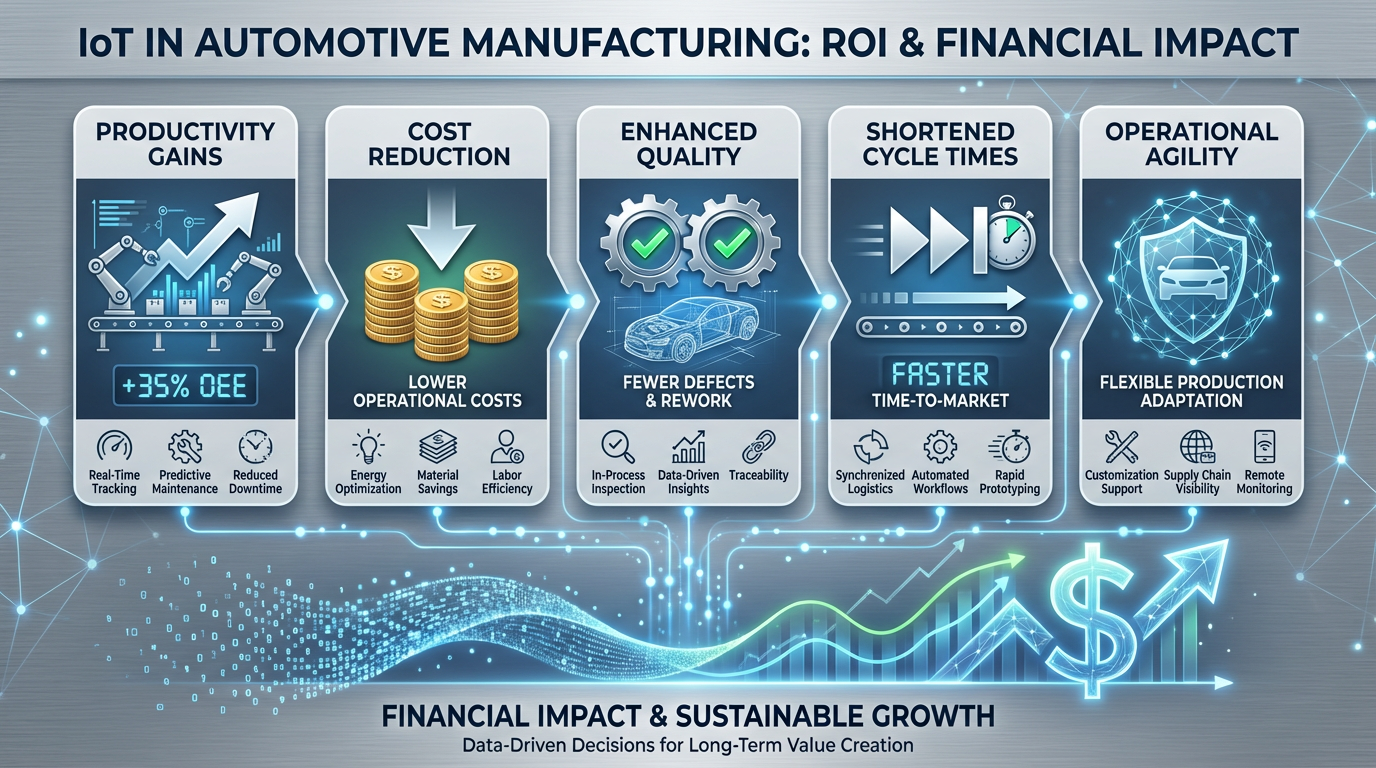
4. Measurable Benefits and Return on Investment (ROI)
The transformation of automotive manufacturing through the adoption of the Internet of Things (IoT) is not merely a technological evolution; it represents a profound strategic shift yielding tangible, quantifiable benefits and substantial returns on investment for automakers worldwide. This section will meticulously analyze the outcomes of IoT implementation, focusing on the substantial productivity gains, significant cost reductions, enhanced quality, shortened cycle times, and increased operational agility that contribute to a compelling financial impact. The automotive industry, a vanguard in embracing Industry 4.0, has witnessed its early gambles on smart factory technologies translate into measurable competitive advantages, solidifying IoT’s role as an indispensable driver of modern manufacturing efficiency and profitability.
4.1 Driving Productivity Gains and Operational Efficiency
The core promise of Industrial IoT (IIoT) in automotive manufacturing lies in its ability to enhance productivity and streamline operations. Through real-time data collection, advanced analytics, and intelligent automation, automakers are unlocking unprecedented levels of efficiency across their production facilities.
4.1.1 Increased Production Output and Labor Productivity
Automakers implementing smart manufacturing solutions are observing significant increases in their production output and labor productivity. A global survey highlighted that these implementations have yielded a notable **10–20% higher production output** and a **7–20% boost in labor productivity** on average [8]. Such gains are critical in an industry characterized by high volumes and intense competition, where even marginal improvements can translate into substantial financial benefits.
The sheer scale of these productivity improvements is underscored by aggregate industry projections. By 2023, smart factory initiatives were estimated to generate between **$135 billion and $167 billion in cumulative productivity gains** for the automotive industry [10]. This represents an impressive **15–24% overall improvement in manufacturing performance** for automakers [10], equating to annual gains of 2.8% to 4.4%. This highlights the immense value that IoT brings to the sector, demonstrating its capacity to optimize complex production systems and achieve remarkable performance uplifts.
These improvements stem from several factors:
- Bottleneck Identification and Resolution: IoT sensors provide granular data on every stage of the production process, enabling manufacturers to pinpoint bottlenecks and inefficiencies in real-time. This allows for immediate corrective actions, preventing minor delays from escalating into major production stoppages.
- Optimized Machine Utilization: By continuously monitoring equipment performance and health (as discussed in Section 3), IoT ensures that machinery operates at peak efficiency for longer periods, reducing idle time and maximizing throughput.
- Enhanced Human-Machine Collaboration: IoT enables safer and more efficient collaboration between human workers and automated systems, particularly with the rise of cobots, whose sales are projected to constitute **34% of all industrial robot sales** by 2025 [25]. This synergy allows humans to focus on higher-value, intricate tasks while robots handle repetitive or strenuous operations, boosting overall site productivity.
4.1.2 Reduction in Unplanned Downtime
One of the most impactful benefits of IoT in automotive manufacturing is the dramatic reduction in unplanned downtime. Production line stoppages are exceptionally costly, leading to lost output, missed deadlines, and increased maintenance expenses. IoT-driven predictive maintenance (PM) systems are proving to be a game-changer in this regard.
Early adopters of IoT within the manufacturing sector have reported significant successes, with a **20–40% reduction in unplanned downtime** [7]. The U.S. Department of Energy further notes that IIoT-based predictive maintenance can potentially **decrease unplanned machine downtime by up to 50%** [11]. This directly translates into millions of dollars in savings and ensures smoother, more consistent production flows.
General Motors’ Arlington Assembly Plant serves as a prime example. By deploying IoT-powered digital twin technology, the plant achieved a **20% reduction in assembly line downtime** [13]. This was realized by simulating and optimizing production virtually, predicting potential issues before they occurred, and scheduling maintenance proactively during non-production hours. This efficiency gain translates into substantial financial savings and increased vehicle output.
Similarly, Toyota Motor North America has successfully implemented an AWS IoT SiteWise system to monitor machine health across several U.S. plants. This system uses real-time data on vibrations, temperature, and cycle times, combined with AI, to flag anomalies [33]. This capability has led to the effective elimination of unplanned outages in some instances, significantly improving productivity and demonstrating the critical role of IoT in maintaining continuous operations [33].
4.1.3 Overall Equipment Effectiveness (OEE) Improvements
Beyond simply reducing downtime, IoT solutions contribute to substantial improvements in Overall Equipment Effectiveness (OEE). OEE is a critical metric combining availability, performance, and quality. IoT-driven initiatives have demonstrably led to OEE gains of **3–7 percentage points** [7].
These gains are achieved through:
- Enhanced Availability: Predictive maintenance directly boosts availability by minimizing unexpected breakdowns.
- Optimized Performance: Real-time monitoring allows adjustments to machine parameters, ensuring equipment operates at optimal speed and efficiency, preventing minor slowdowns.
- Improved Quality: As discussed below, IoT-enabled quality control reduces defect rates, contributing to higher quality scores in the OEE calculation.
The cumulative effect of these improvements is a more efficient and productive factory floor, capable of producing higher quality products at a faster rate.
Table 1: Quantifiable Productivity Benefits from IoT Implementation
| Benefit Category | Quantifiable Impact | Key Contributing IoT Use Cases | Source |
|---|---|---|---|
| Higher Production Output | 10–20% increase | Process optimization, bottleneck removal, enhanced OEE | Deloitte[8] |
| Productivity Boost (Labor) | 7–20% increase | Automation, cobot integration, reduced manual intervention | Deloitte[8] |
| Unplanned Downtime Reduction | 20–50% decrease | Predictive maintenance, digital twins, real-time monitoring | CorGrid[11], Energy Solutions[7], CorGrid[13] |
| Overall Equipment Effectiveness (OEE) | 3–7 percentage points gain | Predictive maintenance, performance monitoring, quality control | Energy Solutions[7] |
| Cumulative Industry Productivity Gains | $135–167 billion by 2023 (15–24% improvement) | Holistic smart factory adoption | Capgemini[10] |
4.2 Substantial Cost Reductions and Quality Savings
Beyond productivity, IoT is a powerful tool for cost reduction across various aspects of automotive manufacturing, from maintenance and rework to energy consumption and supply chain logistics.
4.2.1 Reduced Maintenance Costs
The shift from reactive to predictive maintenance powered by IoT sensors and analytics dramatically impacts maintenance budgets. By anticipating equipment failures, maintenance can be scheduled during planned downtime, avoiding costly emergency repairs and secondary damage. Toyota’s North American plants, for instance, have reported a **17% reduction in overall maintenance costs** due to smarter scheduling enabled by their IoT platform [33]. This is achieved by repairing or replacing components only when necessary, rather than on a fixed schedule (preventive maintenance) or after a breakdown (reactive maintenance). This optimization also extends the lifespan of machinery, reducing capital expenditure on new equipment.
4.2.2 Enhanced Quality Control and Defect Reduction
Quality is paramount in the automotive industry, where defects can lead to expensive recalls, warranty claims, and reputational damage. IoT-enabled quality control systems are significantly improving product quality and reducing defect rates.
- Real-time Anomaly Detection: IoT sensors measure critical parameters (e.g., torque, temperature, pressure) during assembly, enabling immediate detection of deviations from specifications. This allows for instant corrections on the line, preventing the production of faulty parts.
- Machine Vision and Digital Twins: Advanced machine vision systems, powered by IoT and AI, can inspect components and assemblies with far greater speed and accuracy than human eyes, identifying even minute flaws. Digital twins often integrate these visual inspection results to refine process parameters. Mercedes-Benz, for example, achieved a remarkable **4× reduction in defect rates** on certain components after implementing IoT-driven, self-optimizing production systems [10]. This significant reduction translates directly into immense savings from avoided rework, scrap, and potential recall costs.
Volkswagen’s Anchieta plant in Brazil implemented an IoT-based quality inspection for engine assembly using high-resolution cameras and AI. This system successfully caught subtle assembly mistakes, boosting the first-pass yield to 98% [35]. Such improvements not only save direct costs but also bolster brand reputation and customer satisfaction.
4.2.3 Optimized Inventory and Supply Chain Costs
Automotive manufacturing relies heavily on just-in-time (JIT) principles, making an optimized supply chain crucial. IoT provides end-to-end visibility, enabling better inventory management and reduced logistical costs.
- Real-time Tracking: RFID tags, GPS, and other IoT devices track components and materials in transit and within the factory. This provides precise location and status information, allowing manufacturers to respond swiftly to disruptions. In Brazil, automakers use IoT to track parts across the supply chain, quickly rerouting shipments or adjusting schedules to avoid delays [12].
- Inventory Reduction: By accurately monitoring material flow and consumption, automakers can minimize excess stock, reducing warehousing costs and the risk of obsolescence. Toyota has leveraged IoT and analytics to reduce excess inventory on its factory floors, aligning production more closely with actual demand [23], [24].
- Reduced Parts Shortages and Production Delays: Real-time IoT tracking helps automakers avoid costly parts shortages and delays [12], ensuring lines keep running and meeting production targets without incurring expedite fees or other disruption-related expenses.
4.2.4 Energy Savings and Sustainability Impact
IoT plays a significant role in reducing energy consumption and promoting sustainability within auto plants. By deploying smart sensors, manufacturers can monitor and manage energy usage more effectively.
- Granular Energy Monitoring: Thousands of IoT sensors can track electricity, water, and gas consumption at a granular level (e.g., per machine, per zone). This data identifies energy-intensive processes or faulty equipment that is consuming excess power.
- Dynamic Energy Management: IoT systems can dynamically adjust lighting, HVAC, and machine operation based on real-time data inputs like occupancy or production schedules. Volkswagen’s smart factory initiatives incorporate IoT sensor networks to monitor power usage, contributing to their CO₂ reduction goals [27]. Mercedes-Benz’s Factory 56, for instance, deploys an IoT energy management system with AI that cut power consumption per vehicle by **15%** [34].
These efforts not only lead to significant cost savings in utilities but also align with corporate sustainability objectives, offering both financial and reputational benefits.
Table 2: Quantifiable Cost Reductions and Quality Improvements from IoT
| Benefit Category | Quantifiable Impact | Key Contributing IoT Use Cases | Source |
|---|---|---|---|
| Maintenance Costs | ~17% reduction (Toyota) | Predictive maintenance | AMS[33] |
| Defect Rates | 4x reduction (Mercedes-Benz) | IoT-enabled quality control, machine vision, self-optimizing systems | Capgemini[10] |
| First-Pass Yield | Improved to 98% (VW) | AI-powered assembly inspection | CorGrid[35] |
| Energy Consumption | 15% reduction per vehicle (Mercedes-Benz) | IoT energy management, AI optimization | AMS[34] |
| Supply Chain/Logistics | Reduced late shipments, optimized inventory | Real-time tracking, inventory monitoring | CorGrid[12], Capgemini[23], [24] |
4.3 Shorter Cycle Times and Increased Agility
The dynamic environment of the automotive industry demands rapid adaptation to market shifts, technological advancements, and evolving consumer preferences. IoT empowers automakers with the agility required to shorten cycle times, accelerate new product introductions, and respond quickly to disruptions.
4.3.1 Faster Production Cycles and Time-to-Market
Real-time data from IoT devices enables manufacturers to precisely monitor and control every step of the production process. This level of visibility helps in identifying and eliminating micro-stoppages and inefficiencies that collectively extend production cycles. Ford’s global IIoT platform, for instance, provides live visibility of each workstation’s status, helping to flag and address lagging processes. At its Dearborn Truck Plant, this optimized the line rate by approximately **5 trucks per hour** by addressing minor stoppages [36]. Such responsiveness helps reduce overall vehicle assembly cycle times, getting new models to market faster.
4.3.2 Enhanced Flexibility and Adaptability
IoT, particularly when combined with digital twin technology, allows automotive plants to become more flexible and adaptable.
- Virtual Prototyping and Simulation: Digital twins provide a virtual replica of the physical factory, allowing engineers to simulate process changes, test new layouts, or integrate new machinery without disrupting actual production. This capability can cut months off the ramp-up time for new models or product refreshes [30]. BMW’s new plants are entirely designed using digital twin simulations, which significantly improved initial efficiency upon opening [30], [31].
- Configurable Production Lines: IoT-connected robotic systems can be quickly reprogrammed over-the-air to handle different vehicle variants or production tasks. The development of 5G-enabled factories further enhances this flexibility, as machines can be rearranged without the need for extensive re-cabling, fostering highly adaptable manufacturing setups [28], [29].
This agility is crucial in an industry grappling with rapid innovation cycles (e.g., transition to EVs) and increasing customization demands.
4.4 Overall Financial Impact and Return on Investment (ROI)
The cumulative effect of improved productivity, cost reductions, quality enhancements, and increased agility translates into significant financial returns, compelling automakers to invest heavily in IoT.
4.4.1 Compelling ROI Metrics
The financial incentives for IoT adoption in automotive manufacturing are robust. Initial investments in smart factory technologies often yield returns within a surprisingly short timeframe. Well-implemented industrial IoT projects in heavy manufacturing typically show an **Internal Rate of Return (IRR) in the range of 25–45%** [19]. Payback periods are often around just **1.5–3.5 years** [20]. These high IRRs and rapid payback periods dwarf many traditional manufacturing investments, making the business case for IoT exceptionally strong.
The benefits are already observable on a large scale. Ford’s global IIoT platform initiative, connecting over **70 factories worldwide** [36], resulted in approximately **$1 billion in savings** in 2023 through various efficiencies including energy savings, quality improvements, and downtime reduction [36]. This concrete example underscores the massive financial leverage that IoT can provide when scaled across an enterprise.
4.4.2 Investment Trends Driven by Proved Value
The demonstrated ROI is fueling continued and increased investment in IoT. **78% of manufacturers globally now allocate over one-fifth of their annual improvement budget to smart factory technologies** (IoT, automation, AI) [17]. Even more significantly, **88% plan to maintain or increase these investments** year-over-year [18]. This consistent and growing commitment indicates a widespread confidence among manufacturers in the financial viability and strategic importance of IoT.
The automotive sector, in particular, has been a frontrunner. By 2019, approximately **30% of automotive factories were already converted into “smart” facilities** [3], exceeding initial plans. Automotive executives aimed to convert an additional **44% of factories into smart facilities by 2025** [5], a higher rate than any other industry and a clear testament to the sector’s belief in the technology’s transformative power and financial returns.
Table 3: Financial Returns and Investment in Automotive IoT
| Metric | Value/Rate | Details | Source |
|---|---|---|---|
| Internal Rate of Return (IRR) on IIoT Projects | 25–45% | Typical for well-implemented industrial IoT projects in heavy manufacturing | Energy Solutions[19] |
| Payback Period | 1.5–3.5 years | Common timeframe for IoT project ROI realization | Energy Solutions[20] |
| Manufacturers Allocating >20% Budget to Smart Factory Tech | 78% | Global proportion of manufacturers, including automotive | Deloitte[17] |
| Manufacturers Planning to Increase Investment Year-over-Year | 88% | Indicates strong confidence in continued ROI | Deloitte[18] |
| Ford’s Reported Savings from IIoT Program | ~$1 billion (in 2023) | Through efficiencies in energy, quality, downtime reduction | HiveMQ[36] |
| Projected IoT Spending in Manufacturing | $674 billion by 2032 (24.5% CAGR) | Global forecast, demonstrating sustained long-term investment | CorGrid[1] |
4.4.3 Competitive Differentiation and Strategic Advantage
Beyond immediate cost savings and productivity gains, IoT creates a strategic advantage that is harder to quantify but equally vital. Manufacturers are accumulating vast datasets from their connected factories, which can be analyzed to inform continuous improvement, process re-engineering, and even product design [21]. This data-driven approach fosters a cycle of innovation: for instance, if IoT data reveals a specific part is frequently failing during assembly, this insight can prompt a design change, improving reliability throughout the vehicle’s lifespan.
Companies like Tesla have leveraged IoT data not only to optimize factory output but also to rapidly iterate on vehicle engineering, demonstrating an innovation pace that challenges traditional incumbents [21]. Furthermore, the ability to share IoT-derived feedback with suppliers fosters collaboration and elevates quality standards across the entire supply chain. In the long term, this capacity for data-driven precision, speed, and continuous improvement creates a widening gap between digital leaders and those who lag in IoT adoption. The ROI of IoT, therefore, extends beyond financial metrics to encompass sustained competitive edge and market leadership.
4.5 Challenges and Barriers to Realizing Full ROI
Despite the compelling benefits, the journey to realizing the full ROI from IoT in automotive manufacturing is not without its hurdles. These challenges, if not adequately addressed, can slow implementation and dilute the potential financial gains.
4.5.1 Integration with Legacy Systems
A significant barrier is the complexity and cost associated with integrating modern IoT solutions with existing, often decades-old, legacy equipment and proprietary control systems (brownfield plants). Retrofitting sensors or extracting data from outdated Programmable Logic Controllers (PLCs) requires custom engineering and substantial investment. An estimate from a top-ten OEM suggested a **$4–7 million investment per brownfield plant** to implement smart factory technology [22]. This cost disproportionately affects smaller manufacturers and suppliers, creating a ‘digital divide’ where only newer or flagship plants become fully connected [15]. Overcoming this requires phased approaches and the utilization of middleware and edge gateways to bridge the gap between old and new technologies.
4.5.2 Data Management and Interoperability
The sheer volume of data generated by IoT devices presents another challenge. By 2025, global IoT devices are projected to produce **73 zettabytes of data annually** [23]. In automotive factories, a significant portion of this data (reportedly over **70%**) often goes unanalyzed due to fragmented systems and data silos [24]. Different departments may deploy siloed IoT solutions, making it difficult to achieve a unified view of operations. To combat this, **45% of manufacturers are adopting enterprise-wide data architecture standards**, and **54% have a unified data model for IoT data** [25], [26], which is crucial for maximizing data utility.
4.5.3 Cybersecurity Threats
The increased connectivity of IoT devices introduces new cybersecurity risks. Each sensor or device can be a potential entry point for unauthorized access or cyberattacks. **55% of automotive manufacturers express concern about unauthorized access to IIoT systems** [14], with nearly half fearing intellectual property theft via connected factory networks [14]. Breaches can lead to production disruptions, equipment tampering, or the exposure of sensitive data. Implementing robust cybersecurity measures, including device authentication, encryption, network segmentation, and regular risk assessments (conducted by **68% of firms** in the past year [15]), adds complexity and cost to IoT deployments.
4.5.4 Skills Gap and Change Management
Perhaps the most critical challenge is the human element. The expansion of IoT has revealed a significant **skills gap**, with **69–72% of manufacturers reporting difficulty hiring** for roles in IoT/OT engineering and data analytics [16]. Furthermore, over a third of firms cite adapting their workforce to new “Factory of the Future” technologies as a top challenge [17]. Effective change management requires investment in training (nearly half of manufacturers provide in-house training [18]) and fostering a culture that embraces data-driven decision-making, ensuring employees see IoT tools as augmenting, rather than replacing, their roles.
4.5.5 Scaling and Perceived ROI Uncertainty
While pilot projects often demonstrate impressive results, scaling IoT across multiple plants and product lines can be challenging. Some executives remain cautious, with **65% expressing concerns about operational risks** when rolling out IoT at scale [19]. The complexity of measuring and attributing the exact ROI for softer benefits like flexibility or quality improvements can also make obtaining funding approval difficult. Success in scaling often requires dedicated digital transformation teams, clear C-level sponsorship, and the adoption of modular IoT platforms that can be replicated across global operations.
4.6 Conclusion to Measurable Benefits & ROI
The automotive industry’s enthusiastic adoption of IoT is a testament to the technology’s profound and measurable impact on manufacturing operations. From significant productivity surges and drastic reductions in unplanned downtime to substantial cost savings through enhanced quality control and energy efficiency, the benefits are clear, quantifiable, and financially compelling. Automakers are embracing digital twins, predictive maintenance, and real-time process optimization not just as technological novelties but as essential tools for achieving a competitive edge.
The impressive internal rates of return and rapid payback periods for IIoT projects are driving continued, substantial investment, signaling a long-term commitment to digital transformation. While challenges such as legacy system integration, cybersecurity, and the skills gap demand strategic attention, the industry’s proactive approach to addressing these issues underscores its determination to unlock IoT’s full potential. The future of automotive manufacturing is undeniably connected, data-driven, and intrinsically linked to the ongoing evolution of IoT.
The next section will delve into the challenges and risks associated with IoT implementation, including technical complexities, cybersecurity concerns, data privacy issues, and the need for significant workforce upskilling.

5. Challenges and Barriers to IIoT Implementation
The automotive manufacturing sector has embraced the Industrial Internet of Things (IIoT) with unprecedented zeal, driven by the promise of dramatic efficiency gains, enhanced quality, and significant financial returns. While the allure of smart factories that offer real-time data, predictive maintenance, and optimized supply chains is strong, the path to full-scale IIoT implementation is fraught with considerable challenges. These obstacles range from the technical complexities of integrating cutting-edge technologies with outdated infrastructure to the more human-centric issues of workforce readiness and cybersecurity vulnerabilities. Despite the rapid adoption rates and a projected global IoT spending in manufacturing reaching an astonishing $674 billion by 2032 (a 24.5% CAGR)[1], many companies, especially smaller players, find themselves grappling with fundamental barriers that threaten to slow down or even derail their digital transformation efforts. Understanding these challenges is critical for automotive manufacturers to strategically navigate their IIoT journeys, ensuring that the substantial investments made translate into sustainable competitive advantages without introducing unacceptable levels of risk or operational disruption.
Integrating with Legacy Systems: The Brownfield Dilemma
One of the most pervasive and often underestimated challenges in IIoT implementation within automotive manufacturing is the integration of new, advanced IoT technologies with existing legacy systems. Many automotive factories, particularly those that have been operational for decades, rely on machinery and control systems that predated the concept of pervasive connectivity and digital data exchange. These “brownfield” sites represent a significant hurdle to achieving a seamlessly integrated smart factory environment.
The core of this problem lies in the proprietary nature and sheer age of much of the installed industrial equipment. Older machines often use bespoke hardware, outdated communication protocols, and control systems (such as Programmable Logic Controllers, or PLCs) that were never designed to interface with modern IP-based networks or cloud platforms. Extracting data from these systems and feeding it into an IoT platform requires custom engineering, middleware solutions, and often, significant hardware retrofits. For instance, sensors might need to be painstakingly attached to older machinery to gather operational data, and then external gateways introduced to translate proprietary machine signals into a format comprehensible by the IoT network.
The cost associated with such integration efforts is substantial. A top-ten OEM estimated a considerable investment of approximately $4–7 million per brownfield plant just to implement smart factory technology in existing facilities[2]. This figure does not account for the operational downtime that may be required during the retrofit process, which itself can translate into millions of dollars in lost production for an automotive plant running 24/7.
Consider specific examples within the automotive landscape:
- Older plants in established automotive hubs, such as those in Detroit or Toyota’s long-standing lines in Japan, frequently require extensive upgrades or complex middleware solutions to enable data flow to modern IoT ecosystems[3]. These facilities, while highly efficient in their traditional operations, lack the inherent digital architecture to support plug-and-play IoT devices.
- Smaller manufacturers and suppliers within the automotive ecosystem face an even more acute version of this challenge. They often operate with tighter capital budgets and may lack the financial resources to simultaneously replace aging machinery and invest in comprehensive IoT retrofits. This creates a significant digital divide, where large, well-funded OEMs can afford to transform their flagship plants, while smaller entities struggle to keep pace, potentially limiting their ability to compete effectively in a digitally evolving supply chain[4].
The consequence of this integration difficulty extends beyond mere financial outlay. It can lead to a fragmented IIoT landscape where only select, newer, or more critical equipment is connected, leaving vast swaths of the production process unmonitored and optimized. This piecemeal approach prevents the realization of a truly holistic smart factory vision, where data from every corner of the plant contributes to a unified operational picture.
Manufacturers are attempting to overcome this by adopting phased implementation strategies, prioritizing the most critical assets or areas where the ROI from IIoT is clearest. Furthermore, the development of open standards like OPC UA (Open Platform Communications Unified Architecture) and the proliferation of edge computing gateways are helping to bridge the gap between operational technology (OT) and information technology (IT) systems. These technologies provide a standardized way to communicate with diverse industrial equipment, abstracting away some of the legacy complexity. However, the inherent heterogeneity of industrial control systems ensures that legacy integration will remain a significant and costly barrier for automotive manufacturers for the foreseeable future. Until fundamental architectural shifts or comprehensive industry-wide standardization become commonplace, the brownfield dilemma will continue to slow the pace and increase the expense of IIoT adoption.
Complexities in Data Management and Interoperability
The promise of IIoT is inextricably linked to data. However, the sheer volume, velocity, and variety of data generated by connected devices in an automotive factory introduce significant complexities in data management and interoperability. A typical automotive plant, with thousands of sensors monitoring everything from temperature and vibration to torque levels and cycle times, can easily generate petabytes of data daily. This enormous influx of information presents a double-edged sword: it holds the potential for unprecedented insights but also poses immense challenges in storage, processing, analysis, and effective utilization.
By 2025, global IoT devices are projected to generate an astounding 73 zettabytes of data annually, a fourfold increase from 2019[5]. Automotive plants are major contributors to this data deluge. Yet, a stark reality revealed by research is that a substantial portion of this data often remains unutilized. Estimates suggest that over 70% of IoT data generated in manufacturing is never analyzed[6]. This underutilization stems from several core issues:
- Data Silos: In many automotive factories, IIoT deployments occur in a compartmentalized manner. Different departments (e.g., maintenance, quality control, logistics, energy management) often implement their own point solutions, leading to isolated data sets and systems that do not communicate with each other. This creates “data silos” where valuable information remains locked within departmental boundaries, preventing a holistic view of operations. For example, data indicating a slight anomaly in a machine’s vibration (from a maintenance IoT system) might be critical for understanding a subtle quality defect (monitored by a quality IoT system), but if these systems are siloed, the correlation is missed.
- Lack of Interoperability: Even when data is collected, diverse data formats, proprietary protocols, and incompatible software platforms hinder its exchange and aggregation. Translating data between different vendors’ equipment or various generations of manufacturing systems requires significant effort in data cleansing, transformation, and normalization. This lack of interoperability prevents the creation of a ‘single source of truth’ for factory operations, making comprehensive analysis and cross-functional optimization exceedingly difficult.
- Scalability of Data Infrastructure: Managing enormous volumes of data requires robust and scalable data infrastructure, including cloud-based platforms, edge computing capabilities, and advanced analytics tools. Automakers need to invest in data lakes, data warehouses, and powerful computational resources to store, process, and analyze this data effectively. Without a well-planned data architecture, companies risk drowning in raw data without gaining actionable insights.
To address these data management and interoperability issues, leading automotive manufacturers are adopting strategic approaches:
- Enterprise-wide Data Architecture Standards: Approximately 45% of manufacturers report adopting an enterprise-wide data architecture standard for their smart factories[7]. This initiative aims to standardize how data is collected, stored, and accessed across different systems and plants, moving away from fragmented point solutions.
- Unified Data Models: A more specific approach involves implementing a unified data model for IoT data, with 54% of manufacturers reporting this adoption[8]. A unified data model defines common semantics, metadata, and relationships for various data points, ensuring consistency and making data more amenable to integrated analysis. This allows data from disparate sources (e.g., robotics, quality sensors, environmental monitors) to be correlated and analyzed together, deriving deeper insights.
- Leveraging Open Standards and Platforms: The industry is moving towards open protocols and cloud platforms to foster better interoperability. Open protocols, like MQTT (Message Queuing Telemetry Transport) for lightweight messaging, facilitate device communication. Furthermore, industry consortia and organizations like the Industrial Internet Consortium are actively promoting standardized frameworks and best practices to enhance data exchange and integration.
- Edge Computing for Local Processing: Edge computing plays a crucial role in managing data at the source, reducing the amount of raw data transmitted to the cloud and enabling real-time decision-making where latency is critical. This distributed processing capability helps in filtering, aggregating, and preprocessing data before it moves further into the network, thereby alleviating some of the burden on central data systems.
Despite these efforts, translating raw sensor data into meaningful business intelligence remains a significant challenge. It requires not only robust technical infrastructure but also expertise in data science, analytics, and domain knowledge to correctly interpret and act upon the insights. Automotive manufacturers must commit to a comprehensive data strategy that encompasses data governance, quality, security, and lifecycle management to unlock the full transformative potential of their IIoT investments. Failure to do so risks turning the promised data advantage into an unmanageable data burden.
Significant Cybersecurity Threats and Data Privacy Concerns
As automotive factories become increasingly connected through IIoT, the attack surface for cyber threats expands dramatically. Every sensor, actuator, robot, and connected device integrated into the operational technology (OT) network represents a potential vulnerability that can be exploited by malicious actors. The consequences of a cyberattack in a manufacturing environment can be catastrophic, ranging from intellectual property theft and operational disruption to physical damage and safety hazards.
Automotive manufacturers are keenly aware of these escalating risks. A significant majority, approximately 55% of smart manufacturing adopters, express high concern about unauthorized access and cyber intrusions into their IIoT systems[9]. This concern is not unfounded. The specialized nature of OT systems often means they were not initially designed with modern cybersecurity protocols in mind, making them inherently more vulnerable than traditional IT networks. Moreover, the integration of IT and OT networks, while enabling greater data flow and analytics, inadvertently exposes OT systems to the broader cyber threat landscape previously confined to IT.
The potential impacts of successful cyberattacks are diverse and severe:
- Production Disruption and Downtime: A ransomware attack or denial-of-service event could halt entire production lines, leading to massive financial losses. The Honda factory cyberattack in 2020, which temporarily ceased production globally, serves as a stark reminder of this vulnerability.
- Intellectual Property Theft: Connected factory networks store sensitive data related to vehicle designs, manufacturing processes, and R&D. Nearly 50% of automotive manufacturers fear intellectual property theft via these connected networks[10]. Trade secrets, if compromised, could severely undermine a company’s competitive edge.
- Data Manipulation and Product Quality: Malicious actors could tamper with manufacturing execution systems or process control parameters, leading to quality defects, compromised products, or even safety critical failures in vehicles.
- Supply Chain Attacks: The interconnectedness of the automotive supply chain means a vulnerability in a smaller supplier’s IIoT system could potentially be exploited to gain access to larger OEM networks, creating a ripple effect.
- Safety Risks: In highly automated factories, a cyberattack that overrides or manipulates industrial control systems could lead to physical harm to workers or damage to expensive machinery.
In response to these threats, automotive manufacturers are significantly bolstering their cybersecurity postures for IIoT environments:
- Regular Security Assessments: Around 68% of firms conducted a smart manufacturing cybersecurity risk assessment in the past year[11]. These assessments are crucial for identifying vulnerabilities, evaluating risks, and developing appropriate mitigation strategies.
- Network Segmentation: A common practice is to segment IT and OT networks, creating a protective barrier between the enterprise IT systems and the critical industrial control systems on the factory floor. This helps contain breaches and prevent lateral movement of attackers.
- Robust Authentication and Access Control: Implementing strong authentication methods (e.g., multi-factor authentication) and granular access controls ensures that only authorized personnel and devices can access critical systems and data.
- Secure-by-Design Principles: Adopting a “secure-by-design” approach means embedding security considerations from the outset of IIoT deployment, rather than as an afterthought. This includes using secure coding practices, device hardening, and robust encryption protocols for data in transit and at rest.
- Patch Management and Regular Updates: Ensuring that IIoT devices and software are regularly updated with the latest security patches is vital, though often challenging given the operational criticality of industrial equipment.
Beyond cybersecurity, data privacy concerns also loom large, particularly with the increasing collection of data that might directly or indirectly identify individuals (e.g., worker location data from wearables, biometrics for access control). Regulatory frameworks such as Europe’s GDPR (General Data Protection Regulation) and Brazil’s LGPD (Lei Geral de Proteção de Dados) impose strict requirements on how personal data is collected, processed, and stored. Automotive companies must ensure their IIoT implementations comply with these evolving privacy laws, which adds another layer of complexity to data governance and project planning.
The continuous evolution of cyber threats, coupled with the intricate nature of OT environments, means that cybersecurity will remain a paramount and ongoing concern for automotive manufacturers as they progress with IIoT adoption. Proactive, multi-layered security strategies are essential to protect critical assets, maintain operational integrity, and safeguard sensitive information in the connected factory of the future. Failing to address these security and privacy challenges can undermine trust, incur significant financial penalties, and ultimately jeopardize the success of IIoT initiatives.
Pervasive Skills Gap and Change Management Issues
Even with the most advanced IIoT technologies, successful implementation ultimately hinges on the capabilities of the workforce. However, the automotive industry faces a significant skills gap, making it challenging to find, train, and retain individuals with the expertise required to manage, operate, and troubleshoot complex smart factory environments. Furthermore, incorporating IIoT necessitates significant organizational and cultural changes, presenting substantial change management issues.
The Skills Gap
The demand for new technical skills driven by IIoT is outpacing the supply of qualified professionals. Research indicates that between 69-72% of manufacturers report moderate to significant difficulty hiring for critical roles in IIoT/OT engineering, data analytics, artificial intelligence, and related technology domains[12]. The nature of these roles is multidisciplinary, requiring a blend of traditional engineering knowledge (mechanical, electrical, industrial) with expertise in software development, data science, network security, and cloud computing.
Key areas affected by the skills gap include:
- IoT/OT Engineers: Professionals proficient in deploying, configuring, and maintaining IIoT devices, gateways, and industrial networks. They bridge the gap between IT and OT, understanding both industrial protocols and enterprise IT infrastructure.
- Data Scientists and Analysts: Experts capable of extracting meaningful insights from the vast amounts of data generated by IIoT systems. They develop algorithms, build predictive models (e.g., for predictive maintenance), and present data in actionable formats.
- Cybersecurity Specialists: Individuals with expertise in securing industrial control systems (ICS) and IIoT networks against sophisticated cyber threats.
- AI/ML Engineers: Professionals who can develop and implement artificial intelligence and machine learning models to optimize production processes, quality control, and predictive capabilities.
This talent crunch means companies either struggle to fill essential positions, leading to slower IIoT adoption, or resort to costly outsourcing, which may not always provide the deep institutional knowledge required for long-term success.
Change Management and Workforce Adaptation
Beyond the technical skills gap, the integration of IIoT profoundly impacts existing roles and work processes, demanding significant change management efforts. More than one-third of firms cite adapting their workforce to new “Factory of the Future” technologies, including IIoT, as one of their top implementation concerns[13].
Challenges in change management typically arise from:
- Resistance to Change: Seasoned production staff and maintenance technicians, accustomed to traditional methods, may exhibit skepticism or resistance towards new IoT systems. Concerns about job displacement due to automation, discomfort with new digital tools, or a lack of understanding regarding the benefits of IIoT can hinder adoption.
- Retraining and Upskilling Existing Workforce: The existing workforce, while possessing invaluable domain knowledge, often lacks the digital literacy and technical skills required for an IIoT-enabled environment. Retraining programs are essential but can be resource-intensive and time-consuming. Examples of such efforts include:
- Toyota’s use of mixed reality (e.g., HoloLens 2 headsets) for training technicians, which has reportedly cut certain training times by 50% by making troubleshooting more intuitive[14].
- Volkswagen running an AIoT training academy for plant engineers to upskill staff internally.
- Cultural Shift: IIoT transforms factories from reactive to proactive environments, shifting decision-making from intuition-based to data-driven. This requires a fundamental cultural shift where employees at all levels embrace data analytics, continuous improvement, and cross-functional collaboration.
- Alleviating Fear of Job Displacement: A critical aspect of successful change management is reassuring employees that IIoT tools are designed to augment, not entirely replace, human capabilities. Highlighting how IIoT can make jobs safer (e.g., IoT wearables preventing accidents), more efficient, and strategic (e.g., predictive maintenance reducing reactive “firefighting”) can foster acceptance and engagement.
To address these challenges, automotive manufacturers are undertaking several initiatives:
- Internal Training Programs: Nearly half of manufacturers are providing in-house training on smart factory technologies not just for employees but also for senior executives, demonstrating a commitment to top-down digital literacy[15].
- Partnerships with Academia and Tech Providers: Collaborating with universities and technology firms to develop specialized courses and certifications helps to build a pipeline of skilled workers.
- Redesigning Job Roles: Creating hybrid roles that combine traditional manufacturing expertise with data analytics or connectivity skills can help bridge the gap.
- Early Employee Involvement: Involving employees in the planning and implementation of IIoT solutions, soliciting their feedback, and empowering them as early adopters can build buy-in and reduce resistance.
Ultimately, bridging the skills gap and effectively managing organizational change are not secondary considerations but critical success factors for IIoT implementation. Companies that prioritize investing in their human capital, fostering a culture of continuous learning, and communicating the vision and benefits of IIoT clearly will be better positioned to harness the full potential of their smart factory endeavors. Without a skilled and engaged workforce, even the most technologically advanced IIoT systems will fail to deliver their promised value.
Uncertainty in Scaling and Measuring ROI
While many automotive manufacturers have successfully conducted IIoT pilot projects with impressive results, scaling these initiatives across multiple plants, diverse product lines, and global operations often presents a more complex set of challenges. This includes the inherent difficulty in replicating success across heterogeneous environments and quantifying the precise return on investment (ROI) that can secure further funding and organizational buy-in.
Scaling Challenges
Pilot projects are typically confined to a specific production line, a limited set of machines, or a single factory. These controlled environments allow for focused attention and easier troubleshooting. However, expanding these solutions to an enterprise level introduces several complexities:
- Heterogeneity of Operations: Auto manufacturers often operate factories with varying ages, layouts, equipment generations, and even localized operational practices. A solution that works perfectly in a new, greenfield plant might not seamlessly integrate into an older brownfield site without significant customization and cost. This lack of standardization makes “copy-pasting” IIoT solutions challenging.
- Geographic and Regulatory Differences: Global automotive players must contend with diverse regulatory environments, data sovereignty laws, connectivity infrastructure variations, and local workforce skill levels across different regions. What is feasible in North America might face different hurdles in Europe or Asia.
- Integration Overhead: As the number of connected devices and systems grows, so does the complexity of managing and integrating them. This includes provisioning thousands of sensors, ensuring network stability, and managing a massive data pipeline, which can rapidly become overwhelming without robust, scalable platforms.
- Resource Strain: Rolling out IIoT at scale requires a sustained commitment of capital, IT/OT personnel, and internal champions. Many organizations find their internal resources stretched thin when moving beyond initial pilots.
- Operational Risks: The concern about continuity is paramount. Approximately 65% of executives express concerns about operational risks, such as disrupting live production, when deploying IIoT at scale[16]. Any failure in a widespread IIoT system could have far-reaching and costly consequences.
This hesitancy to scale is understandable. For example, an automaker might more easily justify a multi-million-dollar investment in a new electric vehicle production line (which directly generates revenue) than in upgrading an older line with IIoT sensors, even if the latter promises strong efficiency gains. The perceived risk and complexity often make large-scale IIoT deployments appear daunting.
Measuring and Proving ROI
Another significant barrier is accurately measuring and proving the ROI of IIoT initiatives, especially when scaling. While pilots often show clear benefits (e.g., a specific percentage reduction in downtime), attributing bottom-line impact to IIoT across an entire large organization can be elusive:
- Intangible Benefits: Many IIoT benefits, such as increased flexibility, enhanced quality, improved worker safety, or faster time-to-market for new models, are hard to quantify directly in financial terms. While these contribute to overall business health, finance departments often struggle to connect them directly to IIoT expenditure, slowing down approvals for further investment.
- Longer Payback Periods for Large Projects: While individual predictive maintenance projects may have quick paybacks (e.g., 1-2 years)[17], a comprehensive factory-wide or enterprise-wide IIoT overhaul can involve substantial upfront costs. The payback period for such large-scale initiatives might be longer, requiring sustained commitment and patience from leadership.
- Attribution Challenges: In a manufacturing environment where multiple initiatives are often running concurrently (e.g., lean manufacturing, automation upgrades, new software systems), isolating the specific financial impact of IIoT can be difficult. Gains in productivity might be attributed to overall operational excellence rather than precisely to the IIoT components.
- Conflicting Priorities: Within a large automotive corporation, different departments may have competing priorities for investment. Without a clear and compelling ROI that resonates across finance, operations, and IT, IIoT initiatives can struggle to secure the necessary capital and political support for widespread deployment.
Companies that have successfully scaled IIoT and demonstrated strong ROI typically employ certain strategies:
- Strong Executive Sponsorship: C-level support is critical to ensure IIoT is viewed as a strategic imperative, not just a departmental IT project.
- Dedicated Digital Transformation Teams: Establishing cross-functional teams focused solely on driving IIoT adoption, standardization, and measurement across the organization.
- Modular and Replicable Platforms: Developing IIoT solutions on modular, cloud-based platforms that can be easily replicated and customized across different sites, ensuring consistency and reducing per-site deployment costs. Ford’s strategy of connecting over 70 factories worldwide to a unified IIoT data platform exemplifies this approach, allowing insights and applications developed in one plant to be quickly rolled out to others[18].
- Clear Metrics and KPIs: Defining explicit key performance indicators (KPIs) and metrics upfront that directly link IIoT activities to business outcomes (e.g., OEE improvements, waste reduction, energy savings, defect rates) and rigorously tracking these allows for clear measurement of impact.
Despite the impressive productivity gains reported by early adopters (e.g., 10-20% higher production output, 7-20% productivity boosts)[19], the challenge remains for many organizations to translate these localized successes into verifiable, enterprise-wide financial benefits. Overcoming internal silos, securing consistent funding, and standardizing technology across diverse global operations are non-trivial challenges that automotive manufacturers must navigate to fully realize IIoT’s promised gains and justify the significant investments required. The companies that master the art of scaling and ROI measurement will solidify their leadership in the next era of automotive manufacturing.
The challenges outlined in this section underscore that while the potential of IIoT in automotive manufacturing is immense, its full realization depends on addressing foundational issues related to technology integration, data governance, cybersecurity, and human capital development. The next section will delve into specific use cases that showcase how automotive manufacturers are successfully overcoming these barriers, demonstrating both the practicality and the transformative power of IIoT in real-world scenarios.
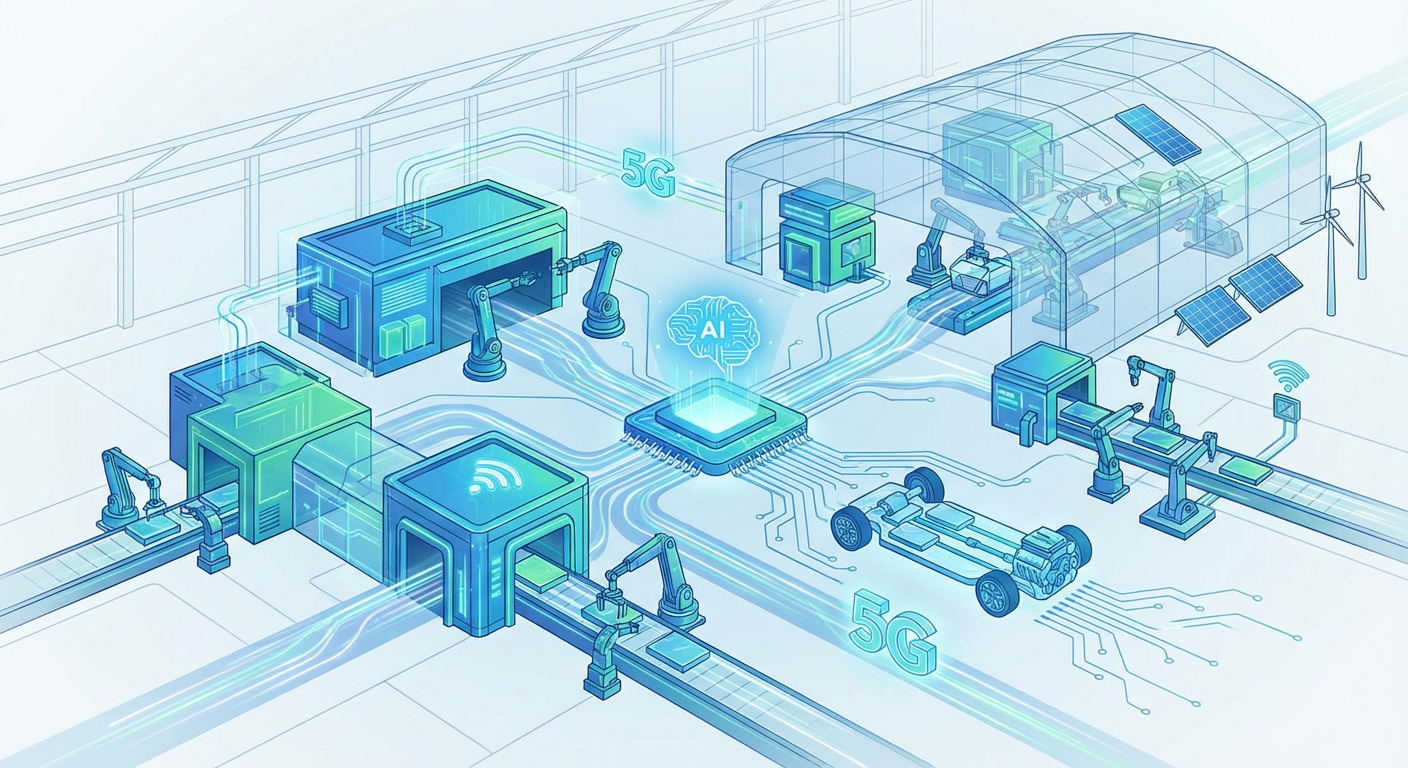
6. The Road Ahead: Emerging Trends and Future Outlook
The automotive manufacturing landscape is undergoing an unprecedented transformation driven by the rapid adoption of the Internet of Things (IoT). While significant progress has already been made in deploying IoT solutions across factory floors, the true potential of this technology is still unfolding. The trajectory for IoT in automotive manufacturing points towards an even more interconnected, intelligent, and autonomous future, characterized by pervasive 5G connectivity, advanced Artificial Intelligence (AIoT) integration, and the establishment of fully data-driven and sustainable smart zones. This section will delve into the critical emerging trends and future outlook for IoT in automotive manufacturing, exploring how these innovations will reshape production processes, supply chains, and environmental footprints.
The global spending on IoT in manufacturing is projected to skyrocket, indicating a sustained and aggressive investment strategy by the industry. Forecasts suggest that global IoT spending in manufacturing will reach an astonishing **$674 billion by 2032**, demonstrating a compound annual growth rate (CAGR) of 24.5% during this period2. Manufacturing currently leads all other industries in IoT investment, accounting for over one-third of the total global IoT spending in 20233. The U.S. alone is expected to contribute approximately $146.6 billion to this figure by 20322. This robust financial commitment underscores the industry’s belief in IoT as a foundational technology for future competitiveness and efficiency. By 2025, it was anticipated that 44% more factories would be smart-enabled, a rate that significantly outpaces other sectors, positioning automotive as a vanguard in Industrial IoT (IIoT) adoption6. The future, therefore, is not merely about incremental improvements but about a fundamental reimagining of how vehicles are designed, produced, and delivered, with IoT serving as the central nervous system of this evolving ecosystem.
6.1. The Transformative Impact of 5G Technology
The advent and widespread deployment of 5G networks are set to revolutionize the capabilities of IoT in automotive manufacturing, providing the necessary high-bandwidth, ultra-low latency, and reliable connectivity crucial for next-generation smart factories. Traditional factory environments, often reliant on wired Ethernet or older Wi-Fi standards, struggle to meet the demanding requirements of real-time data processing for thousands of connected devices. 5G addresses these limitations by offering a robust wireless infrastructure that can support complex, critical applications on the shop floor.
By 2025, approximately 42% of manufacturers were already leveraging 5G in some capacity within their facilities, a clear indicator of the rapid adoption of this technology14. Major automotive original equipment manufacturers (OEMs) are actively piloting private 5G networks in their plants, recognizing its potential to enable completely wireless, highly adaptable manufacturing setups, referred to as “smart zones”19. These zones represent a paradigm shift, where machines and devices can be rearranged and reconfigured without the cumbersome process of laying new cables, thereby enhancing flexibility and accelerating production changes.
The technical specifications of 5G are particularly well-suited for industrial applications:
- Enhanced Mobile Broadband (eMBB): Provides significantly higher data speeds, allowing for rapid transmission of large volumes of sensor data, high-resolution video streams from machine vision systems, and large program files for robotic arms.
- Ultra-Reliable Low-Latency Communications (URLLC): Offers extremely low latency (potentially sub-1ms) and high reliability, which is critical for time-sensitive applications like autonomous guided vehicles (AGVs), real-time control of collaborative robots (cobots), and synchronized machine-to-machine communication. This ensures that commands are executed instantly and feedback loops are closed without delay, preventing costly errors or production bottlenecks.
- Massive Machine-Type Communications (mMTC): Supports a density of up to one million connected devices per square kilometer, enabling pervasive connectivity for thousands of IoT sensors, actuators, and devices across an expansive factory floor without network congestion.
For instance, consider an assembly line where autonomous robots and vision systems need to coordinate instantly to install and verify a component with sub-millisecond precision. 5G’s URLLC capabilities make this possible, enhancing both precision and speed. Furthermore, augmented reality (AR) instructions can be streamed seamlessly to workers’ smart glasses anywhere in the factory, providing real-time data overlays and guidance without lag. Companies like Ford and BMW have already conducted trials using 5G to support more flexible production layouts. The ability to move machines and rework entire sections of a factory without the constraints of physical cabling significantly reduces reconfiguration time and costs, allowing manufacturers to adapt more quickly to changing market demands or new product introductions.
The integration of 5G with edge computing will further bolster the resilience and performance of automotive IoT systems. By processing data closer to its source, edge computing reduces reliance on cloud connectivity, ensuring that critical IoT functions can continue even if external network connections are temporarily disrupted. This local processing also minimizes data transfer latency, which is crucial for real-time control applications. The future trajectory suggests that ubiquitous high-speed 5G connectivity will not merely facilitate existing IoT applications but will amplify their impact, paving the way for more integrated, responsive, and autonomous manufacturing processes. In essence, 5G is the foundational layer that will unlock the full potential of automotive IoT, creating an environment where data flows freely, decisions are made in real-time, and production lines achieve unprecedented levels of efficiency and adaptability.
6.2. The Synergistic Integration of Artificial Intelligence (AIoT)
The convergence of Artificial Intelligence (AI) and the Internet of Things (IoT), often termed AIoT, represents the next significant leap in automotive manufacturing intelligence. While IoT provides the data, AI provides the intelligence, enabling factories to move beyond mere data collection to proactive, self-optimizing, and eventually autonomous operations. The sheer volume of data generated by IoT devices highlights the necessity of AI: by 2025, IoT devices are expected to generate 73 zettabytes of data annually30, with a staggering 70% or more of this data going unutilized31. AI offers the means to process, interpret, and extract actionable insights from this vast ocean of information.
Manufacturers are already experimenting with AI-driven analytics on their IoT data. For example, machine learning algorithms are being employed not only to predict maintenance needs but also to determine optimal process settings for maximizing yield and energy efficiency. Consider an automotive paint shop: AI, fed by real-time IoT sensor data on humidity, temperature, paint thickness, and curing times, could adjust parameters on the fly for each vehicle body, minimizing defects and improving overall finish quality. Similarly, robotic welders equipped with computer vision and AI could detect and correct faulty welds in real-time, preventing costly rework and improving structural integrity.
The scope of AIoT extends significantly beyond predictive maintenance and quality control. Key areas include:
- Autonomous Operations: AI, leveraging IoT data, will enable factory equipment and processes to operate more autonomously. This could range from robotic systems making independent decisions on material handling and assembly sequences to entire production cells adjusting their output based on real-time demand signals and component availability.
- Generative AI in Manufacturing: Emerging generative AI technologies are beginning to be explored for complex manufacturing tasks. For instance, generative AI could analyze vast IoT datasets to suggest optimal factory layouts, predict future maintenance requirements, or even design more efficient production processes. A significant portion of manufacturers (24%) have already begun deploying generative AI at scale in their operations32. This indicates a growing confidence in AI’s ability to drive strategic decision-making and operational improvements.
- Digital Supervisors: The future factory floor might be orchestrated by “digital supervisors” – advanced AI systems that oversee and optimize the coordination of all IoT devices and processes. Human managers would then shift their focus from day-to-day supervision to managing exceptions, strategic planning, and continuous improvement initiatives. Tesla, despite its pioneering efforts and occasional challenges in full automation, has demonstrated the potential of integrating AI into manufacturing, providing a glimpse into the future of highly automated production lines.
- Intelligent Resource Allocation: AIoT systems can dynamically allocate resources, including machinery, personnel, and materials, based on real-time production status, supply chain fluctuations, and maintenance schedules. This ensures optimal utilization and minimizes waste.
The integration of AI into IoT ecosystems will lead to factories that are not only connected but also inherently smart and capable of continuous learning and adaptation. This dynamic capability is crucial for an industry facing rapid product cycles, increasing customization demands, and persistent supply chain vulnerabilities. AIoT promises to transform automotive manufacturing into a highly responsive, resilient, and efficient ecosystem, where predictive insights drive automated actions, leading to superior quality, lower costs, and faster time-to-market.
6.3. Fully Connected, Data-Driven, and Sustainable Smart Zones
The ultimate vision for automotive manufacturing, powered by IoT, is the establishment of fully connected, data-driven, and sustainable smart zones. These zones transcend the traditional factory floor, encompassing interconnected facilities, optimized supply chains, and environmentally responsible practices, all underpinned by data. The journey towards this vision involves the maturation and widespread adoption of several key technologies and methodologies.
6.3.1. Digital Twins and Large-Scale Simulation
Digital twins, virtual replicas of physical assets, processes, or entire factories, will evolve to become even more detailed and pervasive. Currently used for individual machines or production lines, the future entails creating comprehensive digital twins of entire factories and even extended supply chains. Companies like Volkswagen are already developing digital twin models of complete production lines to simulate changes virtually. General Motors, for instance, has collaborated with technology firms such as NVIDIA to model assembly workflows in simulation environments like Omniverse, optimizing robot coordination before physical implementation33.
The benefits of large-scale digital twin implementation are immense:
- “What-If” Scenario Planning: Manufacturers can run countless simulations to test the impact of changes, such as introducing a new model variant, altering a supplier’s component, or modifying a production process. This virtual experimentation avoids costly and time-consuming physical trial-and-error, significantly reducing risk and accelerating innovation cycles.
- Predictive Optimization: As digital twins are continuously updated with real-time IoT data from the physical factory, they can mirror production second by second. This enables the twin to run multiple control strategies in simulation and feed back the optimal one to the physical factory in real-time, leading to genuine self-optimization.
- Supply Chain Resilience: Extending digital twins to the supply chain network allows companies to simulate disruptions (e.g., natural disasters, geopolitical events) or demand spikes across their entire logistics system. This foresight enables proactive planning and mitigation strategies, enhancing overall supply chain resilience.
BMW’s latest manufacturing facilities are a testament to this trend, having been designed entirely using digital twin simulations. Their planning teams virtually collaborated, identifying improvements that led to significantly higher initial efficiency upon the plants’ opening3435. This approach results in manufacturing that is not merely connected but also exceptionally foresighted, capable of resolving potential problems in the virtual realm long before they manifest as costly downtimes in the physical world.
6.3.2. Sustainability and Green IoT Initiatives
Pressure for automotive companies to reduce their environmental footprint is growing, and IoT is emerging as a critical enabler for sustainability. Smart zones in the future will be inherently green, with IoT systems meticulously monitoring and optimizing every aspect of resource consumption and waste generation.
Key applications of IoT in driving sustainability include:
- Energy Management: Thousands of IoT sensors will track electricity, water, and gas usage in real-time, identifying inefficiencies and facilitating precise measurement of improvements. OEMs like Ford are implementing IoT systems to control lighting and HVAC based on occupancy and machine operation, leading to significant energy savings. Volkswagen’s smart factory initiatives use IoT sensor networks to monitor power consumption and dynamically adjust systems to meet CO₂ reduction goals.
- Emissions Monitoring: IoT will play a vital role in monitoring carbon emissions directly from production processes. Institutes in Brazil, for example, have deployed IoT systems to monitor carbon emissions in automotive plants, feeding data into sustainability compliance systems25.
- Circular Economy Enablement: IoT can facilitate the transition to a circular economy model. By tagging parts and materials with IoT sensors and recording their provenance on blockchain, automakers can ensure responsible sourcing, track component lifecycles, and optimize recycling processes39. This enhanced transparency benefits both consumers and regulators, helping to verify ethical and sustainable practices.
- Smart Grids within Factories: Future factories could feature integrated smart energy grids that leverage IoT data. These grids could dynamically shift production timings to align with periods when renewable energy sources are most abundant, further minimizing reliance on fossil fuels.
McKinsey studies highlight that digitalization and IoT are indispensable for decarbonizing automotive production, especially with the mainstream adoption of electric vehicles (EVs)3637. BMW’s new plants exemplify this commitment, featuring digital energy control centers that utilize real-time IoT data to manage resource usage down to individual production cells38. This demonstrates that IoT is not just about efficiency but also a powerful instrument for meeting environmental commitments and fostering greener, more responsible manufacturing.
6.3.3. The Evolving Automotive IoT Ecosystem
The future outlook for IoT in automotive manufacturing is robust, promising continued expansion and deeper integration. Market forecasts consistently predict double-digit annual growth in automotive IoT spending through at least 203040. The global automotive IoT market, encompassing both connected vehicles and factory systems, is expected to reach approximately **$322 billion by 2028**41.
This growth is driven by several interconnected factors:
- Vehicle Connectivity: As vehicles themselves become “computers on wheels” with sophisticated connectivity features, the automotive industry naturally adopts similar data-centric approaches in their production. There’s a closing feedback loop where IoT data from connected cars on the road informs manufacturing processes. For instance, if real-time sensors in customer vehicles detect a common field failure, production processes can be immediately adjusted to address the issue. By 2040, an estimated 80-90% of cars on the road are projected to be IoT-connected42, creating an unprecedented data stream from product usage back to manufacturing.
- New Business Models: This rich data environment could lead to innovative business models. Automakers might offer “production as a service,” dynamically adjusting production volumes and configurations in real-time response to demand and usage data, all enabled by IoT-driven agile factories.
- Standardization and Collaboration: To support this expansive vision, continued investment in scalable IoT platforms and improved industry standards is crucial. Alliances between automakers and tech giants, such as Volkswagen’s partnership with AWS on the “Industrial Cloud,” aim to create common IoT data infrastructures for entire manufacturing networks. As open-source IoT frameworks mature and standards improve, even smaller suppliers will be able to integrate into these digital ecosystems, fostering a more inclusive and interconnected value chain.
The long-term vision is a fully integrated automotive value chain: intelligent factories seamlessly linked with smart supply chains and smart products (vehicles). All components will constantly exchange data to optimize the entire system, from raw material sourcing to vehicle end-of-life. IoT is poised to be the central nervous system that makes this comprehensive, data-driven ecosystem a reality. Those companies that successfully harness this ubiquitous connectivity to become more efficient, flexible, and innovative will undoubtedly lead the automotive manufacturing industry into the next decade.
In conclusion, the emerging trends in automotive IoT point towards a future characterized by hyper-connectivity, intelligent automation, and comprehensive sustainability. The integration of 5G, AIoT, and advanced digital twin technologies will elevate manufacturing from reactive to predictive, and from isolated to integrated. While challenges related to cybersecurity, legacy system integration, and skills gaps persist, the industry’s continued heavy investment and the profound benefits realized to date suggest that these obstacles will be systematically addressed. The automotive manufacturing sector is on the cusp of a revolutionary era, driven by IoT, promising unprecedented levels of efficiency, quality, and resilience, while simultaneously advancing environmental stewardship on a global scale.
The next section will delve into the specific applications of IoT in different stages of the automotive manufacturing process, detailing how these emerging trends are being put into practice.
7. Notable Case Studies and Industry Leaders
The automotive manufacturing sector, a perennial bellwether for industrial innovation, has rapidly embraced the Internet of Things (IoT) as a cornerstone of its Industry 4.0 transformation. Far from being a mere technological trend, IoT solutions are delivering profound, quantifiable benefits across major automakers globally, reshaping production processes, enhancing quality, and driving unprecedented efficiency gains. This section delves into specific examples of leading automakers who have successfully deployed IoT, detailing the initiatives undertaken and the substantial, measurable outcomes achieved. These case studies not only highlight the practical applications of IoT in a complex manufacturing environment but also underscore the strategic imperative for digital transformation, setting a benchmark for the entire industry. The commitment to IoT-driven smart factories has solidified the automotive industry’s position as a frontrunner in Industrial IoT (IIoT) adoption, pushing the boundaries of what is possible in modern production.
7.1 Pioneering the Smart Factory Revolution: Global Automotive Leadership in IoT Adoption
The automotive industry has consistently demonstrated a proactive stance in adopting advanced manufacturing technologies, with IoT at the forefront. By 2019, approximately 30% of automotive factories had already been converted into “smart” facilities, integrating IoT and advanced analytics. This figure surpassed initial industry expectations, indicating a more aggressive pursuit of digital transformation than originally planned [3]. The momentum continued, with automakers aiming to smart-enable an additional 44% of their factories by 2025 [4]. If realized, this ambitious target would place nearly half of all automotive production sites in the IoT-enabled category, significantly outpacing other manufacturing sectors where the next highest adoption rate was 42% in discrete manufacturing [5]. This rapid conversion reflects a strong belief among industry leaders that IoT is not just an incremental improvement but a foundational shift capable of delivering massive efficiency gains and competitive advantages.
The financial commitment supporting this transformation is substantial and growing. Global IoT spending in manufacturing is projected to skyrocket from $97.0 billion in 2023 to an estimated $673.9 billion by 2032, representing a staggering 24.5% Compound Annual Growth Rate (CAGR) [10]. This makes manufacturing the leading industry for IoT investment, accounting for over one-third of global IoT spending in 2023 [2]. Automakers are significant contributors to this trend, allocating considerable portions of their budgets towards smart factory technologies. A global survey revealed that 78% of manufacturers now dedicate over 20% of their annual improvement budget to evolving smart factory initiatives, and a further 88% plan to maintain or increase these investments year-over-year [11]. This aggressive investment is predicated on the proven returns: IoT-driven initiatives are delivering substantial productivity benefits, with estimates of cumulative productivity gains for the auto industry reaching $135–167 billion by 2023, representing a 15–24% performance uplift [6]. Such compelling returns underscore why nearly half (46%) of global auto manufacturers are already deploying IIoT solutions at scale on their factory floors by 2025 [12].
North America has emerged as a particularly strong region for automotive IoT adoption, commanding 43% of the global automotive IoT market as of 2022 [10]. The presence of advanced infrastructure and supportive policies in the U.S. and Canada has fostered an environment conducive to early and widespread adoption. However, this is not an isolated phenomenon, as Asia-Pacific and European regions are also rapidly increasing their investments, indicating a global race towards smarter manufacturing. For instance, in Brazil, the Rota 2030 program is catalyzing IoT adoption, with 40% of large Brazilian manufacturers planning to boost IIoT investments by 2026 [10]. This global momentum highlights IoT as a core pillar of future automotive manufacturing competitiveness, driving companies to leverage these technologies for strategic advantage in an increasingly digitized global economy.
| Metric | Value / Projection | Source | Implication |
|---|---|---|---|
| Global IoT spending in manufacturing (2023) | $97.0 billion | corgrid.io[1] | Foundation for rapid growth. |
| Global IoT spending in manufacturing (2032) | $673.9 billion | corgrid.io[1] | 24.5% CAGR, indicating massive investment. |
| Manufacturing’s share of global IoT spending (2023) | >1/3 | businesswire.com[2] | Leading industry in IoT investment. |
| Automotive factories smart-enabled by 2019 | 30% | capgemini.com[3] | Exceeded initial plans, showing early leadership. |
| Target for smart factories by 2025 | 44% (additional) | capgemini.com[4] | Automotive outpacing other sectors in smart factory goals. |
| Cumulative productivity gains for auto industry from smart factories (by 2023) | $135–167 billion | capgemini.com[6] | 15–24% performance uplift, demonstrating strong ROI. |
| Manufacturers allocating >20% of improvement budget to smart factory tech | 78% | deloitte.com[11] | Strong confidence in ROI, driving continued investment. |
| Automotive manufacturers using IIoT solutions at scale (by 2025) | 46% | deloitte.com[12] | IoT devices and analytics becoming standard tools. |
| North America’s share of global automotive IoT market (2022) | 43% | corgrid.io[10] | Regional leadership in overall automotive IoT. |
7.2 Success Stories: Automakers Driving Innovation with IoT
Major automakers have moved beyond pilot projects and are now deploying IoT solutions at scale, demonstrating tangible improvements across various operational facets. These real-world examples highlight the versatility and impact of IoT in complex manufacturing environments.
7.2.1 General Motors: Digital Twins Revolutionizing Assembly Line Efficiency
General Motors (GM) has made significant strides in optimizing its manufacturing processes through the deployment of IoT and digital twin technology. At its Arlington, Texas plant, a major production site for SUVs, GM implemented a comprehensive program leveraging thousands of sensors and virtual simulation models. This initiative allowed the plant to proactively identify potential issues and test process changes in a virtual environment before physical implementation. The results were impressive: GM reported a **20% reduction in unexpected downtime** on critical assembly lines [8].
For example, real-time IoT monitoring of equipment in the paint shop enabled maintenance to be scheduled during planned downtime, effectively preventing unforeseen stoppages that could halt production. The digital twin of the assembly line also played a crucial role in optimizing critical parameters, such as conveyor speeds and robot coordination, contributing to an estimated 5% increase in throughput. This transformation of a legacy plant into a more flexible and efficient operation has delivered millions of dollars in savings from avoided downtime and established a successful blueprint for GM to replicate across its other facilities.
7.2.2 Toyota: Achieving Near-Zero Unplanned Downtime with Predictive Maintenance
Toyota, known globally for its pioneering production system, has also embraced IoT to enhance its manufacturing capabilities, particularly in predictive maintenance. In 2023, Toyota Motor North America deployed an advanced IoT-based predictive maintenance system across several U.S. plants, aiming for an ambitious goal of zero unplanned downtime. Leveraging AWS IoT SiteWise and proprietary machine learning algorithms (internally referred to as “Toyotarity”), the system continuously collects real-time data from thousands of machines, monitoring critical parameters such as vibrations, temperature, and cycle times [19].
At Toyota’s truck plant in San Antonio, this IoT platform successfully detected early warning signs of excessive wear in a critical weld robot’s servo motor. This foresight allowed the maintenance team to replace the component during a scheduled overnight shift, averting a costly and disruptive unplanned line stoppage. Since its implementation, Toyota reports virtually **no unplanned production stoppages** directly attributable to machine failure in the lines where the system is active. Furthermore, the intelligent scheduling of maintenance based on real-time data has led to a 17% reduction in overall maintenance costs.
Beyond predictive maintenance, Toyota has also integrated mixed reality (MR) into its training programs. Technicians using Microsoft HoloLens 2 headsets receive IoT data overlays directly onto physical equipment, providing intuitive guidance for troubleshooting. This innovative approach has reportedly **cut certain training times by 50%**, making complex maintenance and repair procedures more accessible and efficient [19]. Toyota’s experience exemplifies how combining real-time data with advanced visualization and workforce enablement tools can drive both significant productivity gains and skill improvements.
7.2.3 Mercedes-Benz: “Factory 56” – A Blueprint for Digital Production
Mercedes-Benz’s “Factory 56” in Sindelfingen, Germany, which opened in 2020, stands as a premier example of extensive IoT integration in a state-of-the-art greenfield facility. Dedicated to the production of S-Class and EQ electric models, the plant operates on a fully digital production system. Within this highly connected environment, wireless Automated Guided Vehicles (AGVs), directed by IoT sensors, efficiently deliver parts to the assembly line. Workers are equipped with tablets that provide live instructions and critical quality alerts, streamlining operations and communication.
Drawing lessons from earlier pilots, Mercedes-Benz had previously achieved a remarkable **fourfold reduction in defects** on components for its E-Class sedan body assembly through the deployment of IoT sensors combined with self-optimizing algorithms [7]. These crucial insights were instrumental in the design and operation of Factory 56. Each vehicle moving through the assembly process is fitted with an RFID tag that communicates with station equipment, automatically adjusting production parameters to meet the vehicle’s specific customized specifications. This sophisticated level of automation and data-driven adaptation has resulted in a 25% boost in assembly efficiency compared to previous lines, significantly reducing rework requirements.
Moreover, Factory 56 is designed with sustainability at its core. An integrated IoT energy management system, augmented with AI, has successfully reduced power consumption per vehicle by 15%. This commitment to energy efficiency showcases how IoT can contribute not only to operational excellence but also to environmental responsibility. Mercedes-Benz’s Factory 56 demonstrates the pinnacle of what a greenfield smart factory can achieve through comprehensive IoT integration, highlighting both efficiency and sustainability improvements.
7.2.4 Volkswagen: Retrofitting Legacy Plants for a Digital Future
Volkswagen’s Anchieta factory in São Bernardo do Campo, Brazil, provides a compelling case study on how even older, established plants can undergo significant digital transformation. As part of Brazil’s industrial modernization program, this historically significant VW plant (operating for over 60 years) was retrofitted with extensive IoT infrastructure. Over 5,000 IoT devices, including sensors, actuators, and cameras, were installed to connect machinery and monitor the factory environment [1].
A central IIoT platform collects and processes data from critical equipment such as stamping presses, body shop robots, and conveyor motors, alerting managers to any deviations from optimal performance. A particularly notable success was achieved in the areas of ergonomics and worker safety. Volkswagen deployed wearable IoT sensors for employees engaged in repetitive tasks. These sensors vibrate to prompt workers to take micro-breaks or adjust their posture, leading to a **12% reduction in reportable incidents** within a year.
The plant’s updated automated logistics system, guided by IoT tags on parts containers, also streamlined internal supply chains, shortening line-side inventory replenishment time by 30%. Furthermore, VW integrated an IoT-based quality inspection system for engine assembly, utilizing high-resolution cameras and AI to detect subtle assembly mistakes. This dramatically improved the first-pass yield to an impressive 98%. The Volkswagen Anchieta plant demonstrates that with strategic investment and careful implementation, even older manufacturing facilities can be transformed into smart factories, enhancing safety, quality, and output while extending their competitive lifespan.
7.2.5 Ford Motor Company: Global IIoT Platform for Enterprise-Wide Optimization
Ford Motor Company has adopted a holistic, enterprise-wide approach to IoT by deploying a unified IIoT data platform across its global manufacturing network. Utilizing technologies such as HiveMQ, Ford connected over 70 factories worldwide by 2022, enabling them to stream standardized, real-time data into a centralized cloud system [9]. This standardized approach allows for widespread data analysis and the rapid dissemination of best practices.
A prime example of the platform’s impact is seen at Ford’s Dearborn Truck Plant in the USA. This plant historically faced bottlenecks in final assembly due to manual parts sequencing. By introducing IoT sensors and analytics, providing live visibility into each workstation’s status, the plant could identify and address minor stoppages—such as tool recalibrations or delays in parts fetching—that collectively added up to significant productivity losses. Resolving these issues led to an increase in the line rate by approximately five trucks per hour.
On a global scale, Ford’s unified IIoT initiative has generated significant financial returns. In 2023, the company reported saving an estimated **$1 billion through efficiencies** gained via its “Industrial IoT” program [9]. These savings encompass various areas, including energy consumption reductions, quality improvements, and decreased downtime. A key advantage of Ford’s platform strategy is its scalability: solutions or algorithms developed at one plant (e.g., an algorithm to predict paint booth clogs) can be rapidly deployed to other facilities, accelerating innovation and continuous improvement across the entire organization. Ford’s case illustrates the profound impact of scaling IoT at an enterprise level, transforming individual site improvements into compounded organizational benefits and establishing a robust foundation for intelligent manufacturing operations.
These case studies collectively demonstrate that IoT is not merely an optional upgrade but a fundamental component driving competitive advantage, efficiency, and sustainability in the automotive manufacturing landscape.
7.3 Quantifiable Benefits and ROI Realized through IoT Deployments
The broad adoption of IoT in automotive manufacturing is underpinned by substantial, measurable benefits that translate directly into improved financial performance and operational excellence. The quantifiable returns on investment (ROI) are compelling, driving continued and increasing commitment from major automakers.
7.3.1 Enhanced Productivity and Output
IoT and data-driven manufacturing are directly contributing to significant boosts in production output and overall productivity. According to Deloitte’s 2025 global smart manufacturing survey, companies that implemented IoT and automation solutions reported, on average, a **10–20% increase in production throughput** and a **7–20% improvement in labor productivity** [20]. These improvements stem from various IoT applications, including real-time performance monitoring to eliminate bottlenecks, enhanced machine uptime through predictive maintenance, and superior quality control that reduces rework.
For automakers operating in a highly competitive and margin-sensitive industry, a 10% increase in output with stable costs can dramatically improve profitability and help meet growing market demands, especially for emerging segments like electric vehicles (EVs). Even a marginal increase in Overall Equipment Effectiveness (OEE)—often cited as 3–7 percentage points in early IoT adopters [17]—can translate into thousands of additional vehicles produced annually in large-scale plants. Capgemini’s analysis further projects that fully scaled smart factories could yield a **15–24% overall productivity improvement** for the automotive industry [22], amounting to an estimated $135–167 billion in cumulative productivity gains by 2023 [23]. This highlights the enormous financial stakes and the significant value generated by IoT adoption.
7.3.2 Cost Reductions and Accelerated ROI
One of the most immediate and impactful benefits of IoT implementation is cost reduction, primarily through minimized downtime and improved quality. Predictive maintenance, a cornerstone IoT application, reliably cuts unplanned machine downtime by up to 50% according to the U.S. Department of Energy [21]. These systems often deliver a return on investment within 1–2 years [24]. The financial implications are substantial: eliminating hours of unplanned production stoppages can save millions of dollars annually, easily offsetting the initial investment in sensors and software.
Beyond downtime, IoT-driven quality control prevents costly defects and recalls. Mercedes-Benz’s achievement of a **fourfold defect reduction** on specific components [25] not only saves direct scrap and rework costs but also mitigates the potentially enormous expenses and reputational damage associated with vehicle recalls. Such tangible gains contribute to a robust ROI. Industry analyses suggest that well-executed industrial IoT projects frequently achieve internal rates of return (IRR) in the range of **25–45%** [26], with typical payback periods of 1.5–3.5 years. These attractive financial metrics provide a strong business case for widespread IoT adoption.
7.3.3 Enhanced Agility and Faster Cycle Times
IoT fosters greater operational agility and reduces production cycle times by providing real-time visibility into every stage of the manufacturing process. Live data streams from machines and workstations allow automakers to instantly identify and address process slowdowns. For instance, Ford’s plants utilize IoT data analytics to automatically flag any workstation falling behind takt time, enabling immediate intervention by engineers [27]. This capability has contributed to reducing overall vehicle assembly cycle times and maintaining stringent production schedules.
The flexibility afforded by IoT also supports faster adaptation to market changes. Digital twins, virtual replicas of production lines updated with real-time IoT data, enable manufacturers to simulate “what-if” scenarios, such as integrating a new model variant or accommodating a supplier part with slightly different dimensions, all before making costly physical changes. BMW’s new plants, for example, are designed entirely using digital twin simulations, allowing virtual collaboration and optimization that result in higher initial efficiency upon plant opening [28]. This ability to simulate and optimize virtually can shave months off the ramp-up time for new models or refreshes, providing a critical competitive advantage in a fast-paced market.
7.3.4 Industry-Scale Financial Impact and Competitive Differentiation
The cumulative impact of IoT-driven improvements across the automotive sector is immense. The projected $160 billion in productivity value from smart factories by 2023 [29], even if partially realized, represents tens of billions saved or earned. Companies like GM and Ford have reported hundreds of millions in cost reductions directly attributable to efficiency programs leveraging digital tools like IoT.
While significant progress has been made, only about 10% of auto companies were classified as “frontrunners” fully deploying smart factory technology at scale by 2020 [30], with only a fraction of the total projected productivity improvement achieved [31]. This indicates substantial remaining potential for IoT benefits to be captured across the industry. Manufacturers successfully scaling IoT across their global operations stand to gain enormous cumulative savings, potentially equating to the cost of building an entire new factory by optimizing existing ones.
Beyond immediate financial gains, IoT provides a strategic advantage through data-driven insights. The vast amounts of production data collected by IoT systems can inform continuous improvement initiatives and even influence future product design. Tesla, for instance, leverages IoT data from its factories to rapidly iterate on vehicle engineering, contributing to its accelerated innovation cycle [32]. This continuous feedback loop, extending from production to product design and into the supply chain, creates a widening gap between digital leaders and their less digitized counterparts. The long-term ROI of IoT thus extends beyond direct cost savings to encompass enhanced quality, faster innovation, and more resilient, data-driven manufacturing ecosystems.
7.4 Challenges and Obstacles in Achieving Widespread IoT Implementation
Despite the compelling benefits and numerous success stories, the widespread adoption and scaling of IoT in automotive manufacturing are not without significant hurdles. These challenges span technological, operational, cultural, and strategic dimensions, requiring careful navigation for successful digital transformation.
7.4.1 Integrating with Legacy Systems
A primary obstacle is the inherent difficulty and cost associated with integrating modern IoT solutions with existing legacy manufacturing systems. Many automotive plants, particularly older ones, still rely on equipment and control systems that may be decades old and often proprietary. Retrofitting these machines with sensors, extracting data from outdated Programmable Logic Controllers (PLCs), and ensuring seamless data flow to contemporary IoT platforms can be a complex and expensive endeavor. Estimates suggest that a top-ten OEM might face a **$4–7 million investment per brownfield plant** to implement smart factory technology in existing facilities [34].
This high cost disproportionately affects smaller manufacturers and suppliers, who may lack the capital to undertake comprehensive IoT upgrades across all their equipment simultaneously [35]. The result can be a digital divide, where flagship or newer plants become highly advanced operations, while older production lines remain disconnected. Overcoming this requires phased implementation strategies, focusing on critical equipment first, and leveraging middleware and interoperability standards like OPC UA and edge gateways to bridge the gap between old and new technologies.
7.4.2 Data Management and Interoperability
The proliferation of IoT devices generates an unprecedented volume of data in factories. By 2025, IoT devices globally are expected to produce 73 zettabytes of data annually [36], with automotive plants contributing significantly. However, a major challenge is that a large portion of this data—an estimated 70%—remains unanalyzed [37]. This is often due to data silos, where different production systems (e.g., maintenance, quality control, logistics) operate independently, making it difficult to establish a unified data view.
Fragmented deployments, where IoT solutions are implemented departmentally, exacerbate this issue. Achieving a single source of truth requires substantial IT/OT (Information Technology/Operational Technology) integration and the adoption of common data architectures. Encouragingly, 45% of manufacturers are adopting enterprise-wide data architecture standards for their smart factories, and 54% have a unified data model for IoT data [38]. These efforts, along with the development of open protocols and cloud platforms, are crucial for ensuring interoperability and enabling comprehensive data analysis. Without effective data management strategies, manufacturers risk being overwhelmed by data without gaining actionable insights.
7.4.3 Cybersecurity Threats and Privacy Concerns
The expansion of IoT connectivity inevitably introduces heightened cybersecurity risks. Every connected sensor or device represents a potential vulnerability and entry point for malicious actors. Automotive companies are highly cognizant of this threat, with approximately **55% of smart manufacturing adopters expressing significant concern about unauthorized access to IIoT systems** [39]. The fear of intellectual property theft via connected factory networks is also prevalent [40].
A cyber attack could lead to severe consequences, including production outages, tampering with equipment settings, or the exposure of sensitive manufacturing data (e.g., vehicle designs, process secrets). High-profile incidents, such as the ransomware attack that temporarily halted production at a Honda factory in 2020, serve as stark reminders of these dangers. In response, manufacturers are bolstering IoT security measures, with around 68% having conducted smart manufacturing cybersecurity assessments in the past year [41]. This includes segmenting IT and OT networks, implementing strict access controls, and adhering to guidelines like NISTIR 8259 for IoT device security [42]. Additionally, compliance with data protection regulations such as GDPR and LGPD, which govern personal data collected via IoT (e.g., worker location or biometrics), adds another layer of complexity. Ensuring robust cybersecurity and data privacy is a non-negotiable prerequisite that can add costs and time to IoT deployments but is essential for managing operational and reputational risks.
7.4.4 Skills Gap and Change Management
The successful implementation of IoT solutions is as much a people challenge as it is a technological one. The automotive industry faces a significant scarcity of skilled professionals in areas such as IoT engineering, data science, and automation. Surveys indicate that **69–72% of manufacturers struggle with hiring** for these critical tech roles [43]. Furthermore, adapting the existing workforce to new digital tools and processes represents a substantial change management effort, with over a third of firms citing it as a top concern [44].
Retraining maintenance technicians and production line operators to interact with advanced IoT systems, predictive analytics, and collaborative robots (“cobots”) requires considerable investment. Automakers are addressing this through in-house training programs and partnerships with educational institutions or tech firms to upskill their staff [45]. However, cultural resistance to new technologies or fears of job displacement by automation can hinder adoption. Effective change management strategies involve early employee engagement, showcasing how IoT tools augment roles rather than replacing them, and emphasizing improvements in safety and ease of work. Bridging this talent gap and fostering a data-driven culture are crucial for ensuring smooth IoT integration and maximizing its benefits.
7.4.5 Scaling and Demonstrating ROI for Complex Operations
While pilot projects often yield impressive results, replicating these successes across multiple plants and product lines, especially in a globally distributed organization, can be challenging. Approximately **65% of executives express concerns about operational risks** when rolling out IoT at scale [46]. A large-scale IoT failure or unintended downtime can result in substantial financial losses, necessitating a clear and guaranteed ROI before enterprise-wide adoption.
Measuring the precise ROI of IoT initiatives can also be complex, particularly for intangible benefits like increased flexibility or improved quality, which are difficult to quantify in monetary terms. This can create hurdles in securing funding or lead to piecemeal implementations. Companies that have successfully scaled IoT typically establish dedicated digital transformation teams with strong C-level support, positioning IoT as a core strategic imperative rather than just an experimental project. They also favor modular platforms that can be easily replicated across different sites, fostering continuous improvement. While the confidence in enterprise-wide scaling is growing, overcoming internal silos, securing consistent funding, and standardizing technology across diverse global operations remain non-trivial challenges that automotive manufacturers must navigate to fully unlock IoT’s promised gains.
7.5 The Road Ahead: Emerging Trends and the Future Outlook for Automotive IoT
The trajectory of IoT in automotive manufacturing is one of continuous evolution, driven by advancements in connectivity, artificial intelligence, and digital modeling. The future promises even more deeply integrated, intelligent, and autonomous factory environments.
7.5.1 5G-Powered Factories and Ultra-Low Latency
The widespread deployment of 5G networks is poised to be a game-changer for IoT in automotive manufacturing. 5G’s combination of high bandwidth, ultra-low latency, and enhanced reliability enables unprecedented levels of wireless connectivity for mission-critical applications on the factory floor that were previously limited by wired infrastructure. Automotive OEMs are already piloting private 5G networks, with approximately **42% of manufacturers leveraging 5G** in some capacity on-site by 2025 [47].
This trend will intensify as private 5G spectrum becomes more accessible. With 5G, thousands of devices—including robots, Automated Guided Vehicles (AGVs), and sensors—can communicate in near real-time. This allows for highly precise coordination of autonomous robots, instantaneous streaming of augmented reality (AR) instructions to workers’ smart glasses, and seamless data exchange for complex machine vision systems. Ford and BMW have both conducted 5G trials to create more flexible production layouts, allowing machinery to be rearranged without extensive re-cabling dues to 5G’s ubiquitous wireless coverage. Experts predict the emergence of **5G-enabled “smart zones” within factories**, facilitating highly adaptable and completely wireless manufacturing setups [48]. Coupled with edge computing, 5G will also enhance resilience, ensuring critical IoT functions remain operational even if cloud connections are temporarily interrupted. This foundational high-speed connectivity will amplify all other IoT applications, creating more responsive and connected automotive plants.
7.5.2 AI and IoT Convergence (AIoT)
The next frontier for automotive IoT is its deeper integration with Artificial Intelligence (AI) to create self-optimizing and increasingly autonomous factory operations. The term “AIoT” represents this convergence, where AI algorithms are applied to the vast data streams generated by IoT devices to derive actionable insights and automate decision-making. With IoT devices expected to generate 73 zettabytes of data by 2025 [49], AI becomes indispensable for processing and making sense of this deluge—especially given that over 70% of IoT data currently goes unutilized [50].
In practice, AI could enable an automotive paint shop to dynamically adjust parameters for each vehicle based on real-time IoT sensor feedback (e.g., humidity, paint thickness) to minimize defects. Robotic welding systems could utilize computer vision and AI to detect and correct faulty welds instantly. **Generative AI** is also emerging as a tool for manufacturing, potentially suggesting optimal factory layouts or predictive maintenance schedules based on vast IoT datasets. Indeed, 24% of manufacturers have begun deploying generative AI at scale in their operations [51]. The future will likely see AI playing a progressively larger role in decision-making on the factory floor, leading towards autonomous production where AI systems orchestrate IoT devices, and human managers focus on strategic oversight and continuous improvement rather than day-to-day exceptions.
7.5.3 Digital Twins and Simulation at Scale
The application of digital twins—virtual, constantly updated replicas of physical assets or processes—is expanding from individual machines to entire factories. Automakers are leveraging digital twins to virtualize entire production lines, enabling manufacturers to run “what-if” scenarios (e.g., introducing a new model, altering a supplier’s component) in the virtual environment before implementing costly physical changes. General Motors, for instance, has partnered with tech firms to model assembly workflows in simulation environments like NVIDIA’s Omniverse, optimizing robot coordination prior to floor deployment [52].
BMW’s latest facilities are prime examples, with their new plants designed entirely through digital twin simulations, facilitating virtual collaboration from planning stages and yielding higher initial efficiency upon opening [53]. As computing power and the richness of IoT data grow, these digital twins will become more detailed and accurate, enabling real-time self-optimization. The twins can simulate various control strategies and feed the most effective one back to the physical factory in real time. This capability extends beyond factory walls, allowing manufacturers to simulate supply chain disruptions or demand spikes across their entire logistics network, moving towards a more **foresighted** and resilient manufacturing paradigm where problems are solved virtually.
7.5.4 Sustainability Through IoT
As environmental pressures intensify, IoT is becoming an indispensable tool for automakers to reduce their carbon footprint and achieve sustainability goals. IoT sensors monitor energy consumption, emissions, and waste in real time, allowing manufacturers to identify inefficiencies and precisely measure the impact of interventions. Ford’s smart factory initiatives, for example, leverage IoT systems to control lighting and HVAC based on occupancy and machine operation, significantly reducing energy consumption.
IoT data is also critical for transparent reporting on environmental performance, allowing companies to track the CO₂ emitted during each vehicle’s production and implement targeted reduction strategies. Studies emphasize that digitalization and IoT are essential for decarbonizing automotive production, especially with the mainstream adoption of EVs [54]. We anticipate a rise in “green IoT” use cases, such as smart energy grids in factories that dynamically shift production to periods of high renewable energy availability, or IoT-enabled water recycling monitoring systems. BMW’s new plants feature digital energy control centers that utilize real-time IoT data to manage resource usage at granular levels [55]. Furthermore, the convergence of blockchain and IoT offers new possibilities for supply chain sustainability, enhancing transparency and traceability from sourcing to recycling [56]. Thus, IoT is not merely an efficiency tool but a strategic enabler for building greener and more sustainable automotive manufacturing operations.
7.5.5 Continued Growth and Ecosystem Evolution
The future of IoT in automotive manufacturing is characterized by robust growth and continuous evolution of its ecosystem. Market forecasts predict double-digit annual growth in automotive IoT spending through at least 2030 [57], with the global automotive IoT market (including connected vehicles and factory systems) projected to reach approximately $322 billion by 2028 [58].
A significant driver of this growth is the increasing sophistication of vehicles themselves; as cars transform into “computers on wheels” with extensive connectivity, manufacturers are adopting similar data-centric approaches in their production. A critical feedback loop is forming, where IoT data from connected vehicles on the road informs manufacturing processes, allowing for rapid adjustments based on real-world performance or potential field failures. By 2040, 80–90% of cars on the road are expected to be IoT-connected [59], creating an unprecedented flow of data from product-in-use back to the factory.
This rich data environment may pave the way for new business models, such as “production as a service,” where agile, IoT-driven factories dynamically adjust production volumes in response to real-time demand and usage data. Automakers are investing in scalable IoT platforms and forming alliances with tech giants (e.g., Volkswagen’s partnership with AWS on the “Industrial Cloud”) to establish common IoT data infrastructures across their entire manufacturing networks. As open-source IoT frameworks mature and industry standards progress, even smaller suppliers will integrate into these digital ecosystems. The long-term vision is a fully connected automotive value chain: intelligent factories seamlessly linked with smart supply chains and smart products, all exchanging data to optimize the entire system and drive greater efficiency, flexibility, and innovation.
The case studies and trends discussed highlight the transformative power of IoT in automotive manufacturing. The ability of this technology to deliver measurable improvements in efficiency, quality, and sustainability positions it as a non-negotiable component for future success. While challenges persist, the strategic importance and tangible benefits ensure that IoT will continue to shape the industry’s evolution. The next section will further explore the regulatory landscape and standardization efforts that are crucial for enabling this interconnected future.
8. Key Facts and Data
The transformation of automotive manufacturing through the adoption of the Internet of Things (IoT) is not merely a theoretical concept; it is a demonstrable reality underpinned by compelling statistics and significant data points. This section provides a comprehensive overview of the critical facts and figures that illustrate the profound impact of IoT on the automotive industry, encompassing market growth, operational efficiencies, financial returns, and the persistent challenges that shape its trajectory. From substantial market investments to dramatic reductions in downtime and defect rates, the data unequivocally demonstrates IoT’s pivotal role in shaping the factories of the future.
Market Size and Growth Rates: A Booming Landscape
The global investment in IoT within the manufacturing sector is experiencing explosive growth, positioning it as a leading industry for IoT adoption. In 2022, the estimated value of IoT in manufacturing globally reached $209.4 billion. This figure is projected to surge to $397.9 billion by 2026, indicating an impressive Compound Annual Growth Rate (CAGR) of 17.4% and nearly doubling its value in just four years[1]. This accelerated growth underscores a widespread recognition of IoT’s potential to revolutionize factory operations.
Looking further into the future, the IoT in manufacturing market is forecast to expand from $97.0 billion in 2023 to an estimated $673.9 billion by 2032, reflecting an astounding annual growth rate of 24.5%[2]. This sustained long-term investment trajectory highlights the depth of commitment from manufacturers to integrate advanced digital technologies into their production processes. The United States alone is expected to contribute a significant portion of this growth, with projections indicating approximately $146.6 billion in IoT spending by 2032[3].
The automotive industry stands out within this broad manufacturing landscape as a frontrunner in embracing Industry 4.0. It accounts for over one-third of global IoT spending in manufacturing as of 2023[4], emphasizing its leading role. Regionally, North America held an impressive 43% share of the global automotive IoT market in 2022. This leadership is attributed to advanced technological infrastructure and supportive policy frameworks in countries like the U.S. and Canada. While North America currently leads, regions such as Asia-Pacific and Europe are rapidly increasing their investments, signaling a global race toward smarter manufacturing practices[5].
Smart Factory Conversion and Adoption Metrics
Automotive manufacturers have demonstrated an exceptional pace in converting traditional facilities into “smart factories” equipped with IoT and advanced analytics. By 2019, approximately 30% of automotive factories had already been transformed into smart facilities, significantly exceeding initial plans that projected 24% for the same period. This proactive approach by automakers positioned the industry ahead of its industrial peers in adopting Industry 4.0 principles sooner than anticipated[6].
The sector’s ambitious plans continued, with aims to convert an additional 44% of factories into smart facilities by 2025[7]. If realized, this target would mean that nearly three-quarters of all automotive production sites would be IoT-enabled by the middle of the decade, far surpassing other industries (with the next highest being 42% in discrete manufacturing)[8]. This aggressive adoption strategy reflects the industry’s strong confidence in IoT as a driver of competitive advantage. As of 2025, nearly half, or 46%, of global automotive manufacturers are already utilizing Industrial IoT solutions at scale on their factory floors[9]. This indicates that IoT is no longer an experimental technology but a standard component of modern automotive production. Furthermore, 42% of manufacturers are also integrating private 5G networks into their operations to enhance connectivity and enable real-time data exchange[10].
Productivity Gains and Operational Efficiencies
The comprehensive implementation of IoT-driven initiatives has yielded substantial improvements across various operational metrics within automotive manufacturing. These include significant reductions in downtime, improvements in overall equipment effectiveness (OEE), and notable increases in production output and labor productivity:
- Reduced Unplanned Downtime: Early adopters of IoT report remarkable reductions of 20–40% in unplanned downtime[11]. This is largely attributed to the deployment of predictive maintenance systems, which leverage sensors and AI to anticipate equipment failures, potentially cutting downtime by up to 50%[12]. For example, General Motors leveraged digital twin technology at its Arlington plant to reduce assembly line downtime by approximately 20%[13].
- Overall Equipment Effectiveness (OEE) Gains: IoT solutions have led to OEE improvements of between 3 and 7 percentage points[14]. These gains signify enhanced equipment availability, performance, and quality, directly impacting manufacturing efficiency.
- Increased Production Output and Productivity: Surveys indicate that smart manufacturing implementations have resulted in 10–20% higher production output and a corresponding 7–20% boost in labor productivity on average[15]. One example of productivity translated to millions of dollars in savings: Ford Motor Company’s global IIoT platform has connected over 70 factories worldwide to stream standardized, real-time data into a cloud system, with Ford disclosing it had saved an estimated $1 billion through efficiencies gained via its “Industrial IoT” program. This includes benefits from energy savings, quality improvements and significant reductions in production downtime.
- Quality Improvement: IoT-enabled quality control systems, utilizing technologies such as machine vision and digital twins, have drastically reduced defect rates. Mercedes-Benz Cars, for instance, reported a fourfold reduction in defects on specific components after implementing IoT-driven, self-optimizing production systems[16]. This translates to significantly less rework and waste, enhancing overall product quality.
Financial Returns and Investment Trends
The substantial operational benefits derived from IoT-driven initiatives translate directly into significant financial returns, fueling continued and increased investment in smart factory technologies. The productivity benefits from IoT were projected to deliver cumulative gains of up to $135–167 billion for automakers by 2023[17]. This represents a substantial 15–24% performance uplift across the industry, indicating annual gains of 2.8–4.4%.
The robust return on investment (ROI) is a key driver for further adoption. Well-implemented industrial IoT projects in heavy manufacturing frequently exhibit an Internal Rate of Return (IRR) ranging from 25–45%. These projects often achieve payback periods of just 1.5 to 3.5 years[18], making them highly attractive investments.
Consequently, manufacturers are allocating sizable portions of their budgets to smart factory technologies. A striking 78% of manufacturers globally now dedicate over one-fifth of their annual improvement budget to IoT, automation, and AI technologies[19]. Moreover, an overwhelming 88% plan to either maintain or increase these investments year-over-year, underscoring strong confidence in the long-term ROI of IoT-driven transformations[20].
The economic impact of IoT adoption extends beyond direct cost savings. It drives substantial value creation across the production ecosystem. The following table summarizes key economic benefits and projections:
| Metric | Value/Projection | Source |
|---|---|---|
| IoT in Manufacturing Market (2022) | $209.4 billion | TTI, Inc.[21] |
| IoT in Manufacturing Market (2026 Forecast) | $397.9 billion (17.4% CAGR) | TTI, Inc.[22] |
| IoT in Manufacturing Market (2032 Forecast) | $673.9 billion (24.5% CAGR from 2023) | Corvalent[23] |
| US Automotive IoT Spending (2027 Forecast) | Exceeds $12 billion | Corvalent[24] |
| Cumulative Productivity Gains (Automotive by 2023) | $135–$167 billion (15–24% uplift) | Capgemini[25] |
| Average Production Output Increase (Smart Manufacturing) | 10–20% higher | Deloitte[26] |
| Average Labor Productivity Boost (Smart Manufacturing) | 7–20% higher | Deloitte[27] |
| IRR for IIoT Projects (Heavy Manufacturing) | 25–45% | Energy Solutions[28] |
| Budget Allocation to Smart Factory Tech (over 20%) | 78% of manufacturers | Deloitte[29] |
Key Use Cases and Real-World Successes
The value of IoT in automotive manufacturing is illustrated through several impactful use cases and notable successes from leading automakers:
- Predictive Maintenance: The U.S. Department of Energy highlights that IIoT-based predictive maintenance can lead to a decrease of up to 50% in unplanned machine downtime[30]. Toyota, for example, implemented an AWS IoT SiteWise system in its North American plants, monitoring machine health and flagging issues early, which in some cases has eliminated unplanned outages[31].
- Quality Control and Defect Reduction: Mercedes-Benz achieved a 4x defect reduction on select components through IoT-driven, self-optimizing production systems[32]. General Motors, using digital twin technology, cut assembly line downtime by approximately 20% at its Arlington plant, a direct outcome of improved process quality and defect anticipation[33].
- Supply Chain Optimization: Real-time IoT tracking in supply chains aids automakers in preventing parts shortages and delays, enhancing just-in-time production efficiency. In Brazil, automakers use IoT systems to track parts across the supply chain in real time, rapidly adjusting schedules to mitigate disruptions[34].
- Robotics and Human-Machine Collaboration: IoT forms the backbone for the coordination of robots and human workers. By 2025, collaborative robots (“cobots”), which rely on IoT for real-time monitoring and safety, are projected to constitute 34% of all industrial robot sales[35].
- Energy Management and Safety: IoT applications extend to environmental and safety improvements. The U.S. Department of Energy promotes IoT-based tools for identifying factory inefficiencies, leading to significant reductions in energy consumption and costs[36]. For instance, Volkswagen’s Anchieta plant in Brazil deployed over 5,000 connected devices not only for process automation but also to enhance worker safety through real-time alerts and interlocks[37].
Challenges and Inhibiting Factors
Despite the overwhelming benefits and robust growth, the adoption of IoT in automotive manufacturing is not without its hurdles. Several challenges demand strategic attention to unlock IoT’s full potential:
- Cybersecurity Risks and Data Integration: A significant concern for 55% of automotive manufacturers is unauthorized access and data breaches in IIoT systems[38]. The proliferation of connected devices expands the attack surface, making cybersecurity a top priority. Additionally, legacy equipment integration and data integration issues are pervasive. Connecting older machines and disparate data sources remains complex and costly[39]. An estimated 70% of IoT data in manufacturing is never analyzed, often due to data silos and a lack of unified data architectures[40]. While 45% of manufacturers are adopting enterprise-wide data standards[41], this interoperability challenge is still substantial.
- Skills Gap: A critical barrier is the ongoing skills gap. Nearly half of firms (48%) report moderate to significant difficulty in hiring for IoT-related technical roles, including production and operations technology specialists[42]. More than a third of companies identify workforce skills gaps and adapting existing workers to new IoT-based processes as a top implementation challenge[43]. This talent shortfall slows progress and necessitates significant investment in training and upskilling programs.
- High Upfront Costs and ROI Uncertainty: The initial capital investment required for comprehensive IoT adoption can be substantial, particularly for smaller suppliers who may struggle with these costs. An initial investment of $4–7 million per brownfield plant is estimated for implementing smart factory technology in existing facilities[44]. While the long-term ROI is compelling, potential operational disruptions during implementation and the complexity of precisely measuring ROI can deter some manufacturers[45].
Future Outlook and Emerging Trends
The future of IoT in automotive manufacturing is robust, promising further integration of advanced technologies and expanded capabilities:
- 5G-Enabled Smart Factories: The deployment of 5G infrastructure is set to revolutionize factory connectivity, enabling ultra-low latency communication for thousands of devices. Experts predict the emergence of 5G-enabled “smart zones” in auto plants within a few years, facilitating flexible, wireless, and highly adaptable manufacturing setups[46]. By 2025, approximately 42% of manufacturers were already leveraging 5G in some capacity on-site[47].
- AI and IoT Convergence (AIoT): The convergence of AI and IoT is fostering autonomous and self-optimizing factory operations. AI algorithms are crucial for analyzing the massive volumes of IoT data—estimated to reach 73 zettabytes per year by 2025[48]—and enabling proactive decision-making. Generative AI is also being explored, with 24% of manufacturers already deploying it at scale in operations[49].
- Digital Twins at Scale: The use of digital twins will expand from individual assets to entire factory virtualizations. Companies like Volkswagen are creating digital twin models of whole production lines to test changes virtually, reducing costly physical trial-and-error. BMW’s latest facilities are designed entirely using digital twin simulations, leading to higher initial efficiency[50][51].
- Sustainability through IoT: IoT is becoming an indispensable tool for achieving environmental goals. Sensors monitoring energy usage, emissions, and waste in real time enable manufacturers to identify inefficiencies and adhere to sustainability targets. Studies indicate that digitalization and IoT are crucial for decarbonizing automotive production[52].
- Continued Growth and Evolution: Market forecasts indicate robust double-digit annual growth in automotive IoT spending through at least 2030[53]. The global automotive IoT market, encompassing both connected vehicles and factory systems, is expected to reach around $322 billion by 2028[54]. This growth is driven by the increasing connectivity of vehicles themselves, creating a feedback loop between product and production data. By 2040, 80–90% of cars on the road are projected to be IoT-connected[55].
The data presented in this section highlights a dynamic and rapidly evolving landscape for IoT in automotive manufacturing. While significant progress has been made in leveraging IoT for efficiency, quality, and financial gains, addressing challenges related to cybersecurity, data integration, and talent development will be crucial for sustained growth. The outlook suggests a future where interconnected, intelligent factories are not just an aspiration but a fundamental reality of automotive production.
9. Frequently Asked Questions
The integration of the Internet of Things (IoT) into automotive manufacturing has rapidly shifted from a futuristic concept to a compelling operational reality. This transformation addresses critical industry demands such as enhancing efficiency, improving product quality, and achieving significant cost reductions in a highly competitive global market. As manufacturers increasingly adopt IoT solutions, a host of common questions arise regarding its practical implementation, the tangible benefits it delivers, the obstacles encountered during deployment, and the evolving landscape of this technology. This section aims to provide comprehensive answers to these frequently asked questions, drawing upon extensive research and real-world examples from leading automotive original equipment manufacturers (OEMs).
Understanding the widespread adoption and the projected financial impact underscores the importance of this technological shift. Globally, IoT spending in manufacturing is projected to experience a compound annual growth rate (CAGR) of 24.5%, reaching an astonishing $674 billion by 2032 [1]. Manufacturing already constitutes the largest segment of IoT investment, accounting for over one-third of global IoT spending in 2023 [2]. Automakers, in particular, have been at the forefront of this industrial revolution, proactively converting approximately 30% of their factories into smart facilities by 2019, exceeding their initial plans [3]. This aggressive adoption is driven by the promise of substantial gains, including 20–40% reductions in unplanned downtime and OEE improvements of 3–7 percentage points [4]. These compelling statistics signal a profound and irreversible change, making it crucial to dissect the core aspects of IoT in automotive manufacturing.
What is the Internet of Things (IoT) in Automotive Manufacturing, and why is it important?
The Internet of Things (IoT) in automotive manufacturing refers to the network of interconnected physical devices, sensors, software, and other technologies embedded within production facilities and supply chains. These components collect and exchange data, enabling real-time monitoring, analysis, and control of manufacturing processes, equipment, and resources [5]. Essentially, it transforms traditional factories into “smart factories” where data-driven decisions optimize every stage of production.
The importance of IoT in automotive manufacturing cannot be overstated for several key reasons:
- Enhanced Efficiency and Productivity: IoT enables continuous monitoring of machinery, production lines, and energy consumption. This allows for proactive identification of bottlenecks, optimization of workflows, and reduction of idle time, leading to significant increases in production output and overall equipment effectiveness (OEE) [6]. Early adopters have reported 10–20% higher production output and 7–20% productivity boosts on average [7].
- Improved Product Quality: By integrating real-time data from various sensors (e.g., vision systems, torque sensors, temperature sensors), IoT facilitates immediate detection of defects and deviations from quality standards. This allows for prompt corrective actions, reducing rework, scrap rates, and costly recalls [8]. Mercedes-Benz, for example, achieved a fourfold reduction in defect rates on certain components through IoT-driven self-optimizing production systems [9].
- Predictive Maintenance: Perhaps one of the most critical applications, IoT sensors collect data on machine performance, vibrations, temperature, and other parameters. Advanced analytics and AI algorithms can then predict equipment failures before they occur, enabling scheduled maintenance during off-peak hours and reducing unplanned downtime by up to 50% [10]. GM, for instance, cut assembly line downtime by approximately 20% at its Arlington plant using digital twins [11].
- Supply Chain Optimization: IoT provides real-time visibility into the movement of materials and components throughout the supply chain. RFID tags and GPS trackers monitor inventory levels, shipment locations, and delivery times, helping automakers mitigate parts shortages, avoid delays, and enhance just-in-time (JIT) production efficiency [12].
- Cost Reduction and ROI: The cumulative effect of increased efficiency, reduced downtime, improved quality, and optimized resource utilization translates into substantial cost savings. These benefits lead to strong returns on investment (ROI), with many well-implemented IoT projects in heavy manufacturing showing internal rates of return (IRR) between 25–45% and payback periods of often just 1.5–3.5 years [13]. By 2023, smart factory initiatives were projected to deliver $135–167 billion in cumulative productivity gains for the auto industry [14].
- Workforce Safety and Sustainability: IoT sensors can monitor environmental conditions, detect hazardous situations, and track worker safety, providing real-time alerts. Additionally, IoT-enabled energy management systems track and optimize energy consumption, contributing to sustainability goals and helping meet environmental regulations [15].
In essence, IoT is important because it empowers automotive manufacturers to build more responsive, resilient, and profitable operations in an increasingly complex and demanding global environment. Nearly half of global auto manufacturers (46%) were already using IIoT solutions on factory floors by 2025 [16], solidifying its status as a foundational technology for modern automotive production.
What are the primary use cases of IoT in automotive manufacturing?
IoT in automotive manufacturing spans a wide array of applications across the entire production lifecycle, from raw material intake to final vehicle assembly. These use cases are designed to optimize specific processes, address critical challenges, and deliver measurable improvements.
Predictive Maintenance and Asset Monitoring
This is arguably the most impactful and widely adopted IoT use case. Sensors (e.g., accelerometers, thermal cameras, acoustic sensors) are attached to critical machinery like robotic arms, CNC machines, paint booths, and presses. These sensors continuously collect data on vibrations, temperature, pressure, motor currents, and other operational parameters [17]. This real-time data is then fed into analytical platforms, often leveraging machine learning algorithms, to identify anomalies and predict potential equipment failures before they occur. For example, Ford streams real-time machine data from thousands of factory assets into a central IoT platform, enabling immediate fault detection [18]. Toyota’s North American plants use an AWS IoT SiteWise system to monitor machine health, helping to eliminate unplanned outages [19]. The U.S. Department of Energy highlights that IIoT-driven predictive maintenance can cut unplanned downtime by up to 50% [20].
Quality Control and Anomaly Detection
IoT significantly enhances quality assurance processes. Advanced vision systems, connected to IoT platforms, use high-resolution cameras and AI to inspect components and assembled parts for microscopic flaws or deviations. Digital twins, virtual replicas updated with real-time IoT data, allow engineers to simulate and optimize production parameters to prevent errors. Tesla’s factories use cloud-based IoT analytics for automated quality control to identify paint flaws and misalignments [21]. Mercedes-Benz achieved a fourfold defect reduction on certain components by implementing IoT-driven, self-optimizing production systems [22]. IoT sensors tracking variables like torque, pressure, and dimensions during assembly enable real-time adjustments if readings fall out of specification, leading to fewer defects, less rework, and improved overall product reliability.
Supply Chain Visibility and Inventory Management
Automotive supply chains are notoriously complex. IoT provides end-to-end visibility through connected tracking devices. RFID tags, Bluetooth Low Energy (BLE) beacons, and GPS trackers are affixed to raw materials, components, and finished products, monitoring their location, condition (e.g., temperature for sensitive materials), and movement across the supply chain [23]. This allows manufacturers to track parts in real-time, anticipate and mitigate delays, and optimize inventory levels. In Brazil, automakers use IoT systems to track parts across the supply chain, enabling quick rerouting or schedule adjustments during disruptions [24]. This helps maintain just-in-time (JIT) delivery, reducing warehousing costs and preventing line stoppages due to parts shortages. Within plants, IoT-tagged materials and Automated Guided Vehicles (AGVs) ensure efficient material flow to workstations.
Robotics and Human-Machine Collaboration
IoT acts as the central nervous system for advanced automation on the factory floor. Connected industrial robots constantly transmit performance data, enabling predictive maintenance for the robots themselves and dynamic adjustments to their operations. Collaborative robots (cobots), designed to work alongside human operators, rely on IoT connectivity to monitor their environment, speed, and position to ensure worker safety [25]. By 2025, cobots are projected to constitute 34% of all industrial robot sales [26]. IoT links these robotic systems to the broader production network, allowing for centralized control and rapid reprogramming. BMW’s factories, for example, use IoT systems to synchronize hundreds of robots with millisecond precision, supported by 5G networks for low-latency communication.
Energy Management and Environmental Monitoring
IoT helps automotive plants become more sustainable and reduce operational costs. Thousands of smart meters and environmental sensors monitor electricity, water, gas consumption, and carbon emissions in real-time. This granular data allows identification of energy waste, optimization of heating, ventilation, and air conditioning (HVAC) systems, and dynamic adjustment of lighting based on occupancy [27]. Volkswagen’s smart factory initiatives include IoT sensor networks to monitor power consumption and dynamically adjust HVAC and lighting. In Brazil, SENAI has deployed IoT systems to monitor carbon emissions in automotive plants, feeding data into compliance systems [28]. This enables compliance with environmental regulations and helps achieve corporate sustainability goals.
Worker Safety and Ergonomics
IoT solutions protect workers on the assembly line. Wearable sensors can monitor vital signs, detect fatigue, or track exposure to hazardous conditions. Connected safety vests can alert forklift drivers to a worker’s presence, preventing accidents. Volkswagen’s plant in São Bernardo do Campo, Brazil, has over 5,000 connected devices that not only automate processes but also enhance worker safety through real-time alerts and interlocks [29]. IoT can also provide ergonomic assessments, alerting workers doing repetitive tasks to take breaks or adjust posture to prevent injuries. These applications enhance the overall safety and well-being of the workforce.
These primary use cases illustrate how IoT provides a foundational layer for intelligence, automation, and optimization within modern automotive manufacturing, driving significant improvements across various operational dimensions.
What are the key benefits and ROI associated with IoT adoption in automotive plants?
The benefits of IoT adoption in automotive manufacturing are far-reaching, translating into significant financial returns and strategic advantages. These benefits address critical performance indicators and contribute directly to the bottom line.
Quantifiable Productivity Gains
IoT directly boosts production output and efficiency. Deloitte’s 2025 smart manufacturing survey reported that implementations yielded an average of **10–20% higher production output** and **7–20% productivity boosts** [7]. These gains stem from:
- Reduced Unplanned Downtime: Predictive maintenance, enabled by IoT, can cut unplanned machine downtime by up to 50% [10]. This directly translates into more operating hours and higher production volume. GM’s Arlington plant experienced a ~20% reduction in assembly line downtime through IoT-powered digital twins [11].
- Optimized Processes: Real-time data allows for continuous optimization of machine speeds, robot paths, and material flow, eliminating micro-stoppages and bottlenecks that limit throughput. For instance, Ford’s plants use IoT data to automatically flag workstations falling behind planned rates, allowing immediate intervention and boosting line rates [30].
- Improved Overall Equipment Effectiveness (OEE): Early IoT adopters report OEE gains of 3–7 percentage points [4]. Higher OEE signifies better equipment availability, performance, and quality, directly impacting output.
A Capgemini analysis suggested that fully scaled smart factories could drive **15–24% overall productivity improvement** for the entire auto industry [31], representing an estimated $135–167 billion in cumulative productivity gains by 2023 for automakers globally [14].
Significant Cost Reductions and Accelerated ROI
IoT investments frequently yield quick and substantial returns:
- Maintenance Cost Savings: Shifting from reactive to predictive maintenance reduces emergency repairs, extends equipment lifespan, and optimizes spare parts inventory. This leads to considerable cost savings in maintenance budgets. Predictive maintenance systems can often provide an ROI within 1-2 years [32].
- Reduced Scrap and Rework: Improved quality control through IoT sensors and analytics prevents defects early in the production process, minimizing material waste and labor costs associated with rework. Mercedes-Benz’s fourfold defect reduction on certain components dramatically reduced scrap and warranty costs [33].
- Energy Efficiency: IoT-enabled energy management systems dynamically optimize consumption, leading to lower utility bills. Volkswagen, for example, utilizes IoT sensor networks to manage power consumption in its facilities.
- Supply Chain Cost Optimization: Enhanced visibility and optimized inventory minimize holding costs, reduce expedited shipping fees, and mitigate losses from supply chain disruptions.
Energy Solutions’ analysis indicates that well-implemented industrial IoT projects typically achieve **internal rates of return (IRR) between 25–45%** with payback periods often as short as 1.5–3.5 years [34]. This high ROI encourages further investment across the industry, with 78% of manufacturers allocating over 20% of their improvement budgets to smart factory technologies, and 88% planning to increase these investments [35].
Enhanced Agility and Responsiveness
IoT-driven insights allow manufacturers to react more quickly to market demands, production issues, and supply chain disruptions. Real-time data pinpoints process slowdowns instantly, enabling rapid correction. This agility also extends to product introductions; digital twins allow for virtual simulation of new model variants or production line reconfigurations, significantly reducing the ramp-up time for new vehicles [36]. BMW, for instance, designs its newest facilities entirely using digital twin simulations, which has led to higher initial efficiency when plants opened.
Competitive Differentiation through Data and Innovation
Beyond immediate financial gains, IoT creates a strategic advantage by generating a wealth of operational data. This data feeds continuous improvement cycles, informs product design changes (e.g., identifying frequently failing parts during production), and supports new business models [37]. Companies that effectively leverage IoT data for decision-making can achieve higher quality, innovate faster, and operate more resilient supply chains, widening the gap between digital leaders and laggards.
In summary, the transition to IoT-enabled manufacturing is not merely a technological upgrade but a fundamental shift that delivers substantial and measurable benefits across efficiency, quality, cost, and strategic positioning for automotive companies.
What are the primary challenges and barriers to implementing IoT in automotive manufacturing?
Despite the compelling benefits, the adoption of IoT in automotive manufacturing is not without its hurdles. Manufacturers face several significant challenges that require careful planning and strategic investment to overcome.
Integration with Legacy Systems and Infrastructure
One of the most persistent challenges is integrating new IoT technologies with existing legacy equipment and operational technology (OT) systems [38]. Many older automotive plants have machinery that is decades old, running on proprietary control systems that were not designed for network connectivity. Retrofitting these machines with sensors, establishing data interfaces, and ensuring interoperability with modern IoT platforms can be complex, costly, and time-consuming [39]. An estimated custom engineering investment of $4–7 million per brownfield plant is required to implement smart factory tech in existing facilities [40]. This creates a “digital divide” where newer or flagship plants may be fully connected, while older facilities lag due to the prohibitive costs and complexities of integration [41].
Data Management, Volume, and Interoperability
IoT generates an enormous volume of data – by 2025, IoT devices globally are expected to produce 73 zettabytes of data annually [42]. Managing this deluge of information, ensuring its quality, security, and accessibility across disparate systems, is a major challenge. Data often remains siloed within different departments or specialized applications (e.g., maintenance data separate from quality data). An estimated 70%+ of IoT data in manufacturing is never analyzed or utilized [43]. Achieving true interoperability between various IoT devices, IT/OT systems, and cloud platforms requires robust data architectures, standardized protocols (e.g., OPC UA, MQTT), and effective data governance strategies. While 45% of manufacturers are adopting enterprise-wide data architecture standards and 54% have unified data models for IoT [44], this remains an ongoing effort.
Cybersecurity Threats and Data Privacy Concerns
Every connected device in an IoT ecosystem represents a potential entry point for cyberattacks, making cybersecurity a paramount concern for automotive manufacturers. Approximately 55% of automotive manufacturers express high concern about unauthorized access and cyber intrusions in smart factory environments [45], and nearly half fear intellectual property theft via connected factory networks [46]. A breach could lead to production shutdowns, data manipulation, or theft of sensitive manufacturing processes. To mitigate these risks, companies are investing in robust security protocols, including network segmentation (separating IT and OT networks), strong authentication, encryption, and continuous monitoring. In the past year, ~68% of firms conducted smart manufacturing cybersecurity risk assessments [47]. Data privacy, especially concerning employee data collected via wearables or operational data, also poses challenges in complying with regulations like GDPR or LGPD [48].
Skills Gap and Workforce Adaptation
The successful implementation and maintenance of IoT systems require a highly specialized workforce with skills in areas such as IoT engineering, data science, AI/ML, cloud computing, and cybersecurity. The automotive industry, like many others, faces a significant skills gap. Surveys indicate that 69–72% of manufacturers report moderate or significant difficulty hiring for production and operations tech roles in this expanding landscape [49]. Furthermore, adapting the existing workforce to new “Factory of the Future” technologies is a major concern for over one-third of firms [50]. This necessitates substantial investment in retraining programs, upskilling existing employees, and new hiring strategies to bring in digital talent. Change management is also crucial to overcome resistance from workers who may fear job displacement by automation, emphasizing how IoT tools augment their roles and improve safety.
High Upfront Costs and Challenges in Quantifying ROI
Implementing a comprehensive IoT solution involves significant upfront investment in sensors, connectivity infrastructure (e.g., 5G, Wi-Fi 6), edge devices, software platforms, and integration services. While the long-term ROI is compelling, the initial capital expenditure can be a barrier, particularly for smaller suppliers struggling with limited budgets [41]. Additionally, accurately quantifying the ROI for certain benefits, such as increased flexibility, improved environmental sustainability, or enhanced worker safety, can be challenging. This can complicate the business case for finance departments and slow down project approvals [51]. Proving clear, tangible returns from pilot projects is essential for scaling IoT solutions across a manufacturing enterprise.
Scaling and Operational Risk
While pilot projects often demonstrate impressive results, scaling IoT solutions across multiple plants and diverse production lines within a global enterprise introduces new complexities. Harmonizing technologies, ensuring consistent data quality, and managing operational risks (such as potential disruptions to production) across an entire network are substantial undertakings. About 65% of executives express concerns about operational risks when rolling out IoT at scale [51]. Companies must develop robust implementation strategies that account for technical compatibility, local infrastructure variations, and organizational change management across different regions.
Addressing these challenges requires a holistic approach that combines technological expertise with strategic business planning, strong leadership, and continuous investment in human capital.
What does the future hold for IoT in automotive manufacturing?
The trajectory for IoT in automotive manufacturing is one of continuous growth, increasing sophistication, and deeper integration with other advanced technologies. Several key trends are shaping its future, promising even more responsive, autonomous, and sustainable production environments.
5G-Powered Factories and Ultra-Low Latency Connectivity
The widespread deployment of 5G networks, especially private 5G networks within factory perimeters, is set to revolutionize industrial IoT. 5G’s characteristics—ultra-low latency (near real-time communication), high bandwidth, and massive device connectivity—will unlock capabilities previously unattainable via traditional wired or Wi-Fi networks. By 2025, approximately 42% of manufacturers were already leveraging 5G on-site [52]. This will enable:
- Wireless Critical Applications: Mission-critical systems (e.g., real-time robotic control, autonomous material handling using AGVs) will operate wirelessly with guaranteed reliability.
- Flexible Production Layouts: Machines and robots can be rearranged easily without new cabling, enhancing factory adaptability.
- Augmented Reality (AR) and Virtual Reality (VR) Integration: Seamless streaming of AR instructions to workers’ smart glasses or real-time remote assistance will become widespread [53].
Analysts predict the rise of **5G-enabled “smart zones”** in auto plants, facilitating highly adaptable and responsive manufacturing setups [54].
AI and IoT Convergence (AIoT): Towards Autonomous Operations
The future of IoT lies in its deeper integration with Artificial Intelligence (AI) and Machine Learning (ML), often termed AIoT. While IoT provides the data, AI provides the intelligence to interpret that data and automate decision-making. By 2025, IoT devices will generate 73 zettabytes of data annually [42], and AI will be critical to extracting actionable insights from this immense volume. Key trends include:
- Self-Optimizing Production: AI algorithms will analyze IoT data from sensors to continuously fine-tune process parameters (e.g., robot speeds, paint mixture composition) for optimal quality, efficiency, and energy consumption, leading to self-adjusting assembly lines.
- Advanced Predictive Analytics: Moving beyond simple anomaly detection, AI will enable more sophisticated predictive maintenance, forecasting specific component failures and recommending precise preventative actions.
- Generative AI for Manufacturing: Early deployments show 24% of manufacturers are exploring generative AI for tasks like optimal factory layout design, predictive maintenance scheduling, and even suggesting process improvements based on IoT data analysis [55].
This convergence will move factories towards more autonomous operations, with AI systems orchestrating IoT devices and human managers focusing on oversight and strategic improvements.
Pervasive Digital Twins and Advanced Simulation
The concept of digital twins, virtual replicas of physical assets or processes, will expand to encompass entire factories and even extended supply chains. Continuously fed by real-time IoT data, these twins will become incredibly precise and dynamic. Key developments will include:
- Factory-Level Digital Twins: Automakers will create comprehensive virtual models of entire production facilities, enabling engineers to run “what-if” scenarios for new models, process changes, or unexpected disruptions, minimizing physical downtime and costs. BMW’s latest facilities are designed entirely using digital twin simulations [56].
- Self-Optimizing Twins: Digital twins will not only simulate but also suggest and even implement optimal control strategies in the physical factory in real time, creating a feedback loop for continuous improvement [57].
- Supply Chain Digital Twins: Virtual models of end-to-end supply chains will enable simulation of disruptions, demand spikes, and logistics optimizations, enhancing resilience.
This trend will make manufacturing more “foresighted,” solving problems in the virtual world before they impact real-world production.
Sustainability and Green IoT
As environmental regulations tighten and consumer demand for sustainable products grows, IoT will become indispensable for achieving green manufacturing goals. Future applications include:
- Precision Resource Management: IoT sensors will enable granular monitoring of energy, water, and material usage, identifying and eliminating waste across all processes.
- Emissions Monitoring and Reduction: Real-time tracking of carbon emissions will help fine-tune operations to minimize environmental impact and comply with reporting standards [28].
- Circular Economy Enablers: IoT combined with blockchain technology could enable transparent tracking of component provenance, facilitating recycling, reuse, and responsible sourcing throughout the supply chain [58].
McKinsey studies highlight that digitalization and IoT are essential for decarbonizing automotive production [59], indicating that green IoT will be a strategic imperative.
Continued Growth and Ecosystem Expansion
All indicators point to sustained, rapid growth in automotive IoT spending, exceeding **$12 billion** in the U.S. alone by 2027 [60]. The global automotive IoT market, including both factory systems and connected vehicles, is projected to reach approximately **$322 billion by 2028** [61]. This growth will be fueled by:
- From Product to Factory Feedback Loops: IoT data from connected vehicles on the road will increasingly inform manufacturing processes, allowing for rapid adjustments based on real-world product performance.
- Standardization and Open Ecosystems: The maturation of open IoT standards, open-source frameworks, and common platforms will facilitate easier integration and greater scalability, allowing even smaller suppliers to participate.
- Deep Partnerships: Automakers will continue to forge alliances with tech giants (e.g., Volkswagen’s partnership with AWS on the “Industrial Cloud”) to build robust, shared IoT infrastructures.
The long-term vision is a fully connected and intelligent automotive value chain, where smart factories, smart supply chains, and smart products (vehicles) communicate seamlessly, driven by IoT as the central nervous system. Those companies that successfully harness this accelerating trend will define the future of automotive manufacturing, becoming more efficient, flexible, and innovative.
This detailed exploration of frequently asked questions regarding IoT in automotive manufacturing underscores its current impact and future potential. The next section will delve into specific case studies, providing concrete examples of how leading automotive manufacturers are implementing these technologies and realizing tangible benefits in their production facilities.
References
- Industrial IoT Transforms Automotive Manufacturing
- Worldwide Spending on the Internet of Things is Forecast to Surpass $1 Trillion in 2026, According to a New IDC Spending Guide
- Smart factories in automotive report – Capgemini USA
- Smart factories in automotive report – Capgemini USA
- Smart Sensors & Industrial IoT Predictive Maintenance 2026: Cutting Unplanned Downtime | Energy Solutions
- 2025 Smart manufacturing survey | Deloitte Insights
- Smart factories in automotive report – Capgemini USA
- 2025 Smart manufacturing survey | Deloitte Insights
- Industrial IoT Transforms Automotive Manufacturing
- Smart factories in automotive report – Capgemini USA
- Industrial IoT Transforms Automotive Manufacturing
- Industrial IoT Transforms Automotive Manufacturing
- 2025 Smart manufacturing survey | Deloitte Insights
- 2025 Smart manufacturing survey | Deloitte Insights
- Industrial IoT Transforms Automotive Manufacturing
- 2025 Smart manufacturing survey | Deloitte Insights
- 2025 Smart manufacturing survey | Deloitte Insights
- Industrial IoT Transforms Automotive Manufacturing
- Industrial IoT Transforms Automotive Manufacturing
- Smart Sensors & Industrial IoT Predictive Maintenance 2026: Cutting Unplanned Downtime | Energy Solutions
- Industrial IoT Transforms Automotive Manufacturing
- Industrial IoT Transforms Automotive Manufacturing
- The Future of Industrial IoT in Manufacturing: Trends in 2023 | TTI, Inc.
- Industrial IoT Transforms Automotive Manufacturing
- Industrial IoT Transforms Automotive Manufacturing
- Industrial IoT Transforms Automotive Manufacturing
- Smart factories in automotive report – Capgemini USA
- Smart factories in automotive report – Capgemini USA
- Smart factories in automotive report – Capgemini USA
- Smart factories in automotive report – Capgemini USA
- Smart factories in automotive report – Capgemini USA
- Industrial IoT Transforms Automotive Manufacturing
- Industrial IoT Transforms Automotive Manufacturing
- Smart Sensors & Industrial IoT Predictive Maintenance 2026: Cutting Unplanned Downtime | Energy Solutions
- Smart Sensors & Industrial IoT Predictive Maintenance 2026: Cutting Unplanned Downtime | Energy Solutions
- 2025 Smart manufacturing survey | Deloitte Insights
- 2025 Smart manufacturing survey | Deloitte Insights
- 2025 Smart manufacturing survey | Deloitte Insights
- 2025 Smart manufacturing survey | Deloitte Insights
- 2025 Smart manufacturing survey | Deloitte Insights
- 2025 Smart manufacturing survey | Deloitte Insights
- 2025 Smart manufacturing survey | Deloitte Insights
- 2025 Smart manufacturing survey | Deloitte Insights
- Smart Sensors & Industrial IoT Predictive Maintenance 2026: Cutting Unplanned Downtime | Energy Solutions
- Smart factories in automotive report – Capgemini USA
- Smart factories in automotive report – Capgemini USA
- Smart factories in automotive report – Capgemini USA
- The Future of Industrial IoT in Manufacturing: Trends in 2023 | TTI, Inc.
- Industrial IoT Transforms Automotive Manufacturing
- Industrial IoT Transforms Automotive Manufacturing
- Industrial IoT Transforms Automotive Manufacturing
- 2025 Smart manufacturing survey | Deloitte Insights
- 2025 Smart manufacturing survey | Deloitte Insights
- 2025 Smart manufacturing survey | Deloitte Insights
- A Rapid Increase in IoT Adoption? – Manufacturing & IoT in 2025 Survey – Ubisense
- Industrial IoT Transforms Automotive Manufacturing
- Ford Modernizes Global Manufacturing with Real-Time Data for Intelligent Operations
- Ford Modernizes Global Manufacturing with Real-Time Data for Intelligent Operations
- Data-Driven Decisions: The Sustainable Vehicle Production Key | Automotive Manufacturing Solutions
- Industrial IoT Transforms Automotive Manufacturing
- Industrial IoT Transforms Automotive Manufacturing
- Smart factories in automotive report – Capgemini USA
- Industrial IoT Transforms Automotive Manufacturing
- Smart factories in automotive report – Capgemini USA
- Smart factories in automotive report – Capgemini USA
- 20+ Amazing Industrial IoT Statistics and Trends for 2024 – shoplogix
- Industrial IoT Transforms Automotive Manufacturing
- Industrial IoT Transforms Automotive Manufacturing
- Industrial IoT Transforms Automotive Manufacturing
- 2025 Smart manufacturing survey | Deloitte Insights
- Smart factories in automotive report – Capgemini USA
- Smart factories in automotive report – Capgemini USA
- Smart Sensors & Industrial IoT Predictive Maintenance 2026: Cutting Unplanned Downtime | Energy Solutions
- Smart Sensors & Industrial IoT Predictive Maintenance 2026: Cutting Unplanned Downtime | Energy Solutions
- Smart factories in automotive report – Capgemini USA
- Smart Sensors & Industrial IoT Predictive Maintenance 2026: Cutting Unplanned Downtime | Energy Solutions
- Ford Modernizes Global Manufacturing with Real-Time Data for Intelligent Operations
- Ford Modernizes Global Manufacturing with Real-Time Data for Intelligent Operations
- Data-Driven Decisions: The Sustainable Vehicle Production Key | Automotive Manufacturing Solutions
- Smart factories in automotive report – Capgemini USA
- Smart factories in automotive report – Capgemini USA
- Smart factories in automotive report – Capgemini USA
- Industrial IoT Transforms Automotive Manufacturing
- Industrial IoT Transforms Automotive Manufacturing
- Smart factories in automotive report – Capgemini USA
- Industrial IoT Transforms Automotive Manufacturing
- The Future of Industrial IoT in Manufacturing: Trends in 2023 | TTI, Inc.
- The Future of Industrial IoT in Manufacturing: Trends in 2023 | TTI, Inc.
- 2025 Smart manufacturing survey | Deloitte Insights
- 2025 Smart manufacturing survey | Deloitte Insights
- 2025 Smart manufacturing survey | Deloitte Insights
- 2025 Smart manufacturing survey | Deloitte Insights
- 2025 Smart manufacturing survey | Deloitte Insights
- Insights from IoT Solutions World Congress Bridging Theory Practice | MoldStud
- 2025 Smart manufacturing survey | Deloitte Insights
- 2025 Smart manufacturing survey | Deloitte Insights
- 2025 Smart manufacturing survey | Deloitte Insights
- 2025 Smart manufacturing survey | Deloitte Insights
- Ford Modernizes Global Manufacturing with Real-Time Data for Intelligent Operations
- 2025 Smart manufacturing survey | Deloitte Insights
- Industrial IoT Transforms Automotive Manufacturing
- The Future of Industrial IoT in Manufacturing: Trends in 2023 | TTI, Inc.
- The Future of Industrial IoT in Manufacturing: Trends in 2023 | TTI, Inc.
- 2025 Smart manufacturing survey | Deloitte Insights
- GM’s AI Revolution: Digital Twins Drive Electric Future – Drivetech 360
- Data-Driven Decisions: The Sustainable Vehicle Production Key | Automotive Manufacturing Solutions
- Data-Driven Decisions: The Sustainable Vehicle Production Key | Automotive Manufacturing Solutions
- Data-Driven Decisions: The Sustainable Vehicle Production Key | Automotive Manufacturing Solutions
- Data-Driven Decisions: The Sustainable Vehicle Production Key | Automotive Manufacturing Solutions
- Data-Driven Decisions: The Sustainable Vehicle Production Key | Automotive Manufacturing Solutions
- Data-Driven Decisions: The Sustainable Vehicle Production Key | Automotive Manufacturing Solutions
- Global Automotive IoT Market Report 2023: Growing Use of
- Global Automotive IoT Market Report 2023: Growing Use of
- IoT In Automotive Market Is Expected To Reach around USD
- Industrial IoT Transforms Automotive Manufacturing
- Data-Driven Decisions: The Sustainable Vehicle Production Key | Automotive Manufacturing Solutions
- Data-Driven Decisions: The Sustainable Vehicle Production Key | Automotive Manufacturing Solutions
- Data-Driven Decisions: The Sustainable Vehicle Production Key | Automotive Manufacturing Solutions
- Smart factories in automotive report – Capgemini USA
- Industrial IoT Transforms Automotive Manufacturing
- Ford Modernizes Global Manufacturing with Real-Time Data for Intelligent Operations